

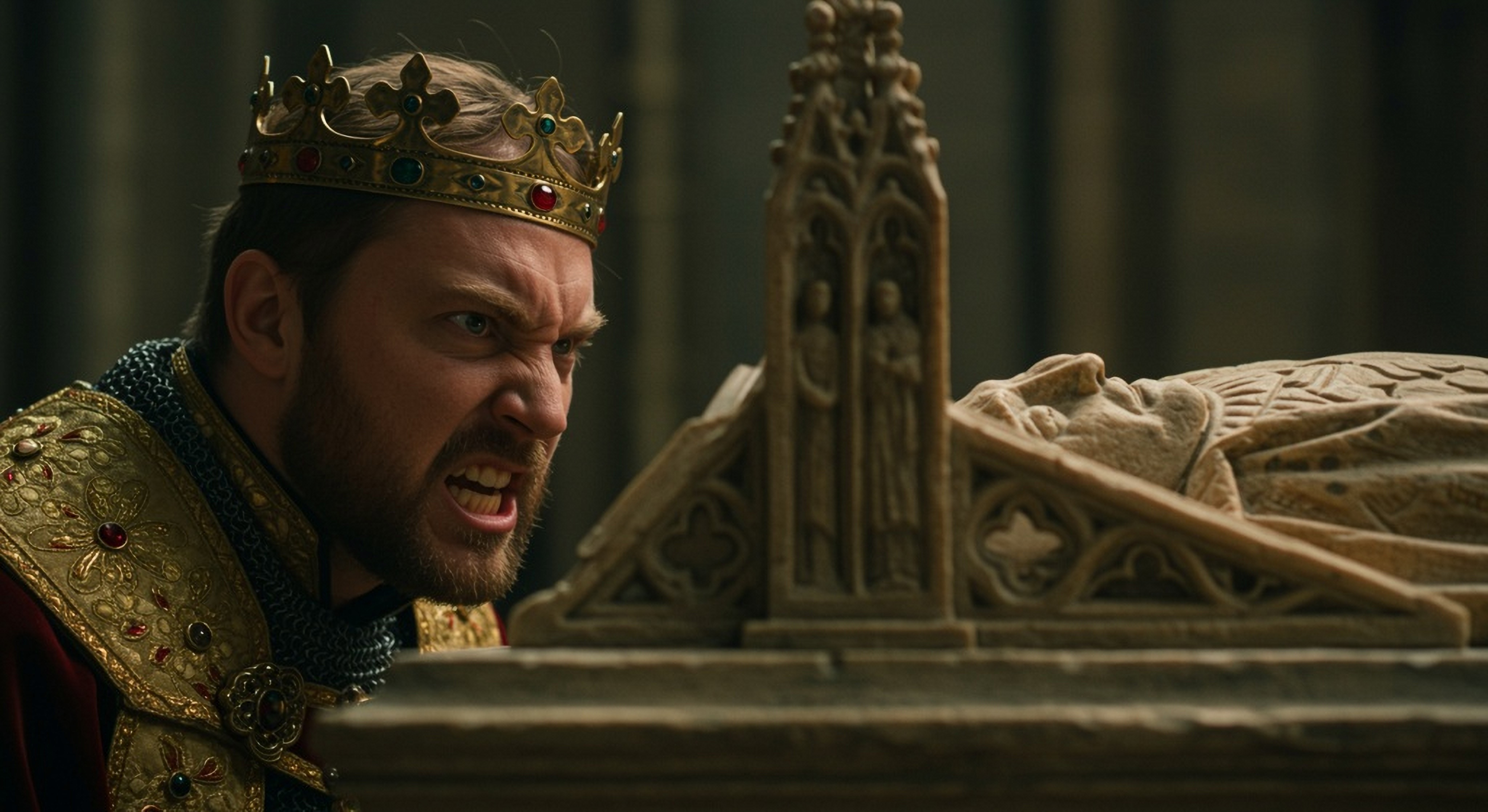
Pope Boniface VIII was accused of heresy, blasphemy, simony, gross immorality, magic, and murder. King Philip IV of France demanded that he be put on trial. But there was one big problem. Pope Boniface was dead.
Boniface (1235-1303) and Philip (1268-1314) had crossed swords when the pope was alive. The king wanted to tax the church within his kingdom to raise money for his wars against England. The pope saw this – rightly – as a challenge to his authority. This resulted in an increasingly acrimonious tit-for-tat between Boniface and Philip.
In 1296, Boniface issued a papal “bull” – a legal ruling – titled Clericis Laicos, insisting that only the pope could allow the church to be taxed in any country. Philip responded with a ban on exporting gold and silver from France, which denied the pope any revenue raised from Catholic congregations. Relations between the two men just went from bad to worse.
In 1300, Boniface declared a “jubilee year” – an opportunity for all Catholics to journey to Rome and have sins forgiven. This new concept was also designed to raise badly needed money after Philip had cut off the French supply of funds to the papacy. Furthermore, it was a desperate attempt by Boniface to reassert papal dominance in Europe, which seemed to be slipping by degrees. Ironically, this cynical move became a regular event – initially every hundred years but in the 20th century, far more frequent. Pope Francis oversaw a jubilee year in 2025.
But the jubilee year just exacerbated the tensions between the king and pope. In 1301, Bernard Saisset, Bishop of Pamiers, was sent to see Philip – on behalf of the pope – to protest about the king’s anticlerical measures. When he returned back to his diocese in the south of France, Saisset suddenly found himself denounced as a rebel, guilty of fomenting revolt against the king. As a southerner, the bishop did indeed dislike the Parisian monarch, which didn’t help matters. Philip demanded the right to discipline Saisset but Boniface stepped in, insisting that only he could admonish his own bishops.
Fed up with Philip, Boniface summoned all the French bishops to Rome. He was keen to regain control of his own church in France and to achieve the “reformation of the king and the kingdom”. The pope wrote that Philip was being advised by “evil counsellors” and had neglected his Christian obligation to support another crusade to the Holy Land. Philip’s grandfather, after all, King Louis IX, had been a committed crusader – fighting in Egypt. Philip responded by forbidding any French bishop to attend the pope’s proposed meeting in Rome.
The Archdeacon of Narbonne, Jacques de Normans, delivered the pope’s complaining words in person to Philip in yet another papal bull titled Ausculta Fili (Listen my son). A noble, the Comte d’Artois, grabbed the parchment and threw it into the fire. Then the king and his advisers did something extraordinary – they forged a papal bull, titling it Deus Time (Fear God).
This document was written in deliberately strident and arrogant language – to be read in all churches throughout France – as if it had come Boniface. The hope was that shocked French congregations would conclude that the pope had gone mad with power. This was an unprecedented act. To fake the pope’s words was an act of heresy.
But it was Philip who would now accuse Boniface of being a heretic. This was a bizarre turn of events. A secular ruler was condemning a spiritual ruler. This represented a complete inversion of the usual state of affairs – where popes excommunicated kings for wrongdoing and not vice versa.
Boniface was enraged. He suspected that two of Philip’s advisers, Pierre Flote and Guillaume de Nogaret, were dripping poison into the king’s ear, encouraging his hostile demeanour towards Rome. With Boniface hinting that he would excommunicate Philip, De Nogaret suggested to the king that he convene a meeting of the nobility and clergy in Paris to condemn the pope as a simonist, robber, and heretic.
DISCOVER: Templar trials sparked the witch hunt craze
On 13 June 1303, the convention was held to consider 29 charges against Boniface – covering nearly ever conceivable crime imaginable. He was even accused of murdering a previous pope, Celestine V, and engaging in magic. Philip imprisoned those who objected to the charges and they were inevitably passed by the meeting, then read out in churches and other forums across France.
At his papal palace in the Italian town of Anagni, Boniface could scarcely believe his ears. He initiated a series of desperate measures to protect his authority and drafted a bull of excommunication against the king. This would mandate every Catholic in France to seek the overthrow of Philip and his replacement by another king who would obey the Holy Father in Rome.
Philip was not going to let that happen. He sent De Nogaret and a band of troops down to Anagni where they teamed up with some of Boniface’s Italian enemies. This armed gang intended to kidnap the pope, bring him back to Paris, and put him on trial. What happened next became the stuff of legend. The group burst into the papal palace and physically roughed up the pope. The soldiers also looted the palace in front of Boniface’s eyes.
Some claimed that Sciarra Colonna, one of Boniface’s enemies in Italy, struck the pope across the face. Others countered that De Nogaret stopped Colonna from killing the pope. Realising his position was hopeless, Boniface sat on the papal throne in his full regalia, tiara on his head, cross and key in each hand, and declared he would die as a pope. Luckily for him, the local townspeople turned up to rescue Boniface and chase out De Nogaret and Sciarra. But a few weeks later, Boniface collapsed and died – possibly of a stroke.
DISCOVER: Omne Datum Optimum – the pope and the Templars
Philip was not going to allow that technicality to stop him putting Boniface on trial. De Nogaret had failed to drag the pontiff back to Paris – but the trial would proceed regardless. Boniface was succeeded by the six month papacy of Benedict XI after which, Clement V became pope. For political reasons, he was unable to rule the church from Rome and relocated the papal court to Avignon. This city today is in modern France but was then part of the Holy Roman Empire.
The proximity to Philip and the French king’s role in getting Clement elected, meant that he was largely under the thumb of Paris. Over the next few years, Philip initiated a series of heresy trials as if he was the pope. Clement was there to rubber stamp these moves. The king tasked his advisers with drawing up charges against the dead Boniface while also putting the entire Knights Templar on trial and pursuing the Beguines – a group of female preachers – while also indicting the Bishop of Troyes on charges of sorcery.
For years, Clement tried to talk Philip out of prosecuting his dead predecessor, deferring the matter to the Council of Vienne, convened by the pope in from 1311 to 1312. By then, the Templars had taken precedence as shutting down the order was a far bigger job than vilifying a corpse. Somehow, Philip allowed the matter to drop. Maybe his health was weakening as he died in 1314, just months after the last Templar grand master, Jacques de Molay, was burned at the stake.
Philip did enjoy a propaganda victory of sorts from the grave. In life, Boniface had imprisoned the Franciscan writer and satirist, Jacopone da Todi. In death, Da Todi got his revenge by mercilessly pillorying Boniface. Far more memorable was the depiction of Boniface being tortured in hell by demons that features in The Divine Comedy, written by the poet Dante Alighieri, while Boniface was still alive. That image of a venal pope has endured – studied by countless generations of students.
If you would like to know more about the Knights Templar, then get your hands on a copy of my book: The Knights Templar – History & Mystery. Published by Pen & Sword and available on Amazon, Waterstones, Barnes & Noble, and WHSmith. Don’t miss out on your copy!



One thought on “Trial of the dead Pope Boniface VIII”