


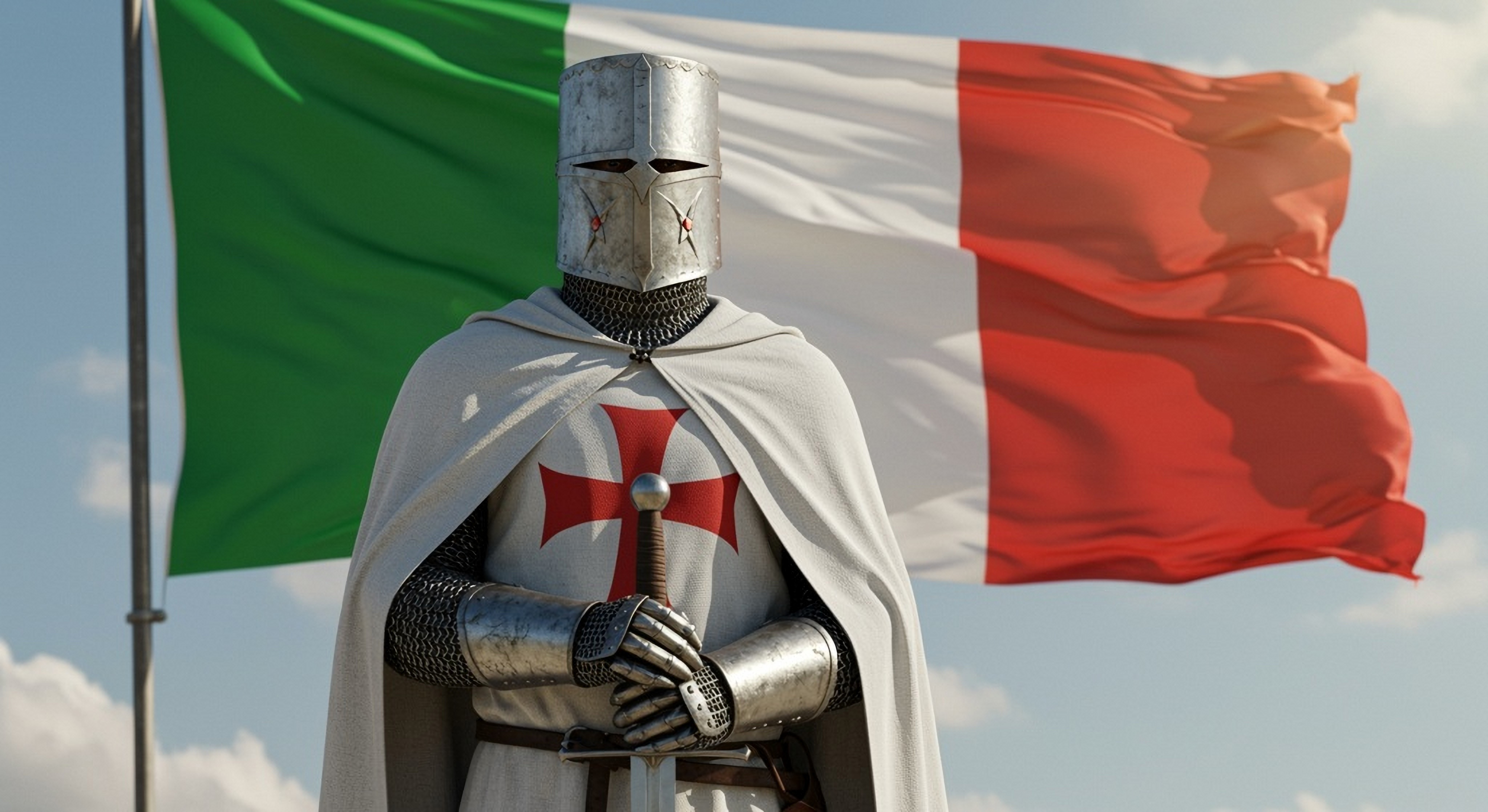
The Knights Templar had a major presence in Italy with preceptories across the country. These wealth creating hubs financed the order’s military activities in the Holy Land. Let’s take a look at the Italian operations of the Templars.
During the Middle Ages, when the Knights Templar existed, modern Italy was fragmented into several states. These included the Republic of Venice, Savoy, Genoa, Naples, and the Papal States. The Templar presence was felt everywhere. There properties included:
- Castello della Magione in Poggibonsi – this was a large Templar preceptory that is remarkably well preserved. It was a staging post on the Via Francigena – a pilgrimage route that started in Canterbury, England, continued through France and Switzerland, and then on to Rome, Apulia, and a ship to the Holy Land. The Templars retained the property until they were banned in 1312, after which Castello della Magione passed to the Knights Hospitaller. It is now owned by a neo-Templar organisation: the Militia of the Temple – Order of the Poor Knights of Christ (Militia Templi – Christi pauperum militum ordo), founded by the Count della Magione in 1979.
- San Pietro alla Magione in Siena – this tenth century church ended up in Templar hands before passing to the Knights Hospitaller in 1312.
- Valvisciolo Abbey in Sermoneta – founded by Greek Catholic monks in the 8th century, it was occupied by Cistercian monks by the 1140s. After an invasion by the Holy Roman Emperor, Frederick Barbarossa, the abbey was severely damaged and it was the Templars who undertook its restoration and set up there. When the order was banned in 1312, the Cistercians moved back in.
- Abbey of St. Michael in Montescaglioso – the Templars had a presence in southern Italy and Sicily from the 1140s. They were in Molfetta from 1148 and Barletta from 1158 – ports to which pilgrims headed on their way to the Holy Land. In a 1157 letter, Pope Hadrian IV refers to Templar properties in Sicily.
- Templars’ Tower at San Felice Circeo – the tower is located in the heart of San Felice Circeo, in the Lazio region of Italy and was built by the Templars between 1240 and 1259.
Under the town of Osimo, there is a series of Templar tunnels, stretching for eight kilometres. The Templars had 400 hectares of land above ground and mills along the Musone river. It’s believed by local historians that after the order was suppressed, the knights may have holed up in the tunnels to avoid unwelcome attention. Here is a film below about the Osimo Templar tunnels.
The Knights Templar appear to have established a base on the island of Sardinia, which was ruled during the medieval period by four “judges”. In 1149, one of these judges – Gonario II of Torres – who ruled north-west Sardinia – encouraged the knights to sink deeper roots in his territory. He was trying to curry favour with the church, having been excommunicated by the Archbishop of Pisa. Eventually, hoping to save his soul, Gonario entered the Cistercian monastery at Clairvaux, founded by the Templar’s spiritual champion, Bernard of Clairvaux.
There was a minimal Templar presence in Liguria, centred on the city of Genoa, due to political hostility with the order. The War of Saint Sabas, between 1256 and 1270, was a conflict between Italy’s two main maritime powers: the Republic of Venice and the Republic of Genoa. The Templars sided with the former and the Knights Hospitaller with the latter. This created an ongoing friction with Genoa.
Relations with the Papal States were usually harmonious. The Templars served as advisers and bodyguards to the popes. They also owned property in Rome, including a church on the Aventine Hill, which later became the church of Santa Maria del Priorato, when it transferred from the Templars to the Knights Hospitaller.
If you would like to know more about the Knights Templar, then get your hands on a copy of my book: The Knights Templar – History & Mystery. Published by Pen & Sword and available on Amazon, Waterstones, Barnes & Noble, and WHSmith. Don’t miss out on your copy!