

Is it possible that the Knights Templar stole the shroud of Jesus – what we now call the Turin Shroud – from a church in Constantinople during the Fourth Crusade in 1204? Was this holy relic spirited away by the Templars, back to France? Did they then hide their stolen property from public view?
Let’s look at the evidence for this controversial theory…
Templecombe reveals the secret of the Templars
In the sleepy Somerset village of Templecombe, in south-west England, there is a curious Templar relic. It’s the image of Christ’s face painted on a wooden panel. The face has a rather ghostly quality and some think it’s a depiction of the facial imprint on the shroud that wrapped his dead body, after the crucifixion.
The curious painting was discovered in 1945 by Templecombe resident Molly Drew. World War Two was raging and her husband was away in the armed forces. One night, she made her way to a windowless outhouse of their cottage to get some firewood. It was then she became aware of a pair of eyes staring down at her from the gloom. What she had discovered – presumably having never noticed it before – was a painting of Jesus dating back to the Templar period.
She called the local church rector – a retired bishop, George Wright – who helped Molly remove the surprisingly heavy piece of wood down from the ceiling. He insisted on taking it back to the rectory for safekeeping where – for reasons best known to himself – he scrubbed it with Vim (a household cleaning product). Molly claimed years later that this removed some of the brilliant colours – especially reds and blues – on the image.
Only in the 1950s, was the importance of this medieval holy art realised. It had been part of the Templar preceptory that had once dominated the village – then known as Combe Templariorium (Vale of the Templars). In the 1970s, the resemblance of the painting to the image of Christ on the Turin Shroud led some to believe that this was proof the knights had owned the shroud long before it ended up in Turin.
Here’s Molly below looking very upset in a 1987 newspaper article – recalling the damage done to the image by the ex-bishop.

DISCOVER: Did the Templars worship Baphomet?
The question was – why was this image placed in a place where it could not easily be viewed and what did it mean to the Knights Templar? Sadly, what remained of the preceptory disappeared during the 19th century and even Molly’s outhouse was demolished at some point in the 1950s. The painted panel is now displayed at St Mary’s church in Templecombe, having been carbon-dated to between 1280 and 1340.
The Templars and an act of political vandalism
Bristol historian Ian Wilson has, for some fifty years, argued the case for the Templecombe painting proving that the Knights Templar obtained the shroud of Jesus during the Fourth Crusade. Vatican archivist and historian Barbara Frale also believes the Templars possessed the shroud during the 13th and 14th centuries.
A quick recap on the Fourth Crusade and the Sack of Constantinople would be a good idea here. Every other crusade up until the fourth had involved attacking the Muslim rulers of the Middle East in order to regain control of Jerusalem and other holy sites. But in 1204, the Republic of Venice – which had bankrolled the Fourth Crusade – diverted the crusaders to the capital of the Byzantine Empire, Constantinople.
This was a Christian city that adhered to the Greek rite and did not recognise the pope as head of the church. But it had been viewed as an ally – though not always an entirely trustworthy one. Venice and the Byzantines were commercial and maritime rivals and the Venetians saw a great opportunity to deal a knock out blow.
Plus they wanted the money back that they had invested in the crusade and reasoned that an orgy of looting by the crusaders in Constantinople would see them repaid. It was a brutally cynical piece of realpolitik that brought an ancient Christian empire to its knees. For the first time in eight centuries, an army breached the huge walls of Constantinople, rushed into the city, and sacked it. Among the many stolen items were church treasures including the vast collection of holy relics held by the emperor.
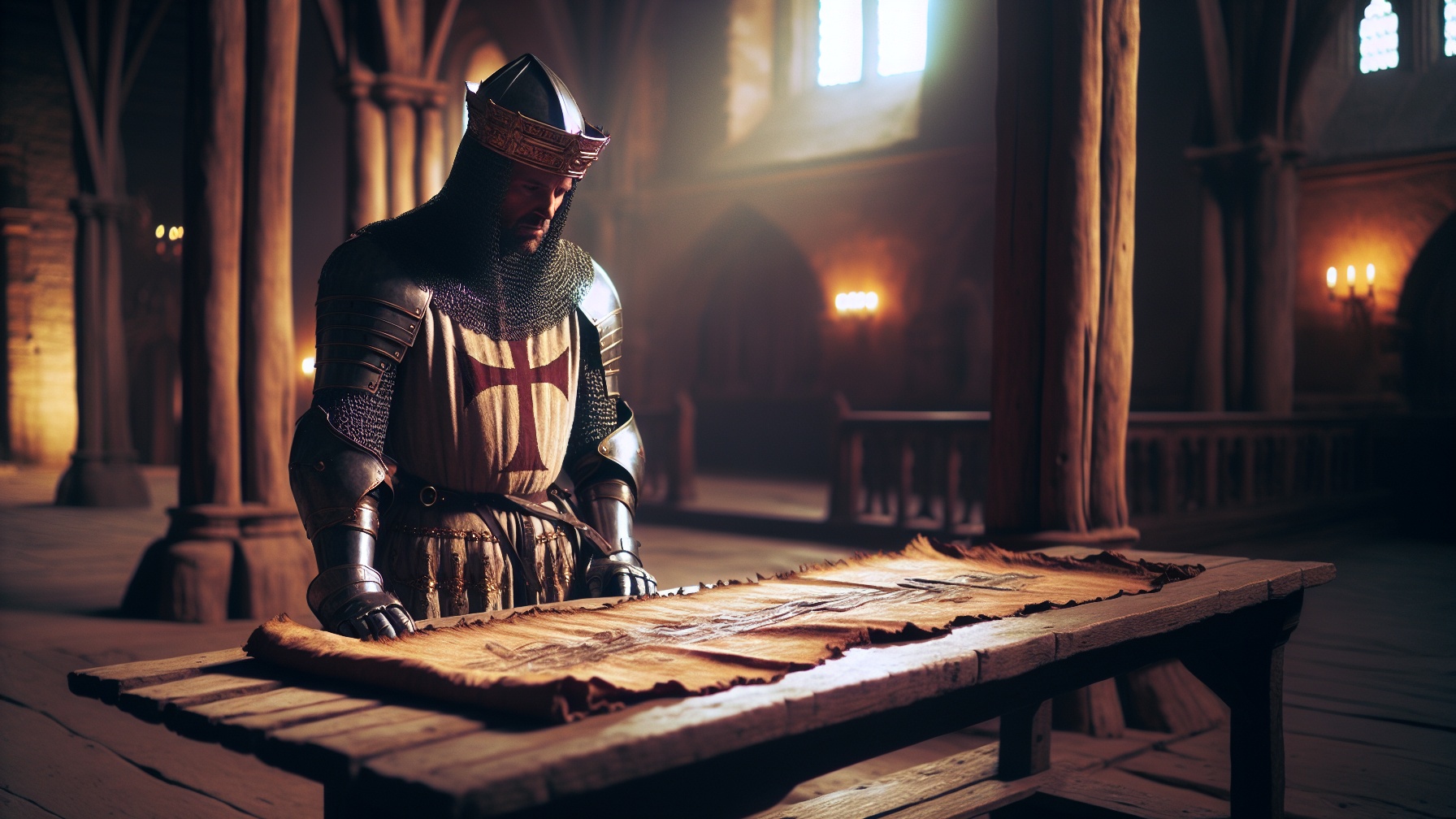
Those relics included the holy shroud of Jesus. Imagine the scene as the Templars, along with other crusaders, burst into the imperial palace, made their way to the Church of the Pharos, and helped themselves to the shroud. Then, inexplicably, the Templars kept it a secret. While they publicly admitted to having other holy relics, they said nothing about the shroud. Why?
One reason given by Frale is that Pope Innocent III was furious at the news that the crusaders had gone to a Christian city and trashed it. He threatened excommunication against all those involved. Therefore, the argument runs, the Templars decided to keep the shroud under wraps.
For those of you wondering how the shroud of Jesus ended up in Constantinople, prior to being looted – a brief explanation. A non-biblical story, found in one of the apocryphal gospels, states that the shroud was brought to the city of Edessa by one of Christ’s disciples after his death. It was used to cure the leprosy of King Abgar of Edessa. Only it may not have been the full-body shroud but just the veil used to wipe Christ’s face when he carried the cross to Calvary. That is a point over which historians argue.
In the tenth century CE, it was brought from Edessa to Constantinople, amid much fanfare, as part of a political deal with the Islamic caliphate, which had conquered Edessa. There is had remained until being pilfered in 1204 – possibly by the Templars.
The Templars and the disappearing shroud
Then the shroud disappears. It re-emerges in 1389 when it is put on display by a French noble, Geoffroi de Charney (or Charny). This was seventy years after the last Templar grand master, Jacques de Molay, was burned at the stake.
Now, those wanting to prove a Templar connection alight on the name De Charney. They point out that De Molay was burned to death alongside the Templar preceptor of Normany whose name was…Geoffroi de Charney. However, proving a familial link between the two is not as easy as one might assume – and God knows I’ve tried.
So, where was the shroud between being stolen from Constantinople in 1204 and reappearing in 1389? Wilson and Frale are convinced the Templars had it under lock and key. There is even a suggestion that it was used in their clandestine initiation rituals, that excited the prosecution so much during their trials. And that the image at Templecombe is a coded reference to these rituals.
Not everybody agrees of course. Professor Malcolm Barber, an expert on the Templars (especially their trials), finds this unconvincing. He thinks that if the Templars really had got their hands on what was to become the Turin Shroud, they would have yelled it from the rooftops. Yet they said nothing.
Final word on the Templecombe head of Jesus
While some believe the Templecombe painting is of Jesus Christ and was owned by the Knights Templar – others disagree. The carbon-dating of the wooden panel gives a range of 1280 to 1340, which certainly covers the Templar period that ended in 1314. However, Templecombe was then handed over to the Knights Hospitaller and some think this panel dates to their period of activity.
In addition, the absence of a halo and the death-like countenance of the head – which is quite different from the Turin Shroud representation (his mouth is agape in Templecombe) – has led some to wonder if this is a depiction of the beheaded John the Baptist. Now that appeals to those who believe the Templars adhered to a cult venerating John the Baptist as the Messiah.
The purpose of this wooden panel has also been hotly debated. Was it intended to be displayed on the wall as an object of veneration or was it simply the lid of a knight’s chest – for keeping his clothes and armour while on the road?
If you would like to know more about the Knights Templar, then get your hands on a copy of my book: The Knights Templar – History & Mystery. Published by Pen & Sword and available on Amazon, Waterstones, Barnes & Noble, and WHSmith. Don’t miss out on your copy!