

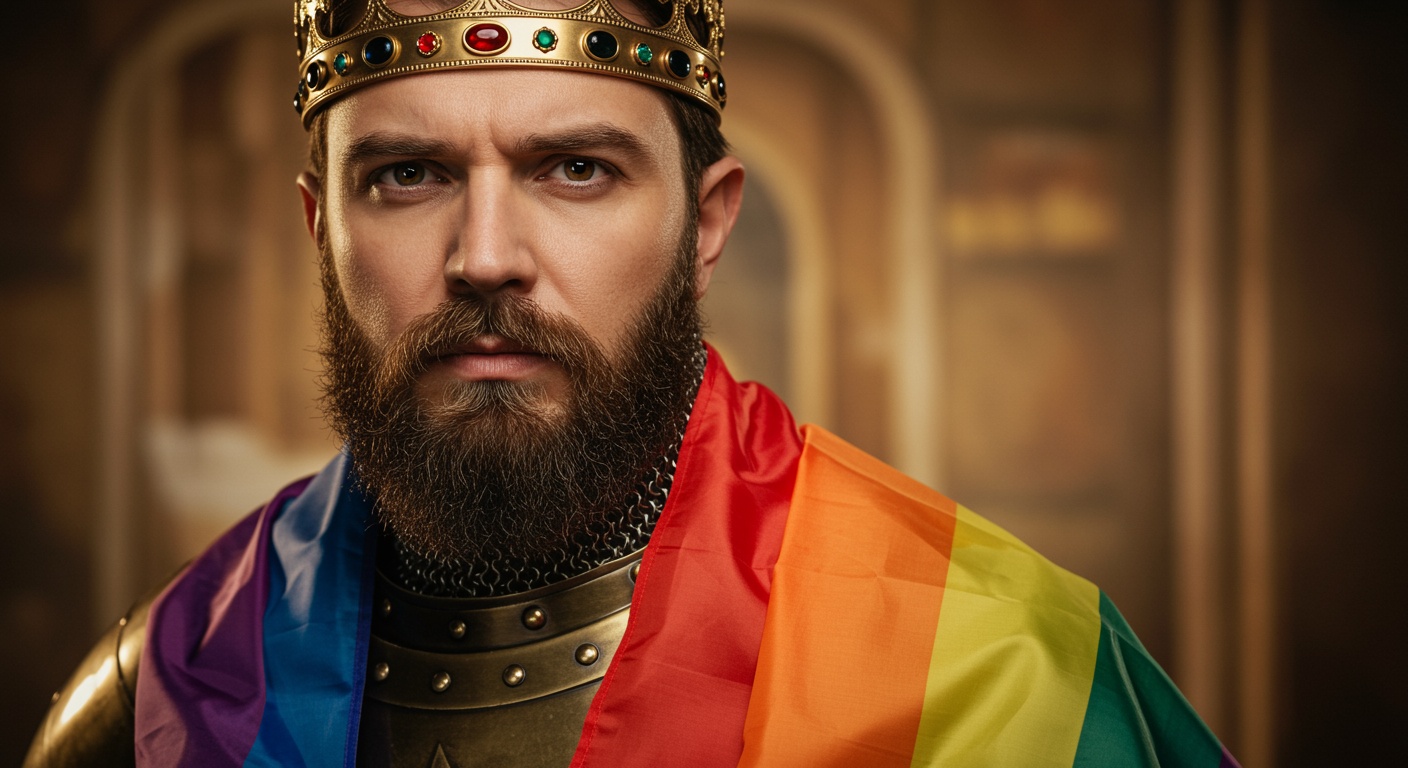
During their trials between 1307 and 1312, the Knights Templar were accused of “sodomy”, specifically same-sex carnal relations. In the medieval period, several kings of England were also alleged to prefer their own sex. The term LGBT – and “homosexual” – didn’t exist in the Middle Ages, but don’t imagine that same-sex desire was invented by Victorian psychologists….as some rather buttoned-up historians do.
That’s not to say that accusing a powerful person of sodomy wasn’t, on occasion, an unfounded slur intended to undermine them. But equally, there was no smoke without fire. BTW, let me pin my rainbow colours to the mast at this point and declare, I’m an LGBT man who is happily married to a ginger bear.
So, let’s meet the medieval kings of England labelled as the equivalent of LGBT during the Templar period. They’re an interesting bunch!
LGBT MEDIEVAL KINGS: William II “Rufus” (c.1057-1100)
I’m illustrating this blog post with statues I photographed in York Minister recently. Near the high altar, there are carved representations of all the Norman and Plantagenet monarchs. So, here’s William II, son and heir of William the Conqueror, who invaded England after winning the Battle of Hastings in 1066.

No wife. No mistress. No children. In a political system where a male heir was critical, William II’s visible lack of interest in women was bound to set tongues wagging. Three medieval chroniclers – Eadmer (writing in 1109), William of Malmesbury (around 1125), and Orderic Vitalis (between 1133 and 1135) – all remarked on the presence of effeminate men at William’s court and whispered about same sex activity.
Strange to say but Victorian historians had no difficulty acknowledging this. It’s in the 20th and 21st century that some writers have felt obliged to erase any suggestion of gay sex at the Norman court. It’s OK to baldly state that William of Conqueror was only interested in women but God forbid if you state that his son was only up for bedding men.
FIND OUT MORE: Were the Knights Templar gay?
LGBT MEDIEVAL KINGS: Richard the Lionheart (1157-1199)
Interestingly, English kings believed to be gay always seemed to have ultra-butch fathers. William II was the son of the sword-swinging conqueror of England, William I. As for the crusading monarch Richard the Lionheart, his father was the short-tempered Henry II, married to the formidable Eleanor of Aquitaine who reputedly murdered one of her husband’s mistresses.

Despite his love of crusading and bravery in battle, Richard was undoubtedly a mummy’s boy. Eleanor adored him and was beside herself when he was kidnapped for ransom on his way back from the crusades in the Holy Land. She even wrote a threatening letter to the pope telling His Holiness to get his finger out and do something to free her beloved Richard.
Eyebrows were raised over Richard’s intense relationship with King Philip II “Augustus” of France. As young men, they shared a bed. Hilariously, one historian has tried to explain this by claiming that diplomatic deals were often cemented under the sheets. I bet they were. The contemporary chronicler Roger of Hoveden (died 1202) was in no doubt something out of the ordinary was going on:
Richard, [then] duke of Aquitaine, the son of the king of England, remained with Philip, the King of France, who so honored him for so long that they ate every day at the same table and from the same dish, and at night their beds did not separate them. And the king of France loved him as his own soul; and they loved each other so much that the king of England was absolutely astonished and the passionate love between them and marveled at it.
The same chronicler relates an incident where a holy man warned Richard that he had to mend his ways.
In the same year, there came a hermit to king Richard, and, preaching the words of eternal salvation to him, said: “Be thou mindful of the destruction of Sodom, and abstain from what is unlawful; for if thou dost not, a vengeance worthy of God shall overtake thee”. The king, however, intent upon the things of this world, and not those that are of God, was not able so readily to withdraw his mind from what was unlawful, unless a revelation should come to him from above or he should behold a sign.
Richard ignored the hermit and was visited by God who “scourged” him with an illness, after which the king turned to the church for help and “after receiving absolution, took back his wife, whom for along time he had not known, and putting away all illicit intercourse, he remained constant to his wife and the two become one flesh and the Lord gave him health of both body and soul”.
LGBT MEDIEVAL KINGS: Edward II and THAT poker! (1284-1327)
Another LGBT king of England with a butch Dad. Edward II was not a nincompoop (as falsely portrayed in Mel Gibson’s movie Braveheart) but made a dread enemy of his wife, Isabella of France (c.1295-1358). She was the only surviving daughter of Philip IV of France – the nemesis of the Knights Templar. From her father, she inherited a ruthless streak and on realising that her husband was far more interested in one of his male courtiers, Piers Gaveston, than her – she took matters into her own hands.

The life and grisly death of Edward II was immortalised in a play written by Christopher Marlowe, a contemporary of William Shakespeare writing 250 years later. Marlowe made it abundantly clear that Edward’s relationship with Gaveston overshadowed his marriage to the queen. You’d have to try very hard to prove that Marlowe, who had a racy private life himself, was not depicting a homosexual relationship.
Isabella overthrew Edward II and had him imprisoned. Gaveston had already been executed. For years, a rumour circulated that the queen had her husband impaled through the rectum with a red hot spit – used for roasting meat. Marlowe was hardly going to ignore that gripping detail. So, in the play, Edward is murdered with a spit while in a prone position.
LGBT MEDIEVAL KINGS: Richard II (1367-1400)
The 14th century ended with the murder of another LGBT medieval king of England: Richard II. Like William II and Edward II, his choice of royal advisers caused consternation. A biography of the king – the Vita Ricardi Secundi (unknown author) – is so homophobic that it’s almost unintentionally hilarious.
Written in Latin, you hardly need a translation. Richard is described as ‘facies alba et rotunda et feminia’ (white, round, and feminine face), ‘lingua breuis et balbuciens’ (stuttering, lisping speech), and ‘mane totam noctem in potacionibus et aliis non dicendis’ (staying up all night drinking and other unspeakable things).

The Benedictine monk Thomas Walsingham (died 1422) chronicled Richard’s stormy reign, which encompassed the Peasants’ Revolt of 1381 and bitter confrontations with parliament. Walsingham described the disgust at the close friendship between the king and Robert de Vere, 9th Earl of Oxford. Richard showered privileges on him, making Robert, Duke of Ireland and Marquess of Dublin (a specially created post). It was made abundantly clear by Walsingham that Richard and Robert were in a sexual relationship.
Richard was overthrown by his cousin, Henry Bolingbroke, who became Henry IV – first of the Lancastrian kings. In his chronicle of what happened, Adam of Usk accused Richard II of ‘sodomies’. And Adam was very close to the political action. He accompanied Bolingbroke in his rebellion and interviewed the imprisoned king at the Tower of London before his murder at Pontefract Castle.
LGBT MEDIEVAL KINGS: Henry VI (1421-1471)
And finally – on our tour of LGBT medieval kings of England we arrive at Henry VI. Richard II became king at ten years of age but Henry outdid him by being declared monarch at just eight months. He assumed the throne in the middle of the Hundred Years War between England and France – and was crowned king of both countries. Unfortunately for Henry VI, he then went on to preside over the loss of all England’s holdings in France – which didn’t endear him to the nobility.

Again a big contrast with his macho, militaristic father, Henry V, who loved nothing better than leading an army into battle. Henry VI could think of nothing worse. He was shy and depressive. And he developed a close relationship with his steward, William de la Pole.
Historians who have led a sheltered life state that it couldn’t have been a homosexual liaison because the king was married…to a woman. As somebody who has lived and loved a bit more, let me assure those historians that married men are perfectly capable of having gay relationships. Why, some of them even have children with women. Yet they slip down to a gay bar or a cruising area. It has ever been thus, I fear.
William was the 1st Duke of Suffolk and – surprise, surprise – had privileges showered on him. Henry was a ditherer when it came to decision making and relied heavily on William to tell him what to do.
In Shakespeare’s play Henry VI, Part One, written over a century later, there’s heavy hinting that the relationship between William and Henry was exceedingly intimate. And yes, of course, this is a fictional account from a playwright. However, Shakespeare did research his plays thoroughly and used existing histories for his facts.
Tell me who you think is the most convincing LGBT medieval king of England!
If you would like to know more about the Knights Templar, then get your hands on a copy of my book: The Knights Templar – History & Mystery. Published by Pen & Sword and available on Amazon, Waterstones, Barnes & Noble, and WHSmith. Don’t miss out on your copy!



That is a fascinating wood carving. It is so exciting to see history unearthed like that. I wish that I was a history professor — Indiana Jones-style, of course.
– Steve, Assistant at NewYorkerApts.com (NYC’s new site for apartments and roommates)