

In 1244, the holy city of Jerusalem fell to an alliance of Muslim forces led by a Khwarazmian army. The Christian and Jewish populations of the city were slaughtered and the bodies of the past crusader Kings of Jerusalem were dragged out of their tombs and thrown into the street. This massacre marked the end of Christian control, which would not resume in Jerusalem until the British mandate in the 20th century (1917-1948).
In 1099, the First Crusade had seen Jerusalem seized from Muslim Fatimid control by an invading crusader army. Nearly a century later in 1187, the Muslim Ayyubid leader Saladin had retaken Jerusalem for Islam. Then in 1229, during the Sixth Crusade, the Christians regained control again. This was due to the arrival in the region of the powerful Holy Roman Emperor, Frederick II – a formidable Christian ruler who saw himself as the successor of the Caesars.
Frederick felt he had a strong claim to Jerusalem, being the husband of Isabella II, Queen of Jerusalem. The title of King and Queen of Jerusalem continued even after the loss of the city in 1187, and throughout the crusading period. When Jerusalem was not in Christian hands, the seat of power would move, for example to Acre, or Cyprus. But in 1229, there was a chance to bring the kingdom back to the city after which it was named.
Keen to avoid a military conflict with Frederick, the Ayyubid ruler of the time – Al-Malik al-Kamil Nasir ad-Din Muhammad, known by the shortened Al-Kamil – agreed to sign a treaty whereby he would hand over Jerusalem (and Bethlehem) to Frederick’s forces so long as the Muslim population of the city was unmolested and the Temple Mount area, including the Dome of the Rock and Al Aqsa Mosque, remained in Muslim hands. Al-Kamil had domestic uprisings, internal factions, and family conspiracies to put down. Frederick, eager to gain a bloodshed-free victory, agreed to Al-Kamil’s generous terms.
In contrast, bristling as they were consigned to the sidelines, the Knights Templar and Hospitaller were furious. So too was the pope who had excommunicated Frederick not just once, but twice. The emperor was still officially cast out of the church when he agreed terms with his Muslim counterpart to take ownership of Jerusalem, by diplomacy and not war.
Whatever his feelings about Frederick, the pope could not ignore this major achievement and capitalised on it by organising the Barons’ Crusade, which made astounding gains, bringing almost the entire eastern Mediterranean seaboard back under Christian control. It almost looked as if the glories of the First Crusade might be revived.
One of the reasons for the success of the Barons’ Crusade was the divisions between the Ayyubids in Damascus and Cairo. Under Saladin, there had been one Ayyubid empire. But now it was split in two. The crusaders played the Syrians and Egyptians off against each other with the Templars courting Syria while the Hospitallers made overtures to Egypt. As a result of this Muslim disunity, Christian forces took control of cities across the region with the minimum of military effort – much as Frederick had done.
But dark clouds were gathering…

This situation would not last. Enter the Khwarazmians – a Turkic/Persian dynasty that had ruled much of central Asia between 1077 to 1232. Then the Mongols arrived. Their empire was torn to pieces by the Mongols and they were reduced to nomadic mercenaries – swords for hire.
Faced with a resurgent crusader presence, Al-Kamil’s son by a Nubian concubine, had taken power on the death of his father in 1238. His name was Al-Malik as-Salih Najm al-Din Ayyub, shortened to As-Salih. His half-brother, Al-Adil, was sultan of Egypt but Al-Kamil would soon overthrow him to reunite Egypt and Syria, much as his great uncle Saladin had done.
As-Salih’s hold on power was shaky, due to poisonous court politics. He was so insecure that he made considerable use of paid-for slave soldiers called Mamluks. They would eventually overthrow the Ayyubid dynasty and instal one of their own as sultan. As-Salih also turned to the roaming Khwarazmians, giving them license to take Jerusalem – on condition they then handed it over to him.
Meanwhile, the Knights Templar under their 16th grand master, Armand de Périgord were still snubbing Frederick II, who essentially wanted to absorb the crusader domains in the Middle East into his vast European empire. The knights, though, were experiencing some public relations difficulties. They had suffered a series of defeats in the 1230s that damaged their reputation as the shock troops of the crusades.
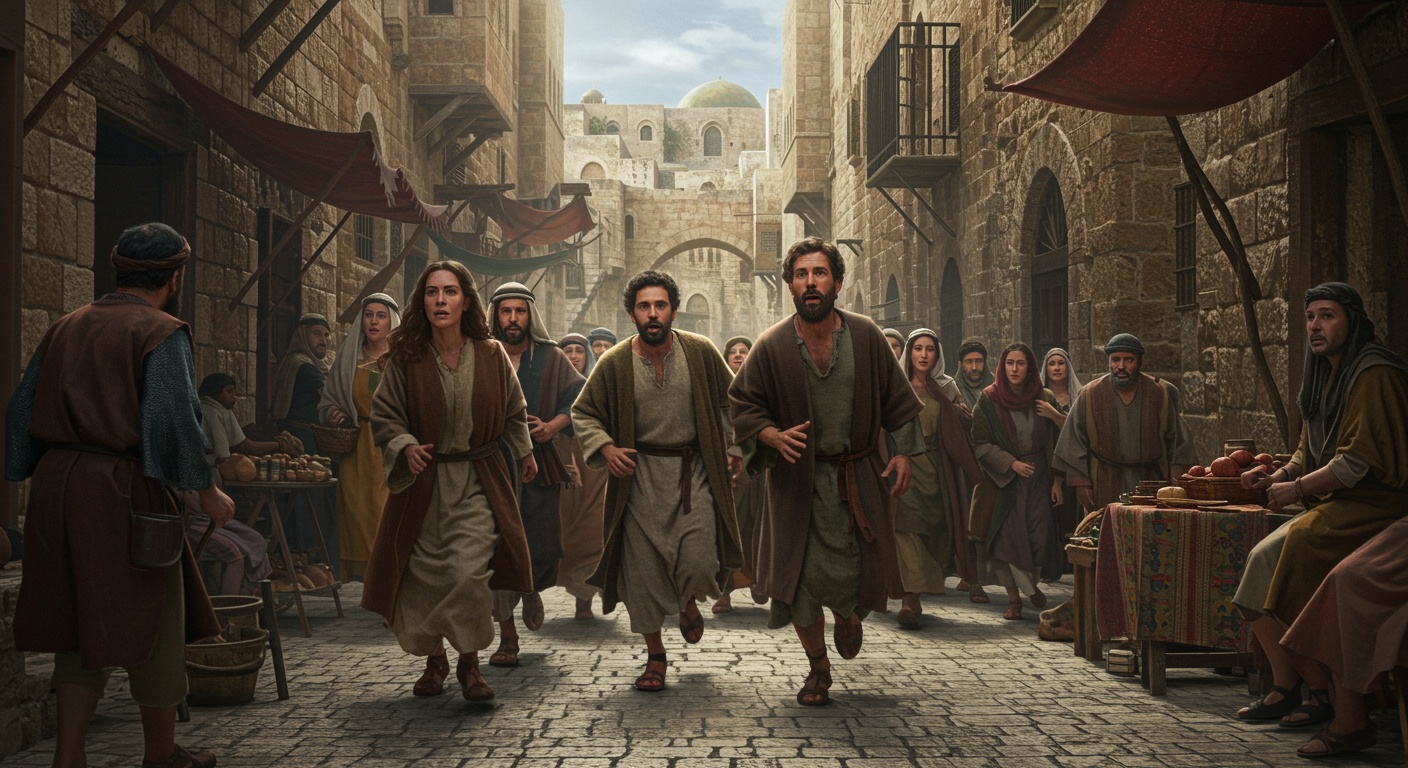
By 1244, the treaty between Frederick II and Al-Kamil had expired (in 1239). Meanwhile, the Barons’ Crusade had petered out in 1241. As-Salih decided to unleash the Khwarazmians on Jerusalem. These steppe warriors, ejected from their homeland by the Mongols, were in no mood for mercy. They broke through the walls and killed the population by the thousands. The carnage and destruction they wreaked on Jerusalem has too often been overlooked. They left the city a smoking ruin. Its walls were levelled and great monuments smashed up.
On entering the church of the Holy Sepulchre, the Khwarazmians dug up the famous crusader kings: Baldwin I and Godfrey of Bouillon. Even Saladin had not committed such a sacrilege. A contemporary chronicler described how several thousand Christians left Jerusalem out of desperation, hoping to avoid the Khwarazmians, only to be subjected to a grisly massacre:
They therefore left the city by night, and wandered about in the trackless and desert parts of the mountains till they at length came to a narrow pass, and there they fell into an ambuscade of the enemy, who, surrounding them on all sides, attacked them with swords, arrows, stones and other weapons, slew and cut to pieces, according to a correct computation, about seven thousand men and women, and caused such a massacre that the blood of those of the faith, with sorrow I say it, ran down the sides of the mountain like water.
And the mass murder continued within the city.
Young men and virgins they hurried off with them into captivity, and retired into the Holy City, where they cut the throats, as of sheep doomed to the slaughter, of the nuns, and aged and infirm men, who, unable to endure the toils of the journey and fight, had fled to the church of the Holy Sepulchre and to Calvary, a place consecrated by the blood of our Lord, thus perpetrating in His holy sanctuary such a crime as the eyes of men had never seen since the commencement of the world.
For those who like to engage in tit-for-tat ‘whataboutery’ in politics and history, they might say: well, didn’t the crusaders do the same to the Jewish and Muslim inhabitants of Jerusalem in the year 1099? To which my response would be: how about we classify both these incidents as war crimes of equal evil? Sectarian hatred has been a curse for humanity for millennia.
The shock wave from this violence spread through the region and led to unexpected alliances. The emir of Homs and a member of the Ayyubid family ruling Kerak – both Muslims – joined up with the Templars, Hospitallers, Teutonic Knights, and the Order of Saint Lazarus (the so-called “leper brothers”) to take on the Egyptian Ayyubids and the dreaded Khwarezmians. The resulting Battle of La Forbie was lost by the Christian side, ending the era of bullish crusading.
However, the fall-out from the battle hit everybody. Fearful of their growing power, the Ayyubids crushed the Khwarezmians the following year. In 1250, the Mamluks ended Ayyubid rule in Egypt. But it was the Christian forces that took the biggest hit. And arguably, the fall of Jerusalem and defeat at La Forbie was far more devastating than what happened at the Battle of Hattin in 1187. There was no crusader recovery this time – just a slow decline towards eventual total defeat. This would lead, in 1307, to the eventual destruction of the Knights Templar.
If you would like to know more about the Knights Templar, then get your hands on a copy of my book: The Knights Templar – History & Mystery. Published by Pen & Sword and available on Amazon, Waterstones, Barnes & Noble, and WHSmith. Don’t miss out on your copy!



Reblogged this on WordPress Report.