


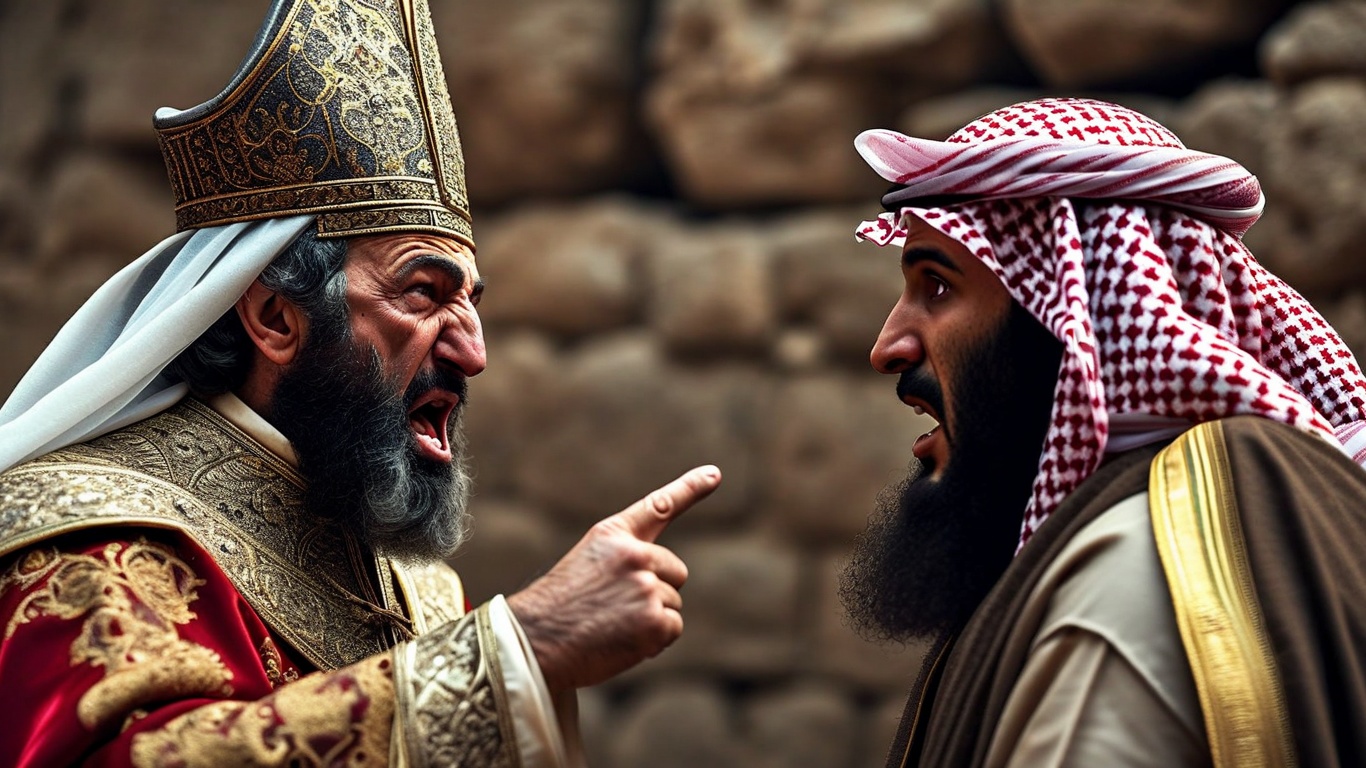
Jerusalem was the most holy place in Christendom. For Medieval Christians, it was the dream of a lifetime to journey there and visit the Holy Sepulchre – site of the crucifixion and resurrection of Jesus. But this was a journey fraught with danger. In 1064-54, a group of medieval Germans went on a long pilgrimage and we have an account of the perils they faced.
It was the risk of death and robbery that pilgrims endured as they trekked to Jerusalem that led to the formation of the Knights Templar. All along the roads into the holy city, a pilgrim might find bleak evidence of crime against his fellow Christians. Their bleached bones might even be scattered in the scorching sun.
In 1064, a huge pilgrimage set out from Germany to the Holy Land. This was 35 years before Jerusalem would be taken by the crusaders. It was still under Muslim rule at this time. However, in most years, there was a policy of tolerance towards these waves of Christian arrivals – not least because they provided a boost to the local economy.
The group was led by Archbishop Siegfried of Mainz, Bishop William of Utrecht, Bishop Otto of Ratisbon, and Bishop Gunther of Bamberg. Despite the high social status of these people, that didn’t protect the pilgrims from thieves and cut-throats. A contemporary account describes the first few weeks of the journey:
These leaders were followed by a multitude of counts and princes, rich and poor, whose numbers seemed to exceed twelve thousand. As soon as they had crossed the river known as the Morava, they fell at once into constant danger from thieves and brigands. Prudently avoiding these dangers, they cautiously made their way to the city of Constantinople.
Constantinople was the capital of the Christian Byzantine Empire that covered the Balkans, Greece, and Asia Minor – though it was about to have its territory dramatically reduced by the Muslim Seljuk Turks. The Byzantines are referred to as the “Greeks” and there was a feeling of suspicion towards them, not least because they had split decisively from the Roman Catholic church in 1054 when the patriarch of Constantinople and the Pope in Rome excommunicated each other.
The chronicler paints a grim picture of their progress after leaving Constantinople:
They left Constantinople a few days later and, after passing through various difficulties and tribulations, came to Latakia. Bishop Gunther made their troubles clear when he wrote from Latakia to his people who were still at home. He said, among other things: “Brethren, we have truly passed through fire and water and at length the Lord has brought us to Latakia, which is mentioned in the Holy Scriptures as Laodicea. We have had the Hungarians serve us without faith and we have had the Bulgarians prey secretly upon us; we have fled from the open raging of the Uzes [i.e. The Byzantine name for the Oghuz Turks] and we have seen the Greek and imperial arrogance of the citizens of Constantinople; we have suffered in Asia Minor, but worse things are yet to come.”
While in Latakia, which is in modern Syria, they met pilgrims returning from Jerusalem who warned them of what they could expect further down the road. It must have made the pilgrimage group shudder.
While they were staying for a few days in Latakia, they began to meet each day many people returning from Jerusalem. The returning parties told of the deaths of an uncounted number of their companions. They also shouted about and displayed their own recent and still bloody wounds. They bore witness publicly that no one could pass along that route because the whole land was occupied by a most ferocious tribe of Arabs who thirsted for human blood.
The German pilgrims deliberated on what to do next. But all agreed that they had embarked on this great march and could not be deterred now. Their souls were in the hands of the Lord. This medieval band of thousands of people arrived in Tripoli where the city’s governor decided to kill them all. The chronicler tells us that the Christians were saved by a miraculous turn in the weather.
They soon came to a city called Tripoli. When the barbarian commander of the city saw such a multitude he ordered that all of them, without exception, be slaughtered cruelly with the sword; he hoped thereby to acquire an infinite sum of money. Immediately there arose from the sea (which beats against one side of the city) a dark cloud, from which there issued a great many lightning flashes, accompanied by terrifying claps of thunder. When this storm had lasted until noon of the next day and the waves of the sea had reached unusual heights, the pagans, united by the urgency of the situation, shouted to one another that the Christian God was fighting for his people and was going to cast the city and its people into the abyss. The commander, fearing death, changed his mind. The Christians were given leave to depart and at once the disturbance of the sea was calmed.
DISCOVER: Differences between the Knights Templar and Knights Hospitaller
They had been travelling for months as they departed a village on Good Friday. It was Easter, a time of celebration for medieval Christians. Christ had resurrected and the sins of humanity forgiven. Sadly, the local population had no interest in the finer points of Christian theology. They decided to attack the pilgrims and showed no mercy – even to the bishops.
On the following day, Good Friday [March 25. 1065] about the second hour of the day, [about 6.30-8 am] just as they were leaving Kafar Sallam, they suddenly fell into the hands of the Arabs who leaped on them like famished wolves on long awaited prey. They slaughtered the first pilgrims pitiably, tearing them to pieces. At first our people tried to fight back, but they were quickly forced, as poor men, to take refuge in the village. After they had fled, who can explain in words how many men were killed there, how many types of death there were, or how much calamity and grief there was? Bishop William of Utrecht, badly wounded and stripped of his clothes, was left lying on the ground with many others to die a miserable death. The three remaining bishops, together with a considerable crowd of various kinds of people, occupied a certain walled building with two stone towers. Here they prepared to defend themselves, so long as God allowed it.
Many of the pilgrims must have done military service of some description and were clearly capable of putting up a spirited fight – which is exactly what they did for two days. On Easter Day, the bishops met the local Arab “sheikh” with a view to paying him off. However, he removed his head wrapping and attempted to strangle Bishop Gunther. But the bishop was no wilting wallflower.
Gunther, who was not at all terrified by the numerical strength of the surrounding enemy, immediately leaped up and knocked the pagan to the ground with a single blow of his fist. The venerable man brought his foot down on the sheik’s neck; then he said to his men: “Quick now! Set to and cast all these men into chains and put them out naked to ward off the missiles which their men are throwing at us.” There was no delay; as soon as he had spoken his orders were carried off. Thus the assault of the attacking pagans was quelled for that day.
Word got back to a local governor accountable directly to Al-Mustansir, the Fatamid Caliph of Cairo, who ruled the region including Jerusalem. For the economic reasons mentioned earlier, he didn’t want Christian pilgrims to fall victim to bandits. This governor arrived with an armed force. The bandits fled, releasing their captives. The German pilgrimage was then escorted to Jerusalem with Fatimid protection. Despite everything, they were overjoyed to arrive there – with no regrets.
One cannot describe with words the fountain of tears which as shed there, the number and purity of the prayers and consecrated hosts which were sacrificed to God, or the joyful spirit with which, after many sighs, the pilgrims now chanted: “We hall now pay reverence at his foot stool.”
After a fortnight in Jerusalem, it was time to leave. But they had to avoid the roads where the bandits were waiting, “for they still sorrowed over the prey which had been snatched from their jaws”. They paid to sail up the eastern Mediterranean coast, back to Latakia, and from there journeyed on to the Hungarian border and the banks of the river Danube. It was time to go home.
If you would like to know more about the Knights Templar, then get your hands on a copy of my book: The Knights Templar – History & Mystery. Published by Pen & Sword and available on Amazon, Waterstones, Barnes & Noble, and WHSmith. Don’t miss out on your copy!




I believe there’s a similar tomb, or church in Italy.