


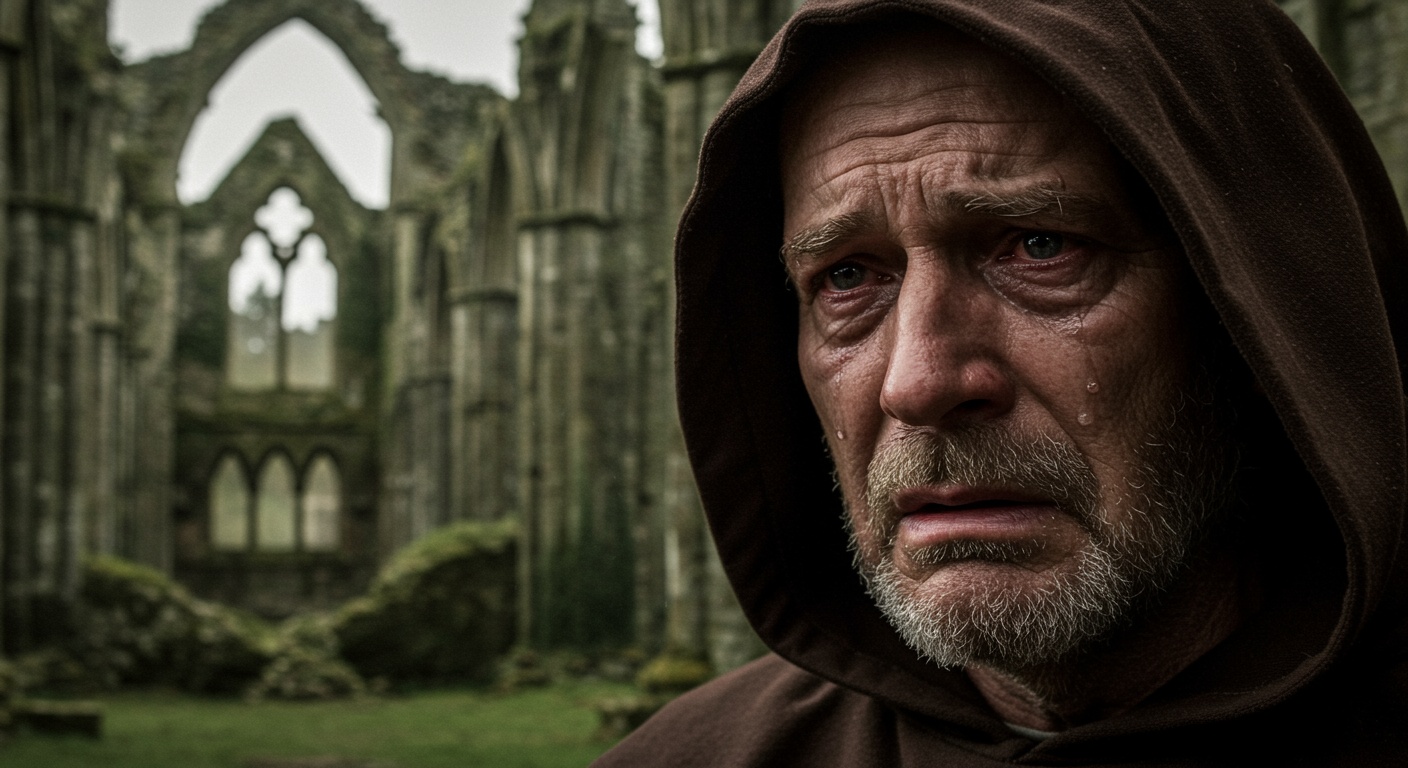
There are ruined medieval churches dotted all over Europe. Some abandoned as villages became depopulated while others were forcibly closed due to religious and political upheaval. Below, I share my exclusive images of these amazing places.
England is home to about 200 ruined churches, mostly left to fall apart after the Protestant Reformation of the 16th century. In Portugal, I’ve seen an entire convent evacuated centuries ago because of river floods – and still in a remarkable state of preservation. While in Sicily, a church was left half built when the Vatican decided it was incorrectly depicting the Virgin Mary.
Let’s start with the gorgeous Fountains Abbey in Yorkshire, northern England. This was one of several hugely wealthy and productive Cistercian abbeys that once dominated the landscape. After four hundred years, Fountains fell victim to King Henry VIII’s decision to replace the Roman Catholic church with the Church of England, headed by himself – and to close the kingdom’s monasteries. The last but one abbot, William Thirsk, was hanged for his involvement in a revolt against the king, the so-called ‘Pilgrimage of Grace’. Here I am standing in the roofless nave dating back to the 12th century.

Below is a very curious church in Sicily with quite a history. This building was never completed because of a change in Catholic theology. It was dedicated to the ‘swooning’ Virgin Mary – Santa Maria dello Spasimo. This was a medieval belief that as Jesus carried his cross to the site of the crucifixion, his mother – Mary – fainted. During the Templar period this became a popular notion – that Mary had also endured a terribly physical suffering alongside her son.
By the 16th century, the Catholic church faced the onslaught of the Protestant Reformation. Protestants claimed that Catholics had deviated from scripture with stories that had nothing to do with the bible. The swooning virgin tale came from an apocryphal gospel not accepted into the New Testament. So, Rome launched the Counter-Reformation – an effort to clean up its theological act. And the order went out to halt construction on this church. To this day, it remains half-built as you can see below.

Below is an abandoned convent in Portugal – Santa Clara-a-Velha, in the university city of Coimbra, central Portugal. It was commissioned by Queen Isabel, the wife of King Dinis. He was responsible for transforming the Knights Templar in Portugal into a new military organisation, the Order of Christ (Ordem do Cristo). Isabel was an intensely pious woman and the convent was consecrated in 1330, six years before her death.
But – there was a problem. The nearby river Mondego often flooded with water pouring into the convent. The nuns tried all kinds of ruses to hold back the water but eventually, in 1677, they quit and moved to a new convent further away from the river. The ghostly remains left behind are remarkably well preserved and include the tombs of centuries of nuns.

Glastonbury Abbey in south-west England was allegedly founded by Joseph of Arimathea, the uncle of Jesus Christ, who according to local legend, brought the Holy Grail here and buried it at the so-called Chalice Well. More likely, the abbey was founded in the eighth century CE. By the Middle Ages, only Westminster Abbey was wealthier than this monastic hive of activity.
There was a slight whiff of corruption around Glastonbury – not least its claim to have the bones of numerous saints and the skeletons of King Arthur and his queen, Guinevere. Holy relics were big business and the monks didn’t miss a trick. But in 1539, along came King Henry VIII and the Protestant Reformation. His commissioners arrived to strip the monastery of its valuables and the abbot, Richard Whiting, unwisely resisted. He was hanged, drawn, and quartered. Below is an image from my recent visit.

Something different to conclude. A while back, I filmed with the former Daily Show comedian Rob Riggle in the ruins of Kilwinning Abbey in western Scotland. Here we are below. He was on a quest to find the Holy Grail. Sadly, Rob didn’t find it.

If you would like to know more about the Knights Templar, then get your hands on a copy of my book: The Knights Templar – History & Mystery. Published by Pen & Sword and available on Amazon, Waterstones, Barnes & Noble, and WHSmith. Don’t miss out on your copy!



6 thoughts on “Exploring Europe’s Ruined Medieval Churches”