

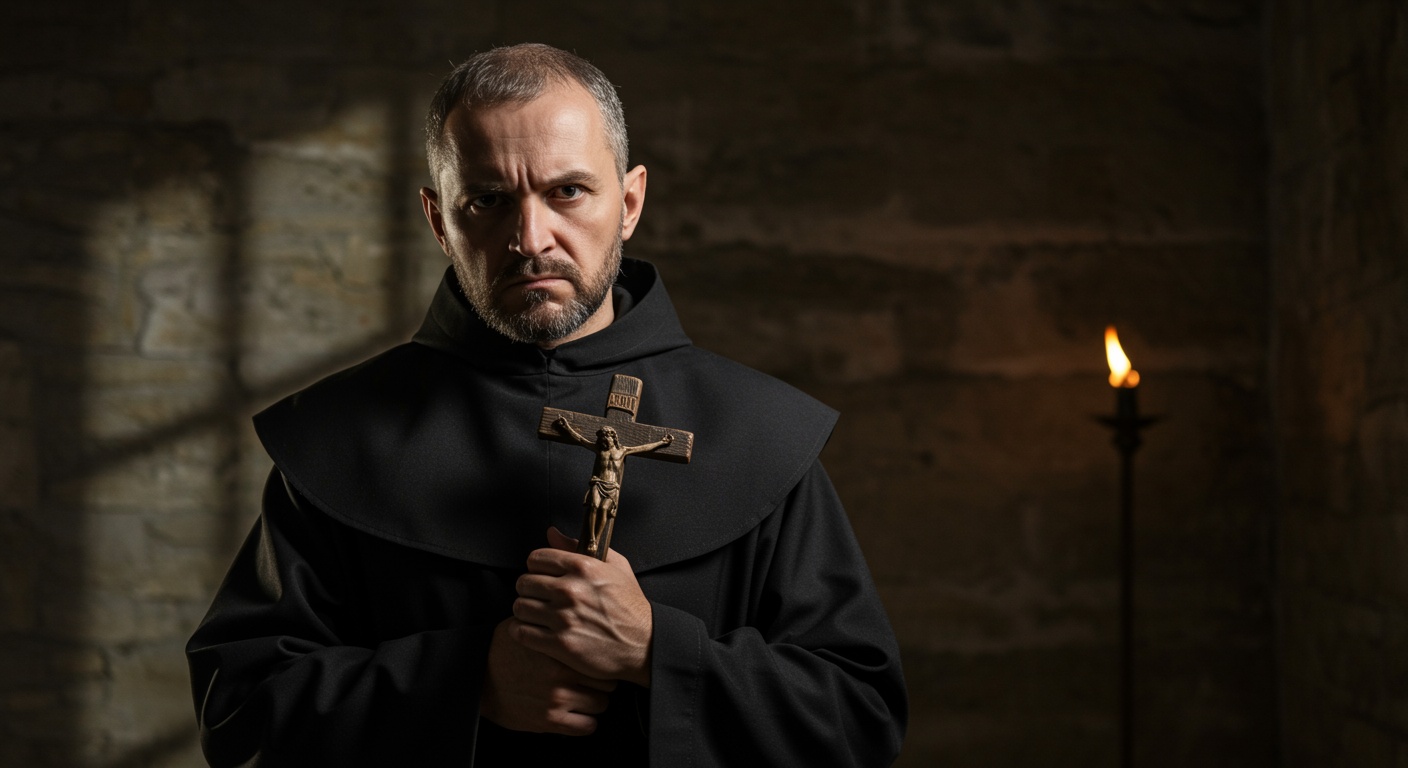
The Inquisition became the Roman Catholic church’s primary weapon against what it classified as heresy – those movements that challenged the power of the popes and questioned official theology and religious practice. But who were the people running the Inquisition – the inquisitors?
In most cases, they combined a sharp intellect with a ruthless determination to destroy heretics. Some clearly enjoyed the more brutal aspects of their job, happy to detail the grisly execution of an enemy they had pursued. While others sincerely believed they were doing God’s work – and even striving to bring the heretic back into the fold.
From the very beginning, inquisitors were the subject of assassinations and attack. These were not well liked people. Let’s go through some of the top personalities starting with William of Paris – an inquisitor who doggedly went after the Knights Templar.
FIND OUT MORE: Interrogation of the Knights Templar in England
INQUISITORS: William of Paris
William of Paris (died 1314) was made the grand inquisitor of France in 1301. Six years later, King Philip IV had arrest warrants served on knights, sergeants, and chaplains in the Knights Templar – he was determined to destroy the order and seize its assets. But he needed confessions – lots of them. The Inquisition under William stepped in to meet the task. With papal approval, they were able to torture and interrogate the knights to stack up the charges levied against them of both heresy and sodomy.
The arrest warrants were drafted in total secrecy – the idea was to take the Templars by surprise on Friday the 13th October 1307. The king’s agents across the kingdom were notified to be on alert on 14 September while William of Paris wrote to Dominican inquisitors and priors to be on standby to extract confessions in dungeons.
Templar knights were held in dungeons across France and torture was applied very quickly. In one account, a knight’s feet were burned so badly that he carried his toe bones in his pocket – and produced them in court. Everybody got the same treatment including the aged grand master, Jacques de Molay.
Pope Clement V was so appalled by the conduct of his own inquisitors – and the king’s jailers – that he suspected all activity in February 1308. But under pressure from King Philip, he was forced to start again. It took five years to get a final judgement against the Templars leading to De Molay’s execution by burning at Notre Dame in 1314.
William of Paris was simultaneously involved in other heresy-related trials at the same time as the Templars. This included an order of women preachers, the Beguines. Their leader, Marguerite Porete, had written what she thought was an innocent enough tract advocating a very personal relationship with God – so intense that one might almost be subsumed into his divinity. That was enough to get her burned at the stake.
The king also demanded the trial of Pope Boniface VIII as a heretic, diabolist, and sodomite, even though this pope had been dead for several years. Philip demanded the inquisition prepare a case against their former boss who had crossed swords with the monarch over the right to tax the church in France without papal permission. This raised the horrific prospect of a repeat of the Cadaver Synod of 897 CE when Pope Formosus had been exhumed, placed on his throne, and put on trial.
And running parallel to all of this – Philip also got the inquisitors to put the Bishop of Troyes on trial for allegedly poisoning Queen Joan – who died during childbirth – using magic spells and potions. Though the king eventually lost interest in this case and the bishop quietly retired.
INQUISITORS: Arnauld Amalric
Between 1209 and 1229, the Pope launched a full-blown crusade against other Christians. While the cream of European knights fought in the Holy Land to retake Jerusalem, Pope Innocent III determined to wipe out a sect called the Cathars. They had spread over southern France and northern Italy – Christians who rejected the church, its sacraments, and wealth. Worse, they let women be priests or ‘parfaits’.
The pope offered crusaders the same exemptions from hellfire after death as applied to joining the fight for the Holy Land. In the first year of the crusade, an army besieged the Cathar stronghold of Béziers. A military leader turned to Amalric and asked how his soldiers should distinguish between Catholics and Cathars once they were inside the city walls.
His reply has gone down in infamy: “Kill them All – for God knows his own (Caedite eos. Novit enim Dominus qui sunt eius).
INQUISITORS: Peter of Verona
Several inquisitors were assassinated by allies of their victims in the Middle Ages. One of those murdered in cold blood was Peter of Verona (1205-1252). He was born to a family sympathetic to the Cathars but in his teens, joined the Dominicans and became an avowed enemy of Catharism. He took on the heresy in northern Italy where it had taken root.
In 1251, he was made chief inquisitor in Lombardy and forced many Cathars to return to the Catholic church. He claimed to have regular conversations with the virgin martyrs Catherine, Agnes, and Cecilia. In one incident, while preaching to a crowd on a very hot day, some Cathars heckled him to provide some shade by divine intercession. Miraculously, a large cloud appeared in the sky.
Unnerved by his success, a group of Cathars in Milan hired an assassin, Carino of Balsamo, who hatched his murder plot with another trained killer, Manfredo Clitoro. The two men followed Peter to a secluded spot and launched their attack.
They struck his head with an axe and laid into a companion friar called Domenico. Legend says that Peter dipped his fingers into his own blood and wrote Credo in Deum (I believe in one God) on the ground – the first words of the Nicene Creed. The blow that killed him sliced the top of his head off.
In a bizarre turn of events, Carino fled to a Dominican friary and confessed everything. Not only was he forgiven, but he became a lay brother and enemy of heresy. He was later beatified by the Catholic church – the first step to sainthood. However, his accomplice took a different path. Manfredo found refuge among the Waldensians – another very active heresy at the time.
INQUISITORS: William Arnaud
William Arnaud (died 1242) was sent by Pope Gregory IX – who was the driving force behind setting up the Papal Inquisition – to step up efforts to annihilate the Cathars. He was sent to the very epicentre of Cathar activity in Albi, Carcassone, and Toulouse – where even the nobility had embraced Catharism. He aroused so much hostility in Toulouse that he was forced to briefly leave until the pope insisted, with threats of dire consequences, that he be let back in.
But Count Raymond VII of Toulouse, a Cathar sympathiser, was determined to get rid of him. His bailiff, Raymond of Alfaro, arranged for a band of armed men to ride out from the castle of Montsegur – a notorious Cathar stronghold – murder Arnaud and eleven other inquisitors. These killers were never apprehended nor punished. The Cathars were so delighted by the news that they composed celebratory songs about his decapitation.
INQUISITORS: Conrad von Marburg
Conrad von Marburg (1180-1233) was the first Inquisitor in Germany and known for his determination to root out heresy at all costs. He did not flinch from levelling allegations at top people. Conrad accused Count Henry III of Sayn of heresy, but the count appealed to the Archbishop of Mainz, Siegfried III. On 25 July 1233, the count was acquitted despite howls of protest from Konrad.
Five days later, Conrad was murdered by Hessian knights while returning to Marburg. Days later, his fellow inquisitors – Conrad Dorso and John the One-Eyed – were also killed. These two men were ex-heretics who had turned against their own kind. After the slaying of their boss, they continued to hunt elite heretics. But the nobleman Heinz von Müllenheim stabbed Dorso to death immediately after being accused of heresy while John was lynched by hanging at Friedberg.
INQUISITORS: Bernard Gui
The first of the big-name inquisitors – he wrote The Guide for Inquiring Into Heretical Depravity (Practica Inquisitionis Hereticae Pravitatis) with case studies on how to interrogate a suspect in a dungeon environment. He was made infamous by the novel and movie, The Name of the Rose, by Umberto Eco – played on screen by actors F. Murray Abraham and Rupert Everett.
He was an early believer in a link between witchcraft and heresy, or as he called these people: “sorcerers and diviners and invokers of demons”.
INQUISITORS: Heinrich Kramer
As the witch trials began to heat up in the 15th century, a German inquisitor wrote the essential guide for spotting and exterminating witches. The Malleus Maleficarum (Hammer of Witches) was published in 1487 and proved to be an instant hit with inquisitors everywhere.
Like many inquisitors, Heinrich Kramer (c.1430-1505) was a Dominican friar. This order was set up in the 13th century specifically to combat heresy. The Dominicans were the intellectuals of the church, legally trained, and ruthless in their interrogation tactics. The Malleus Maleficarum declared that sorcery and heresy were the same thing, and that torture should always be used to extract confessions. It also recommended burning at the stake as the most suitable punishment for witches.
INQUISITORS: Tomas de Torquemada
The notorious ‘Torquemada’ (1420-1498) was the first Spanish Grand Inquisitor put in charge of imposing one faith – Roman Catholicism – on the newly united Spain – a country formed from the union of Castile and Aragon. He is estimated to have burned at least two thousand people.
Torquemada was very suspicious of the Marranos (Jewish converts to Christianity) and Moriscos (Muslim converts to Christianity). It used to be alleged that Torquemada was from a family of Jewish converts, hence his zealous outward hatred of them, but this has been dismissed by historians. Under him, the Spanish Inquisition boomed. So much so that the pope was alarmed at the number of appeals for clemency sent to him from those facing execution by burning.
In 1832, Torquemada’s bones were dug up and burned to protest the inquisition – which still existed in Spain (abolished two years later).
INQUISITORS: Pedro Arbues
Described as “the creature and darling of Torquemada”, he was the right-hand man of the grand inquisitor. Arbues showed no mercy towards the Marranos. There were appeals from Jewish converts to King Ferdinand and Queen Isabela of Spain for the persecution to stop but it fell on deaf ears. So, two wealthy Marranos – Juan de la Abadia and Juan Esperandeu – decided to assassinate Arbues.
Abadia’s sister had been executed by the Inquisition and his father accused of heresy. An attempt to kill him in his bedroom failed but then he was stabbed to death at mass in his church. The vengeance of the Inquisition was terrible. Esperandeu and his French Jewish servant, Vidal, were put to death in public with extreme cruelty. Abadia attempted suicide while awaiting his fate. Arbues was declared a saint in 1867 by Pope Pius IX.
INQUISITORS: Vincenzo Maculani
Vincenzo Maculani (1578-1667) trained as a bricklayer before becoming a priest and then an inquisitor in Padua and then Genoa. He interrogated the scientist and astronomer Galileo Galilei at the orders of Pope Urban VIII.
If you would like to know more about the Knights Templar – get a copy of my new book: The Knights Templar – History & Mystery – published by Pen & Sword, available on Amazon, Waterstones, Barnes & Noble, and WHSmith.



More excellent Templar history, in audiobook form!…
https://sudmeier.gumroad.com/l/epcyc