

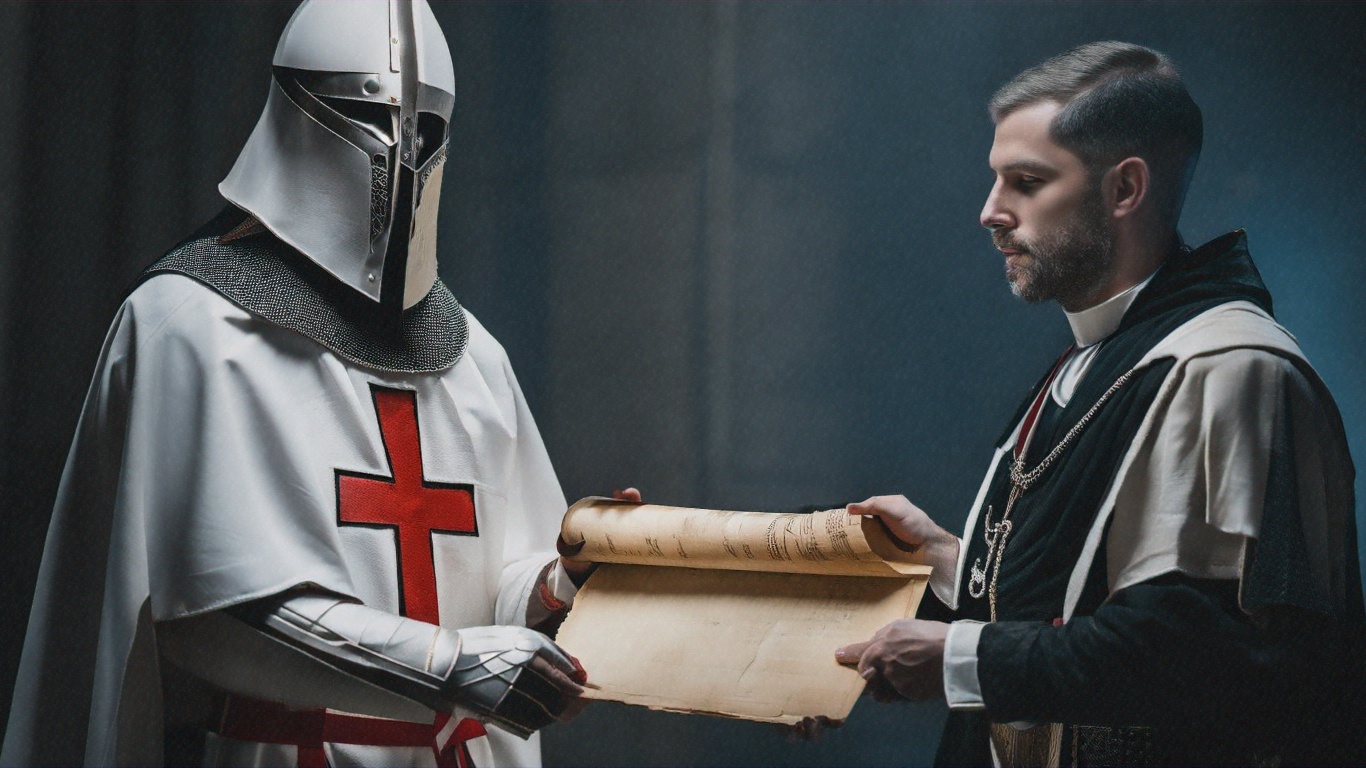
Let’s examine alleged evidence linking the Templars to the Freemasons. There are several documents that have been held up as proof that the Knights Templar transmitted knowledge to the stone masons of the Middle Ages.
Of course there is a deluge of scepticism that has washed over these claims. Take it as read that mainstream historians doubt the veracity of much of what is detailed below. Many Freemasons are also at pains to say these accounts should not be taken at face value. Regardless, let’s delve into these mysterious parchments and legends.
Operative versus Speculative Freemasonry – Before we go any further, let’s make a crucial distinction between ‘operative’ and ‘speculative’ freemasonry. Operative masons worked with stone and built stuff like cathedrals, churches, and bridges in the Middle Ages and long before, stretching back into ancient history. They evolved their own rules, secrets, and values. This was an exclusive brotherhood with a strong sense of camaraderie.
Most stone masons were organised into guilds – trades unions that protected their interests and set standards for entry to the profession. Some masonic commentators have made a distinction between them and those masons involved in building the mighty Cistercian abbeys of England – and other magnificent religious projects.
Guild masons were local in outlook – parochial even – while the church building masons operated nationally, traveling from one job to the next. They embraced bigger picture thinking. These peripatetic masons worked closely with clerical leaders, imbibing religious knowledge and symbols – as well as using passwords to communicate with each other. It’s these church building masons who were the ancestors of today’s Freemasons.
From the 17th century, speculative freemasonry (gentlemen meeting in taverns) absorbed the principles of operative freemasonry without getting their hands dirty. They shared the same origin legends going back to the building of the Temple in Jerusalem. But while operative masons chipped away at stones, speculative masons could be bankers, journalists, traders, etc.
Operative masons protected each other given the hazardous nature of their work and those traditions of mutual help and brotherly love were transmitted to speculative masons. As people joined speculative masonic lodges in the 18th century they became known as ‘speculative’ or ‘accepted’ masons. Early Freemasonry still had a mix of operatives and speculatives but pretty quickly, the operatives disappeared.
Speculative masons retained the square, compass, and aprons that would have been used by operative masons. Establishing a link to the Templar means evidencing that medieval operative masons made contact with the Templars – especially when they were fleeing persecution – and that the result was a blending of their organisational cultures….which later fed into speculative Freemasonry.
King Athelstan and the Masons – Freemasonry claims a long history lost in the mists of the ages. Masons were said to have been active in ancient Greece and Rome where they organised themselves into ‘collegia’, but were then suppressed after the Goth sacks of Rome in the fifth century CE.
In England, a significant moment was when Athelstan – regarded as the first king of the English – asked his half-brother Prince Edwin, to convene a meeting of Master Masons in York, in the year 926 CE. At that gathering, Edwin became a speculative mason, possibly a kind of grand master.
Athelstan was heavily engaged in rebuilding cities like London and York and valued the Masons – indeed ‘loved’ them. So much so that he bestowed many privileges on the masons.
The Old Charges – also known as the Constitutions or Ancient Devoirs – are a trove of some one hundred and thirty documents dating from the 14th to 18th century, from England and Scotland, outlining the duties and values of Freemasonry. They were brought together at the dawn of speculative Freemasonry.
I’d draw a shaky analogy with the way in which early Christians compiled the gospel accounts of Jesus decades after his life as the religion moved from being a Messianic cult to something more philosophical and it became necessary to remember the Messiah’s life story before it was forgotten.
One of the oldest of the Old Charges is the so-called Regius Poem.
Regius Poem – This is a fourteenth century document also known as the Halliwell Manuscript. According to Masonic records, it was at this time that the word ‘freemason’ first appears. It dates to several decades after the suppression of the Knights Templar by Pope Clement V at the Council of Vienne in 1312.
The Regius Poem consists of 64 vellum pages written in rhyming couplets beginning with a reference to Euclid, an ancient Greek mathematician who lived in Ptolemaic Egypt and is revered in Masonry. It then details how Athelstan protected and encouraged the Masons before listing the rules that Masons were to follow. The document was donated to the British Museum by King George II in 1757 but was then lost until rediscovered by a certain James Halliwell in 1838, hence its alternative name: the Halliwell Manuscript.
Cooke manuscript – This dates to somewhere between 1390 and 1450. This document declares: Whosoever desires to become a mason, it behoves him before all things to [love] God and the holy Church and all the Saints; and his master and fellows as his own brothers. It’s very similar to the Regius Poem, giving an account of masonry that stretches back into the ancient world, but puts a heavier emphasis on Christianity.
It discusses the children of a descendant of Cain, called Lamech, who is mentioned in the Old Testament book of Genesis. These kids are super talented with Jabal discovering geometry; Jubal invents music; Tubal Cain masters metallurgy; while a daughter – Naameh – who develops weaving.
When they discover the world is going to be destroyed by either fire or flood, they write their knowledge on a pillar of stone that can resist fire and one of wood that can float. One of these pillars is discovered by Pythagoras – and the other by Hermes. The ability to build the sinful Tower of Babel is grounded in wisdom from these pillars acquired by the architect, Nimrod.
The Regius Poem and Cooke Manuscript were written with operative masons in mind and it’s argued they bear a close resemblance to rule books written for stone masons in continental Europe such as the 1248 Statues of Bologna in Italy and the 1268 Livre des Métiers in France – both written well within the Templar period. The French document refers to francs massons, which has been translated as Freemason – a contender for first ever official mention.
So we’ve established that in the Middle Ages, there were operative stone masons with a keen sense of their own ancient history who communicated through symbols and passwords and had a keen sense of religiosity. They had a close relationship with the church, especially keen abbey builders like the Cistercians – who in turn were closely aligned to the Knights Templar. But where is the solid connection between Templars and Freemasons?
Schaw Statutes – All of which brings us to William Schaw (1560-1602). He is Master of Works to King James VI of Scotland – who will become James I of England after the death of the childless monarch, Queen Elizabeth the First. It’s a time of religious upheaval in both Scotland and England.
James’s mother is the Roman Catholic Mary Queen of Scots who is at loggerheads with her nobles and the leading Protestant Scottish reformer John Knox. She will end up being executed over an alleged coup attempt against her cousin Elizabeth in England – who had sided with the Protestant cause.
James became king as a Protestant and tasked Schaw, who was a Catholic, with a major programme of building works. He in turn drew up a series of statutes to govern how masons worked and conducted themselves. All master masons were bound to obey this document. Both King James and Schaw were accused of being in league with Rome in the 1580s and 1590s with Schaw even being described as a Jesuit. However, by 1603, James was king of England and dissent was silenced while Schaw had died a year earlier.
Before then, on December 28, 1599, the Second Schaw Statute was signed, some of which were addressed specifically to the Kilwinning Mother Lodge – which still claims to be the first Masonic lodge in the world – Lodge Number Zero.
Kilwinning had a large abbey in the Middle Ages with a community of Tironensian monks living there over a four hundred year period. That all came to an end after the Protestant Reformation in the 16th century when a mob, led by John Knox, ‘cast it down’. Put another way, they tore the place apart brick by brick. The tower remains and some of the ruins giving a clue to its previous grandeur.
Some historians have speculated that some Knights Templar, fleeing persecution after the 1307 arrest warrants were served in France against the order, made their way to Kilwinning. There, they took refuge with local stone masons and were protected by the Scottish king, Robert the Bruce, who they had helped defeat the English at the Battle of Bannockburn. Another claim is that they buried the Holy Grail at the abbey. In short, it was these Templars – rubbing shoulders with operative masons – who gave birth to Freemasonry.
Around 1601 or 1602, Schaw signed what has become known as the First Sinclair Charter, confirming the role of the Sinclair family – the Lords of Roslin (or Rosslyn) – as protectors of the masonic craft. It’s suggested that there was a power struggle between Schaw and the Sinclairs over who should regulate the masons. The Sinclairs have a long association with the Templars with some historians claiming they helped the knights escape from Scotland to the New World with their treasure along old Viking shipping routes.
All of the above combines history and mystery surrounding the Knights Templar so it would make a great deal of sense if you were to buy my book: The Knights Templar – History & Mystery. Published by Pen & Sword and available on Amazon, Waterstones, Barnes & Noble, WHSmith, etc.



Hersh may have a point about Christians in senior ranks of the military. You might recall General Boykin who made remarks during the 2003 campaign in Iraq saying it was a crusade. Though the Pentagon did publicly rebuke him for not making it clear these were his personal views. However, this is what Boykin said in 2008 to an audience in Israel:
“Here’s the way I want to enter the gates of Heaven. I want to come skidding in there on all fours. I want to be slipping and sliding and I want to hit the gates of heaven with a bang. And when I stand up and I stand before Christ, I want there to be blood on my knees and my elbows. I want to be covered with mud. And I want to be standing there with a ragged breast plate of righteousness. And a spear in my hand. And I want to say, “Look at me, Jesus. I’ve been in the battle. I’ve been fighting for you.”
Not what you expect a general to say!
I just re-read Hersh’s comments and must admit I came away thinking that he’s making a clear statement that senior military figures have an association with the Knights of Malta and Opus Dei. The suggestion, and feel free to correct me, is that these organisations exert an influence through these members on US military policy.
The coins are a mystery to me – but I’ll investigate further.
Good to hear you’re a sceptic – I used to subscribe to Skeptical Enquirer, great magazine.
I have only just heard about this group. Finding it fascinating reading about their history. I’m a History graduate and founder member of skeptics in the Pub, Norwich, UK, so don’t worry, I’m not a conspiracy nut.
I think however that you don’t do Hersh justice in your analysis. The impression I got was that he was talking about individuals perceptions of themselves as crusaders, rather than an explicit group policy.
I could certainly see a high ranking military man, Christian, a history buff as many military men are… it’s by no means impossible for a group to have formed that played up to these notions.
Certainly Jeremy Scahill, investigative journalist and host on Democracy Now! confirmed having seen and held one of these so called ‘coins’, thoguh it is possible Iperhaps that he saw one of the non-denominational ‘sovereign’ coins of the Order of Malta? Tell me, did/do those coins bare such designs as Hersh suggests?
I think it is all too easy to dismiss as nonsense arguments labelled as ‘conspiracy theries’. It is important not to throw the baby out with the bathwater with such important allegations (given the prominant public role such pretensions might pervade.