

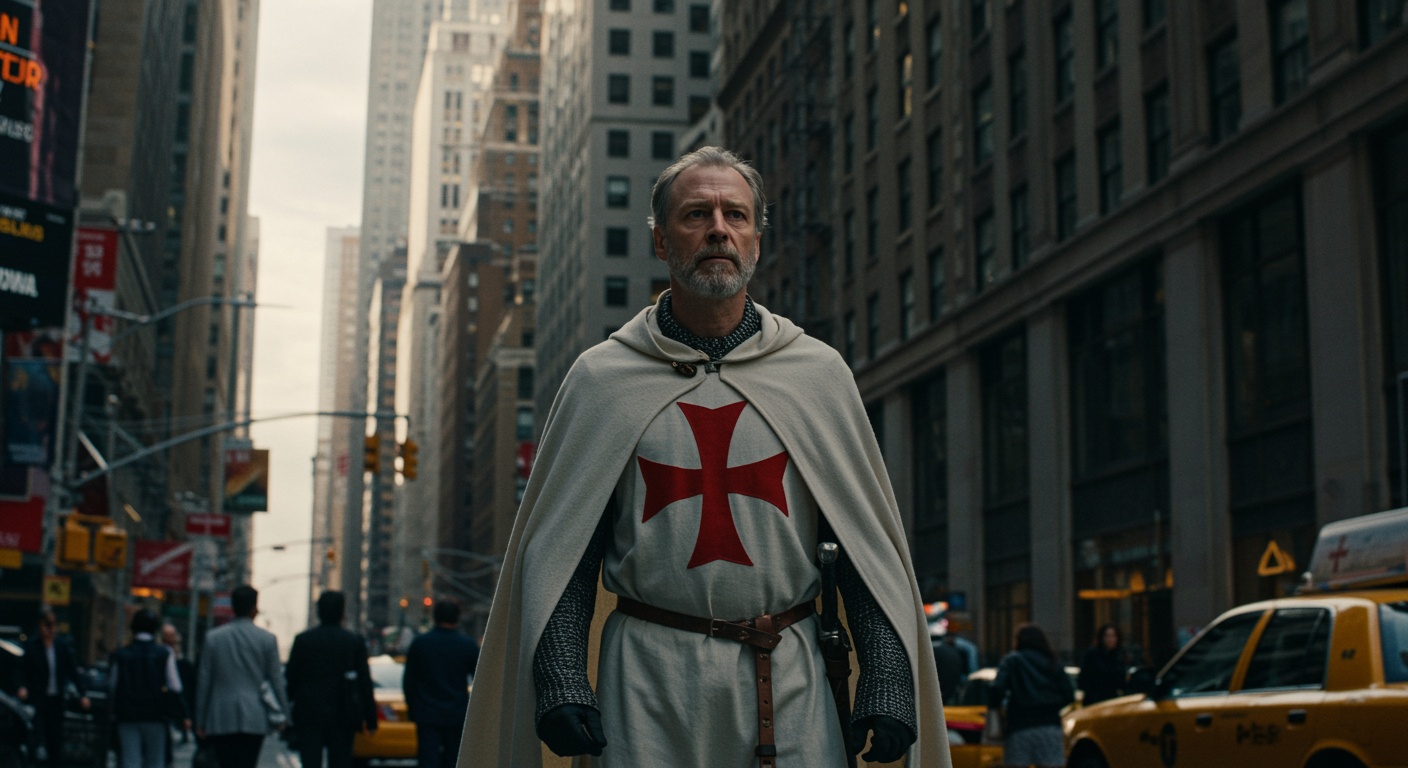
A question I get asked very often is: where are the Templars today? So let me identify some of the modern day Templars because they are a varied bunch and not all following the same agenda. These knights range from Freemasons to Catholics, Neo-Templars and on to fringe political views.
You thought the Templars were finished?
At the Council of Vienne in 1312, Pope Clement V formally banned the Knights Templar. Two years later, the last grand master – Jacques de Molay – was burned at the stake in Paris. The consensus among mainstream historians is that the Templars were finished. Their assets were divided up between the nobility and the Knights Hospitaller while the order’s personnel melted into the population, were pensioned off, or became swords for hire.
But in the centuries since, various organisations have claimed to be the continuation of the Templars – an unbroken link continuing from 1312 to the present day. So, who are these people and do they really have anything to do with the original Knights Templar?
Neo-Templar organisations
There are various neo-Templar groups today that can trace their origins back to the 19th century and a controversial figure, Bernard-Raymond Fabré-Palaprat (1773-1838). An ex-Catholic priest and doctor, Palaprat founded the Ordre du Temple after revealing a curious document: the Larmenius Charter (or Charter of Transmission), which listed a succession of grand masters from De Molay to…..Palaprat.
I deal with this charter and Palaprat’s claim to be the latest Templar grand master in more detail in another blog post and in my book, Downfall of the Templars (Pen & Sword, publishers).
Essentially, Palaprat claimed to be the latest in a line of grand masters going back to Jacques de Molay. He launched his own ‘Johannite’ church in opposition to the Roman Catholic church and he was hostile to Masonic claims that they were the inheritors of the Templar mantle. His neo-Templarism stood apart from both the Catholic church and Freemasonry.
OSMTH and OSMTJ – neo-Templars
During his life, and after his death, Palaprat’s neo-Templar movement proved to be very fractious. In the 20th century, it fractured into rival neo-Templar bodies, which went on to experience further splits. Let me summarise, in simple terms, the fate of Palaprat’s movement and where you can find it today.
A successor organisation to his Ordre du Temple emerged in Belgium, adopting the title International Secretariat of the Templars in 1894. Under the leadership of Emile Isaac Vandenberg, in 1942, during World War Two, it handed over the archives of the order to the Portuguese neo-Templar Antonio Campelo Pinto de Sousa Fontes (1878-1960). Vandenberg died a year later and Fontes became grand master of the Ordre Souverain et Militaire du Temple de Jérusalem (OSMTJ).
Fontes died in 1960, bequeathing the OSMTJ to his son: Fernando Campello Pinto de Sousa Fontes. But as any student of Templar history knows, a grand master is elected – it’s not an inheritance. Whatever Fernando’s merits, a split loomed. In 1970, at a chapter meeting in Paris, a Polish military officer – Antoine Jozef Zdrojewski (1900-1989) – was elected grand master. Fernando refused to accept the decision – having fully expected to win the vote.
After 1970, Zdrojewski led the OSMTJ while Fontes Junior headed up the rival Ordo Supremus Militaris Templi Hierosolymitani (OSMTH). As all you polyglots will note, the OSMTH has the same name as the OMTJ only the former is in Latin and the latter is in French. So now there were two neo-Templar movements but the splitting didn’t stop there. In fact today, there are four OSMTH and five OSMTJ organisations.
In 1992, the OSMTH-MCO split from Fontes Junior alleging mismanagement. Three years later, the OSMTH-Swiss Registry was formed, also leaving Fontes. This organisation has thrived and has a special consultative status with the United Nations. Meanwhile the 1990s and 2000s has seen the OSMTJ, founded by Zdrojewski, generate some split-offs as well. Neo-Templars are a restive bunch. What is the difference in underlying principles behind these groups? Not very much.
That’s the neo-Templars…what about the Freemasons who claim to be Templars?
Masonic Templars
From the dawn of Freemasonry in the early 1700s, Masonic writers have striven to develop an origin story. One of the most influential voices was Andrew Michael Ramsay, normally referred to as Chevalier Ramsay. He was a Scotsman who served as a tutor to Charles Edward Stuart (Bonnie Prince Charlie), a Catholic claimant to the English throne.
In 1737, Ramsay delivered an oration in Paris, which was later published in 1741, where he linked Freemasonry to the Crusader knights and their values. Ramsay’s oration, Discourse pronounced at the reception of Freemasons by Monsieur de Ramsay, Grand Orator of the Order, highlighted the following themes:
- Crusader Ancestry: He suggested that Freemasonry had its roots in the Crusades, with the Crusaders being the founders of the fraternity.
- Moral and Spiritual Values: The oration emphasized the importance of philanthropy, moral values, and a pursuit of knowledge and the fine arts as core principles of Freemasonry.
- Secrecy: Ramsay’s oration also highlighted the importance of secrecy as a key element of Freemasonry
But, to be clear, Ramsay did not say explicitly that Freemasonry was linked to the Knights Templar. Ramsay was a Knight of St. Lazarus of Jerusalem, which may have influenced his connection to the Crusader theme. However, regardless of what he thought, it was the idea of the Freemasons being descended from the Knights Templar that gripped the Masonic world. Over the decades that followed, Freemasons developed Knight Templar “degrees” to which Masons could aspire.
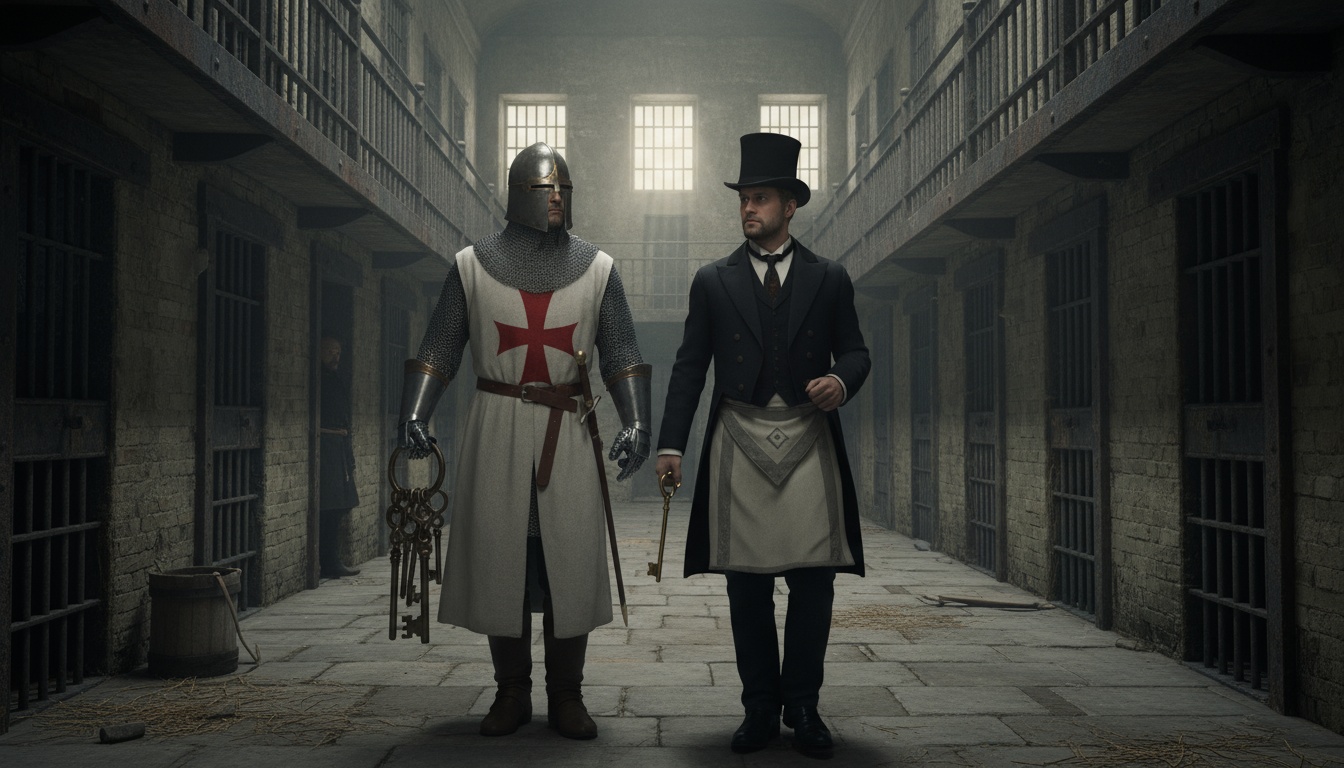
For non-Masons, understanding why some Freemasons call themselves Knights Templar can be difficult to understand. No Freemason needs to earn the Knight Templar degree – and it’s not some kind of ascent or promotion through the ranks. It’s something a Master Mason chooses to do to further their knowledge. There are different rites (Scottish Rite, York Rite) with the route to becoming a Templar varying between the United States and the United Kingdom.
The six highest degrees of the Scottish Rite are all Knight Templar degrees with the 30th Degree – Knight Kadosh – being the oldest Templar degree in Freemasonry. Back in the eighteenth century, it was termed the 24th Degree of Etienne Morin’s Order of the Royal Secret. This was changed to the 30th Degree in 1801 when the Scottish Rite came into being. Furthermore, the 31st, 32nd, and 33rd Degrees were also designated as Kadosh Degrees, which is the same as a Templar degree.
The 33rd Degree is the highest degree in the Ancient and Accepted Rite of Freemasonry, a Scottish Rite body. In England and Wales, this council is known as the Supreme Council 33° and is headquartered at 10 Duke Street St James’s, London.
Any Freemason preparing for those degrees will be more than aware of the Templar connection. In the 28th Degree – Knight Commander of the Temple – the story is told of the survival of the Templars among the Teutonic Knights. While the 29th Degree details the alleged involvement of the Templars at the Battle of Bannockburn in 1314 when the Scottish king Robert the Bruce defeated an English army – with Templar help.
The Knights Templar is the final order in the York Rite. Unlike other Masonic bodies which only require a belief in a Supreme Being regardless of religion, membership in the York Rite Knights Templar is open only to Christian Masons who have completed their Royal Arch and in some jurisdictions their Cryptic Degrees. See one of my other blog posts for a fuller explanation of the York Rite and Templarism.
Roman Catholic Templars
The original Knights Templar were Roman Catholics – accountable directly to the Pope. Yet over the last two hundred years, Freemasons have made a strong claim to the Templar legacy. However, Catholics are not allowed to be Masons on pain of exclusion from the church. Pope Francis recently reaffirmed the Catholic Church’s stance that Catholics are forbidden from joining Masonic lodges, a position established in a 1983 declaration by then-Cardinal Joseph Ratzinger (later Pope Benedict XVI). So how can a Catholic be a Templar today?
Back in 1705, Philippe II, Duke of Orléans convened a meeting of Templars, a few years before Freemasonry as we understand it today was officially formed. So, these Templars are viewed as having been non-Masonic. However, as many Templars became Masons – or some, especially in France, adhered to Palaprat’s neo-Templarism – the Templars in Italy decided to remain loyal to the pope. The Italian Templars believed they were acting in accordance with the first Templars of the Middle Ages.
The successors to these Catholic Templars can be found on the templarstoday.org website which states: “There are no hidden powers, more or less deviant masonries, economic or political powers, strange sects dedicated to even stranger rituals.” Total loyalty to the pope is the overriding position with these Templars supporting the work of priests, nuns, and bishops.
There is no question of association with Masonic Templars: “We pursue the Christian Catholic Way, which is in contrast with Freemasonry (which implies immediate excommunication, by virtue of the repeated rulings by the first Holy Office and by the Congregation for the Doctrine of the Faith).”
If you want to know more about the Knights Templar – then get a copy of my new book: The Knights Templar – History & Mystery – published by Pen & Sword – available on Amazon, Barnes & Noble, WHSmith, and Waterstones.



Christ’s blood line, has always been a puzzle to me, and the fact that Jesus left Mother Mary under the care of the Apostle John makes the puzzle even greater. It seems unthinkable that the Jewish Culture of the times could tolerate a Jewish Holy Mother under the care of a no-blood relation. If Jesus had “blood brothers” of some sort, they would have taken care of her. To me this is one of the strongest insights into the fact that Mary had no other children of her own. It appears that the blood line of Jesus, except for James the brother of the Lord was not influential, and did not prevail.