


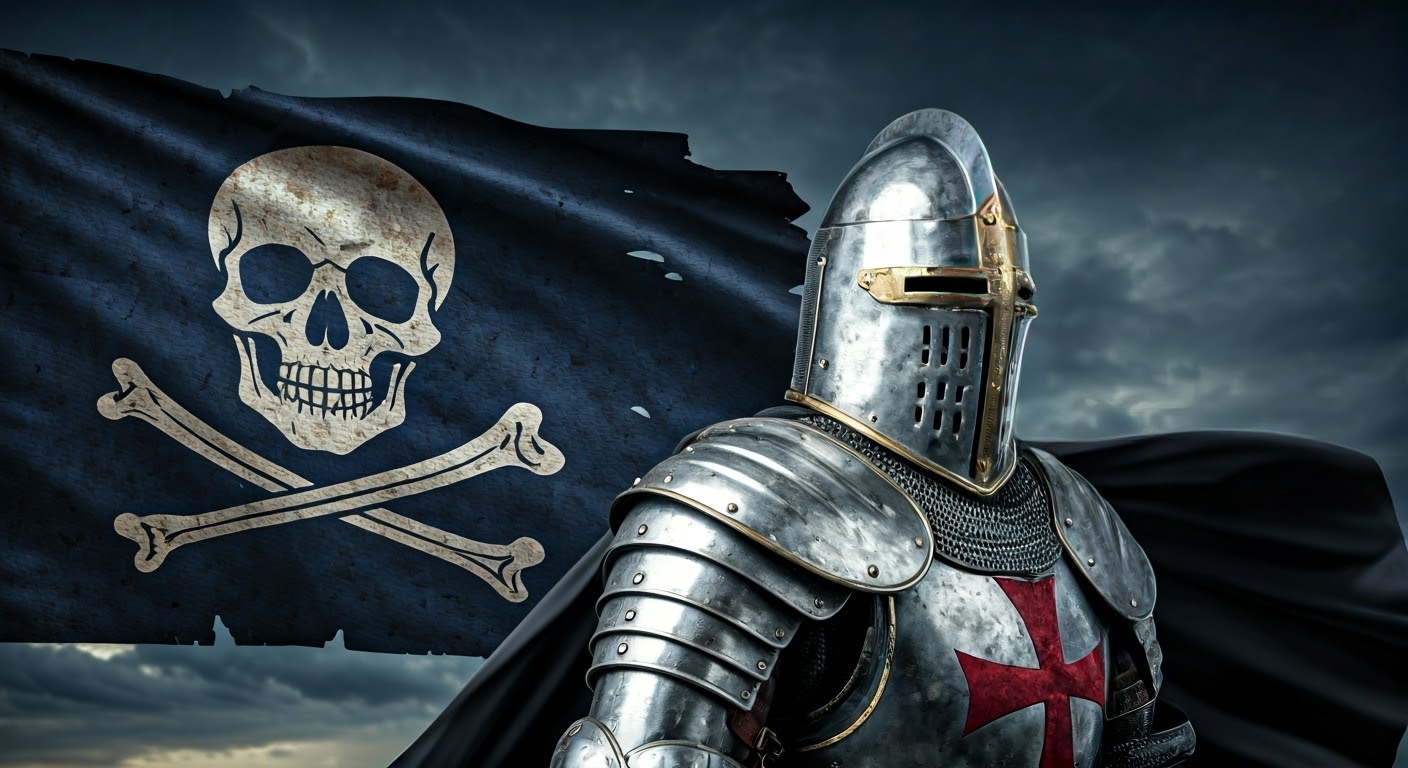
The Knights Templar were crushed by order of Pope Clement V at the Council of Vienne in 1312. Did they quietly resign themselves to their fate? Well, not according to one intriguing theory. Medievalist author Ernesto Frers has argued that the knights took to the high seas as pirates in the Mediterranean – targeting the pope’s commercial ships in an act of revenge.
Let’s explore the theory before making any judgements. The Templars had a fleet, which was used for transporting knights to the Holy Land, as well as for their commercial activities. When arrest warrants were served on the Templars across France in 1307, by order of King Philip IV, the knights had advance warning and rushed down to the port of La Rochelle with their most treasured possessions, spiriting them away under cover of night.
However, over the next five years, those Templars taken into custody were tortured, interrogated, and many were executed. In 1314, the last grand master – Jacques de Molay – was burned at the stake as a heretic. But many other Templars were either pensioned off, melted into the population, joined monastic orders, or became swords for hire. If Ernesto Frers is right, another group of Templars decided to become pirates.
The Templar fleet versus the Papal States
Using ships owned by the order, and harnessing their skills as mariners, they resolved to make the pope’s life a misery by menacing his ships. All vessels owned by the Papal States, and their allies, were fair game for being boarded and their precious cargo taken. As Frers states, they gave birth to the “modern” age of piracy, heralding “the golden age of corsairs, buccaneers, and freebooters”.
He believes their mission was not just about revenge against the pope. They had a greater plan linked to esoteric knowledge they had obtained in the Middle East including the true identity of Jesus, his marriage to Mary Magdalene, and the fate of the Holy Grail. The aim of their illegal fund raising activities, as pirates, was to finance a new universal order “based on spirituality, humanism, and wisdom, possibly inspired by the memory of an ancient era”.
These Templar pirates were not just pilfering from the pope but combatting his dogmas, which they saw as a perversion of the original teachings of Jesus. Logically, of course, this means the charges of heresy levelled against the Templars were true after all. The knights had no qualms about their murderous methods – because the enemy they were fighting deserved everything come to them. The ends truly justified the means.
Aside from being pirates, the Templars also used their maritime skills to become the leading figures in the Portuguese age of maritime discovery in the 15th and 16th centuries. In addition, they continued to operate in the world of high finance, having developed banking skills during the crusades. Much of the wealth accumulated before being banned had been hidden away and it was now added to by the proceeds from piracy, creating a vast fortune.
Templar pirates seek revenge on the Knights Hospitaller
After 1312, the pope ordered the assets of the Knights Templar to be transferred to the Knights Hospitaller. There was no love lost between these military orders and the Hospitallers lost no time grabbing Templar property. Fast forward to the year 1565 and the Hospitallers had converted the island of Malta in the Mediterranean into a heavily fortified base of operations.
The Ottoman Empire, ruled by a Muslim sultan in Istanbul, was determined to take Malta, which would open up western Europe to Ottoman Turkish control. All of Christendom held its breath wondering if the Hospitallers would be able to repel the numerically superior Ottoman armies. But one group of Christians, according to Frers, was working with the Ottomans: the Knights Templar.
Still bristling with anger at the treachery of the Hospitallers, the knights-turned-pirates were prepared to assist the Turks to conquer Malta. In the end, Malta held out though the Ottomans continued to dominate the eastern Mediterranean – with Templar help. One person grateful to see Malta saved for Christ was Queen Elizabeth I of England – even though she used state-sponsored pirates, called ‘privateers’, to harass Spanish galleons sailing from the New World to Europe, laden with gold and silver.
One of those privateers was Sir Francis Drake. Frers argues that the name ‘Drake’ was derived from ‘dragon’, a mythical beast that was one of the Templar emblems. Drake circumnavigated the globe – a huge deal at the time – and Frers argues that he used ancient Egyptian and Chinese maps obtained from the Templar pirates. Fast forward another hundred years and Freemasonry begins to emerge into the lights. Frers argues that this was also the work of the Templars, continuing their activities under a new guise.
If you would like to know more about the Knights Templar, then get your hands on a copy of my book: The Knights Templar – History & Mystery. Published by Pen & Sword and available on Amazon, Waterstones, Barnes & Noble, and WHSmith. Don’t miss out on your copy!



2 thoughts on “Did the Knights Templar become pirates?”