

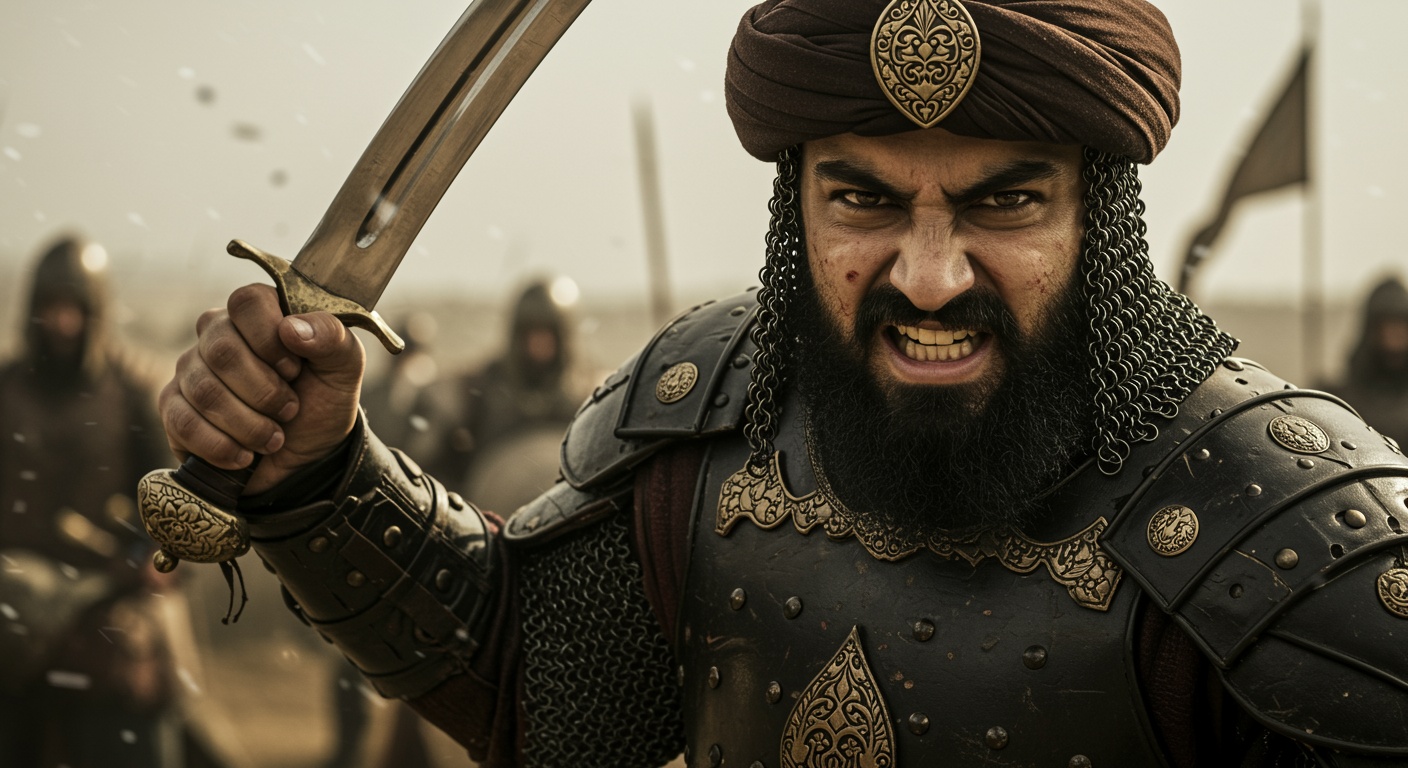
Baybars was the Muslim nemesis of the Templars – a fearsome Mamluk warrior who was ruthless and effective. He proved to be not only a worth opponent of the Knights Templars – but instrumental in their downfall.
Baybars – from slave to sultan
Baybars I, a Mamluk sultan of Egypt and Syria, was a Kipchak Turk sold into slavery, who rose to prominence through military prowess. The Kipchaks – also known as the Cumans – were Turkic nomads who formed a confederation during the medieval period. They were originally based in central Asia and on the Russian steppe. Baybars was born around 1223 north of the Black Sea, in the Kipchak region, and was captured during the Mongol invasion of Russia and Eastern Europe in the 1240s.
He was sold into slavery and trained as a Mamluk, a military slave, in Damascus, then part of the Ayyubid sultanate. The Ayyubids were a Sunni Muslim dynasty of Kurdish origin, founded by Saladin, who ruled Egypt, Syria, and parts of northern Mesopotamia and Yemen between 1169 and 1260, known for their role in ending the Fatimid Caliphate and defeating the Crusaders. Saladin had united the Muslim Middle East during his reign creating a unity among the Saracens that would prove deadly to the Templars.
Mamluks were slaves, initially employed as soldiers, often by the Ayyubid dynasty, and were known for their skills in horsemanship and warfare. The term “Mamluk” means “owned” or “slave” in Arabic, referring to their status as enslaved people. Over time, the Mamluks gained significant power and influence, eventually leading to the establishment of the Mamluk Sultanate in Egypt and Syria in the 13th century.
To be clear then, Mamluks were primarily of Turkic or Caucasian origin, not native to the regions they ruled. They had come as slaves but ended up as masters – and Baybars was one of them. He gained his first major military victory as commander of the Ayyubid army at Al-Manṣūrah in 1250 against the crusaders led by Louis IX of France – a king who was later declared a saint.
Baybars seizes power – becomes implacable foe of the Templars
After angering the first Mamluk Sultan, Aybak, Baybars fled to Syria with other Mamluk leaders, returning to Egypt in 1260 when welcomed back by the third sultan, al-Muẓaffar Sayf al-Dīn Quṭuz. Baybars seized power as the fourth Mamluk sultan in 1260 by assassinating Sultan Quṭuz after a pre-arranged signal, following a victory over the Mongols at the Battle of Ain Jalut, and subsequently consolidating his military position and unifying Muslim Syria and Egypt.
In 1263, Baybars laid siege to Acre, the capital of what was left of the Kingdom of Jerusalem, but abandoned it to attack and sack Nazareth instead. Once that holy town was subdued, he forgot his promise to spare its inhabitants. They were put to the sword.
As sultan, Baybars focused on strengthening his military position, rebuilding Syrian fortresses destroyed by the Mongols, and building new arsenals and warships. Baybars’ ambition was to emulate Saladin in the holy war against the crusaders in Syria. From 1265 to 1271, Baybars conducted almost annual raids against the crusaders.
Templars outwitted by Baybars
The Mongols – who had seemed unstoppable as they advanced into the Middle East and Europe in the early 13th century – were halted by Baybars. Being enslaved by them as a child probably didn’t endear them to the Mamluk warrior. Then it was the Knights Templar who would discover what they were up against.
In July 1266, the castle of Safed, defended by Knights Templar, fell after a six-week siege, resulting in the massacre of the garrison after a promise of safe conduct was broken. The siege of Safed was part of a broader Mamluk campaign aimed at weakening the Kingdom of Jerusalem and other Crusader territories in Palestine.
Baybars also took Arsuf from the Hospitallers and captured Atlit, Haifa, Jaffa, and Antioch. It all began to look like a mopping up operation where, by degrees, Baybars wiped out what was left of crusader-held territory. He died in Damascus on July 1, 1277, at the age of 53, allegedly from drinking poisoned kumis (a fermented dairy drink popular in Turkic and Mongol regions) intended for someone else, though other causes like wounds or illness have been suggested.
DISCOVER: The Knights Templar in Syria
Baybars – hero and saint
In both life and death, Baybars was lionised by the Arab chroniclers as something approaching a saint. Despite his reputation for butchering people as they surrendered to him, the tales portray Baybars as magnanimous and merciful. He cares deeply for his people and even appears in dreams to his son, to advise him on how to improve matters for his subjects. Every battle is won by Baybars and even magicians and sorcerers fear to take him on.
If you would like to know more about the Knights Templar, then get your hands on a copy of my book: The Knights Templar – History & Mystery. Published by Pen & Sword and available on Amazon, Waterstones, Barnes & Noble, and WHSmith. Don’t miss out on your copy!




One thought on “Baybars – slayer of the Templars”