

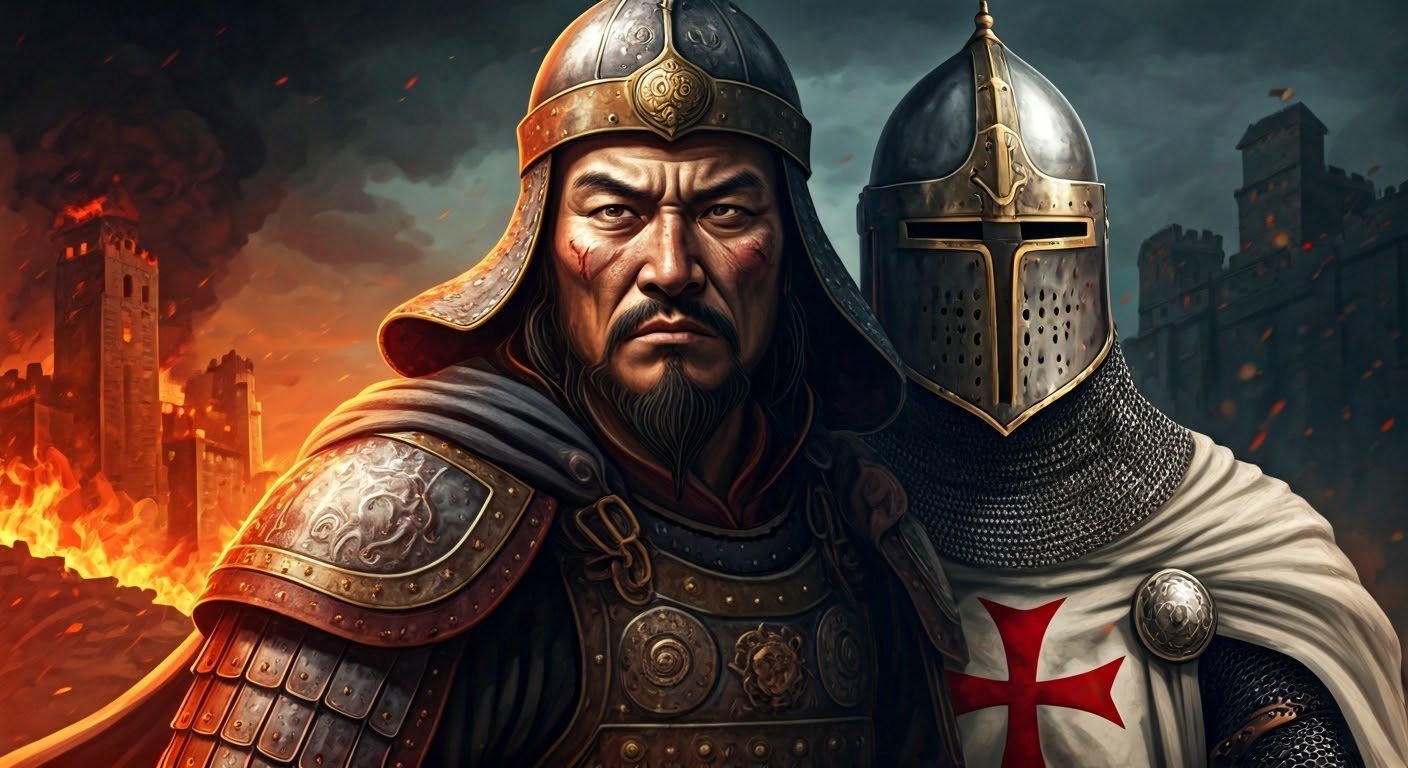
Something incredible and unexpected happened in the early 13th century. The tribes of Mongolia united and then burst out of their traditional homeland creating the biggest empire in history. The Mongol invasion of central Asia, the Middle East, and into Europe struck terror into the hearts of all those it encountered. And it totally changed the dynamic of the Crusades in the Holy Land. The ruler who kickstarted this process was Genghis Khan.
Genghis Khan emerges
This is the story of one of those incredible figures in history who turns the world upside down. Some time around 1162, a child named Temüjin was born to a Mongol chieftain. He became known as Genghis Khan. Now I already hear some linguistic purists screaming that it’s spelt “Chinggis” – but Genghis is the more recognised spelling.
We don’t know what he looked like as there are no contemporary portraits. We have none of his own words. All we have our the deeds of Genghis Khan. Legend relates that he was born clutching a blackened blood clot, a sign that foretold greatness. His father was poisoned when he was a child and his mother struggled to raise seven children. Genghis grew up hunting to survive.
Thousands of miles away, on what would have seemed the other side of the world, Christians were fighting a series of crusades in the Middle East to retake Jerusalem and other holy sites from the Islamic caliphate. This was a distant, inaudible rumble to the warring tribes on the Mongolian plain striving to make a living.
Uniting the Mongols, spread across a vast landscape, seemed impossible. Compared to Europeans with their towns, cities, and settled life on the land – the Mongols were a throwback to an older nomadic existence. But it meant that they were no strangers to travelling at speed, on horseback, across vast distances. Their armour was light – in sharp contrast to the clunky steel of western crusaders – and they could unleash a barrage of arrows whether riding towards or away from an enemy. All this would prove deadly to the west in the years ahead.
DISCOVER: Baybars – slayer of the Templars!
The Mongol invasion begins
Genghis Khan ruthlessly removed all opposition, including from within his own family, and united the tribes. Infused with the idea of a divine mission to conquer, he subdued the neighbouring Chinese kingdom of the Xi Xia in 1205. Ten years later, as King John of England was signing Magna Carta, Genghis Khan had subdued China and the whole of central Asia. The map below shows their victories in Asia.

War crimes (by our modern standard) were committed on a horrific scale with every inhabitant of cities taken – men, women, and children – put to the sword. Genghis Khan drafted a legal code – the Yassa – for his own warriors with draconian punishments. This included execution for any soldier who took an extra bow string without permission or not picking up any item that another soldier had accidentally dropped.
The Mongols turned their attention to the Khwarazmian Empire – centred on Persia. It lay between the Mongol empire in the east and the Islamic Abbasid caliphate to the west. Initially, Genghis Khan contacted the Khwarazmian shah, Muhammad II, with a view to improving trade relations. But the shah was justifiably suspicious of the Mongols and after arresting and executing envoys sent by Genghis Khan, the Mongol army invaded – see the map below for details.

Genghis Khan died in August 1227. The cause of death is a mystery. The following have been stated as the cause: falling from a horse; malaria; typhus; bubonic plague; shot by an arrow (according to Marco Polo); struck by lightning (wrote papal envoy Giovanni da Pian del Carpini); or that his genitals were injured with a knife during very raucous sex play!
Mongols reach the Middle East
The death of Genghis Khan did not halt the Mongol advance. In 1258, they took the capital of the Abbasid caliphate: Baghdad. The caliph, Al-Mustaʿṣim bi-llāh, had lost the support of many of his subjects who could normally be relied on to defend this sacred and ancient city. Once the Mongols breached the walls, they spent a week carrying out what must be regarded as one of the most appalling massacres in history. The densely populated city saw hundreds of thousands of people killed.
Mosques, palaces, and libraries – decorated to a high degree during the Islamic Golden Age – were utterly destroyed. The House of Wisdom – the great library of the city – was ransacked. The leather covers of books were used for boots and sandals by the Mongols. It was said that the river Tigris ran red with the blood of scientists and philosophers. As for the last caliph, he was rolled in a carpet and then the Mongols rode their horses over him, trampling the Islamic ruler to death.
Mongols versus the Knights Templar
Finally, the Mongols flooded into the Middle East and eastern Europe. Inevitably they crossed swords with the Knights Templar – who acquitted themselves well on the battlefield. At the Battle of Legnica (Poland), in 1241, a combined European force of Teutonic Knights, Hospitallers, and Templars, clashed with Mongol forces. The Templars, numbering between 65 and 88, lost only three knights and two sergeants, indicating their effectiveness in close combat.
At the Battle of Mohi (Hungary), in the same year, the Templars fought well but the battle was lost. The Hungarian king, Béla IV, had been trying to convert the Turkic Cuman people (part of the Kipchak federation) to Christianity. The Mongols saw this as a threat to their expanding empire. After the defeat at Mohi, Béla IV had to go on the run through the Balkans, pursued by Mongol warriors. He only narrowly escaped with his life.
Christian Europe did try to form an alliance with the Mongols to subdue the Islamic world. After the Battle of Ain Jalut in 1260, where the Mamluks defeated the Mongols, some Crusaders and the Templars explored the possibility of an alliance with the Mongols against the Mamluks. This led to plans for combined operations, but these plans were ultimately unsuccessful.
If you would like to know more about the Knights Templar – and especially their relationship with the Mongols – then get your hands on a copy of my book: The Knights Templar – History & Mystery. Published by Pen & Sword and available on Amazon, Waterstones, Barnes & Noble, and WHSmith. Don’t miss out on your copy!



Monks are not priests anyway. They live the contemplative life and pray multiple times daily – but no monks – medieval or modern – are ordained as priests. They have priests attached to the order for priests were not allowed to fight. Monks cannot hear confessions nor administer the sacraments, so the arguement that the Templars were not monks because they were not ordained as priests does not hold water.
You make a completely valid point and I doff my proverbial hat to you. This rather shoots down the point raised by this historian. It’s almost a non-point. I’ll keep the post up though to show the argument and its refutation. Many thanks!
If you are talking about monks in a monastery, some are ordained priests who will first have studied for the priesthood and then entered a monastery, or they entered a monastery and then after the years it takes to become a full monastic study for the priesthood through the monastery remaining monks, (i.e. Dominican order) others remained lay monks. So no you can’t say that monks are not priests, and that Templars were not monks and therefore not priests, that is also incorrect.
In my limited knowledge about the Templars, they originated as a monastic order which then devoted their dusty to God by protecting pilgrims to the holy land. In the early time pilgrims were attacked and killed and protecting those who made pilgrimages to the land where Christ was born and lived and died was seen as a sacred dusty. Pilgrimages were done not as tourists do today, they were done for redemption, sacrifice for sins, to find Grace and entry into heaven, they were prayerful but also torturous because many were done totally on foot over unimaginable distance. Even on horseback this was not a pleasure tour. The Templars order came about specifically to protect and guide such pilgrims and pilgrimages protected from “heathens” attacking the Christians.
It is very possible that the order had its share of ordained priests. To say that priests or monks could not kill and therefore the Templars could not have been either priests and/or monks is to say that it was okay for a lay person to kill? First Commandment is after all They shall not kill and applies to all Christians, monk, priest or lay person.. Did the order of Templars have dispensation from this Commandment from the pope? That is a possibility, the church and with it the pope was so very different in that time, 700 + years ago.
All the points you raise are very interesting and pertinent. It is true that the Templars lived by a Rule that was essentially the Cistercian rule – as followed by Saint Bernard of Clairvaux, the Templars’ strongest supporter in the early years. They observed the same daily rhythm as monks punctuated by the usual prayers from dawn till dusk. I’ve often thought of them as the military wing of the Cistercians and the two orders operated in close contact in places like Portugal. The Templars would help conquer territory and the Cistercians would move in behind with their abbeys and skills at land management. Of course the Templars had their own medieval agri-businesses that funded their crusades. So were they priests? No – but they did have their own chaplains to administer the sacraments. In fact they were short of chaplains in the later years of the order. As regards being monks, I get your point. The question then is whether the military orders – Templars, Hospitallers, etc – were regarded as monks at the time. The fact they were directly answerable to the pope points to an affirmative answer and I hear what you’re saying about the distinction between being a monk and a priest. But I think the military orders were seen as distinct from the traditional monastic orders such as the Benedictines, Cistercians, Augustinians, etc. I agree with you about killing people – everybody could do that in the Middle Ages including bishops and priests. And in fact, Bernard of Clairvaux exhorted the Templars to kill in the name of Christ calling it “malecide” (the killing of evil) as opposed to homicide (the killing of another man/woman).