

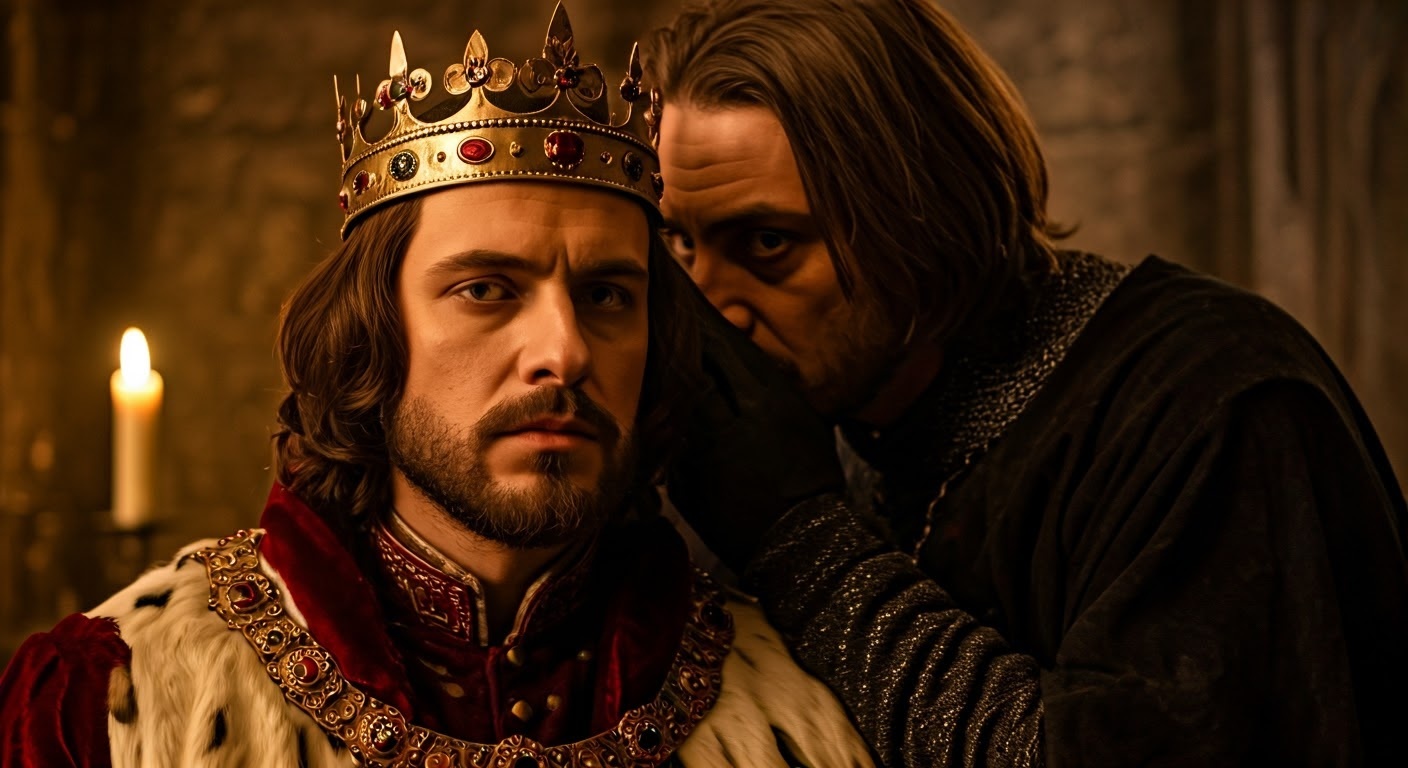
The trials of the Knights Templar between 1307 and 1312 needed voices from within the order to tell tales. Step forward, the prior of Montfaucon: Esquin of Floyran. In return for money, he was prepared to share lurid details of what went on behind closed doors in Templar ceremonies. But was any of it true?
Esquin is sometimes spelt Esquieu of Floyrac or Foyrac – but I’m sticking with Esquin of Floyran. Whatever the spelling, he was regarded as a thoroughly disreputable character. Caught trying to bad mouth the Templars, he was imprisoned by order of the grand master alongside Guillaume Robert, Bernard Pelet and Gérard de Boyzol. But that didn’t stop his scheming.
It emerged during the early phase of the trials that King Philip IV of France had sent spies into the ranks of the Templars to gather information. William of Plaisians claimed that twelve men had infiltrated the Templar organisation. Unsurprisingly – as they wanted to be paid – they re-emerged to confirm that all the king’s worst suspicions were true.
Two years after the Templars were arrested, a knight called Ponsard de Gizy, told the inquisitors that the only reason the knights were on trial was because of malicious accusations from Esquin, Pelet, and De Boyzol. They had all sold their souls for money. Pelet had even agreed to go to England, on behalf of Philip IV, to convince Edward II to join in the purge of the Templars.
Edward had been initially shocked by Philip’s mass arrest of the knights and didn’t believe the shocking content of the warrants. How to suddenly switch from thinking the Templars were warriors for Christ to imagining they had engaged in a two hundred year deception and were actually sodomites and heretics? Philip realised that to sell this story, he needed ex-Templars to spill the beans convincingly. Money undoubtedly helped.
Esquin was certainly in it for the cash. He had initially approached King James II of Aragon with accusations of horrific deeds by the Templars in their initiation rites. But James took one look at Esquin and booted him out of the palace. Furious, Esquin made haste to Paris where Philip proved to be far more receptive.
Displaying bare-faced cheek, Esquin wrote to James in January 1308, just four months after the Templars were arrested across France. He pointed out that James had been the first to know everything – ahead of Philip – and yet had disbelieved the stories.
In this you were unwilling, lord, to give full credence to my words at the time, which is why I had recourse to the lord king of France, who investigated the activities and brought them out into the daylight, particularly as concerns his kingdom.
Esquin then went on to say that he had accurately described the denigration of the crucifix in Templar rituals including the spitting “in contempt of the One who suffered on the Cross”. That they were told to avoid women by their preceptors who told them to have sex with each other whenever the urge for “carnal lust” arose. Esquin went on to say that new initiates had to kiss their receptor on the back, navel, and mouth. And finally, the Templars worshipped a demonic idol and were guilty of “heretical depravity”.
Having made all these points in his letter, Esquin got to the point. He wanted a reward.
My lord, remember that if the activities of the Templars were found to be proved you would give me 1,000 livres in rents and 3,000 livres in money from their goods.
The king’s response is not recorded.
If you would like to know more about the Knights Templar, then get your hands on a copy of my book: The Knights Templar – History & Mystery. Published by Pen & Sword and available on Amazon, Waterstones, Barnes & Noble, and WHSmith. Don’t miss out on your copy!



Then again so does Washington Irving, because of his novel (mostly) most people still think Medieval people believed the earth was flat. They didn’t btw. Even William Shakespeare does not soem extent. Rant over.
This is a great post. I knew about the Eleanor crosses that Edward built, and that he truly loved Queen Eleanor and was devastated at her death. It seems there is evidence that he loved his daughters as well, though his son Edward seems to have caused him no small annoyance, not least because of an acquaintance with a certain Piers Gaveston.
Not that Gaveston actually got thrown out of any windows of course, nor indeed did Edward’s daughter in law Isabella (the ‘she wolf’ of France) actually’ have an affair with one William Wallace.
Your Braveheart observations are totally right of course – that Mel Gibson has so much to answer for! Gaveston was more than likely beheaded and his body was left by the roadside.
Right, Gaveston was beheaded on the orders of the Earl of Lancaster. Edward II’s cousin. I can’t remember the date, but it was certainly after Edward Longshanks had died.
Yes, that Gibson has a lot to answer for. Misleading people and misinforming thier view of history for over 10 years. How many people have I met that still believe that film is true?
First of all may I humbly put you right one one thing?
This is that Braveheart was the nickname given to Robert Bruce, King of Scotland, and not to William Wallace. It was never even associated with the Latter until a certain movie came out. Of course now most people believe that Wallace was called Braveheart, shows how influential movies can be.