


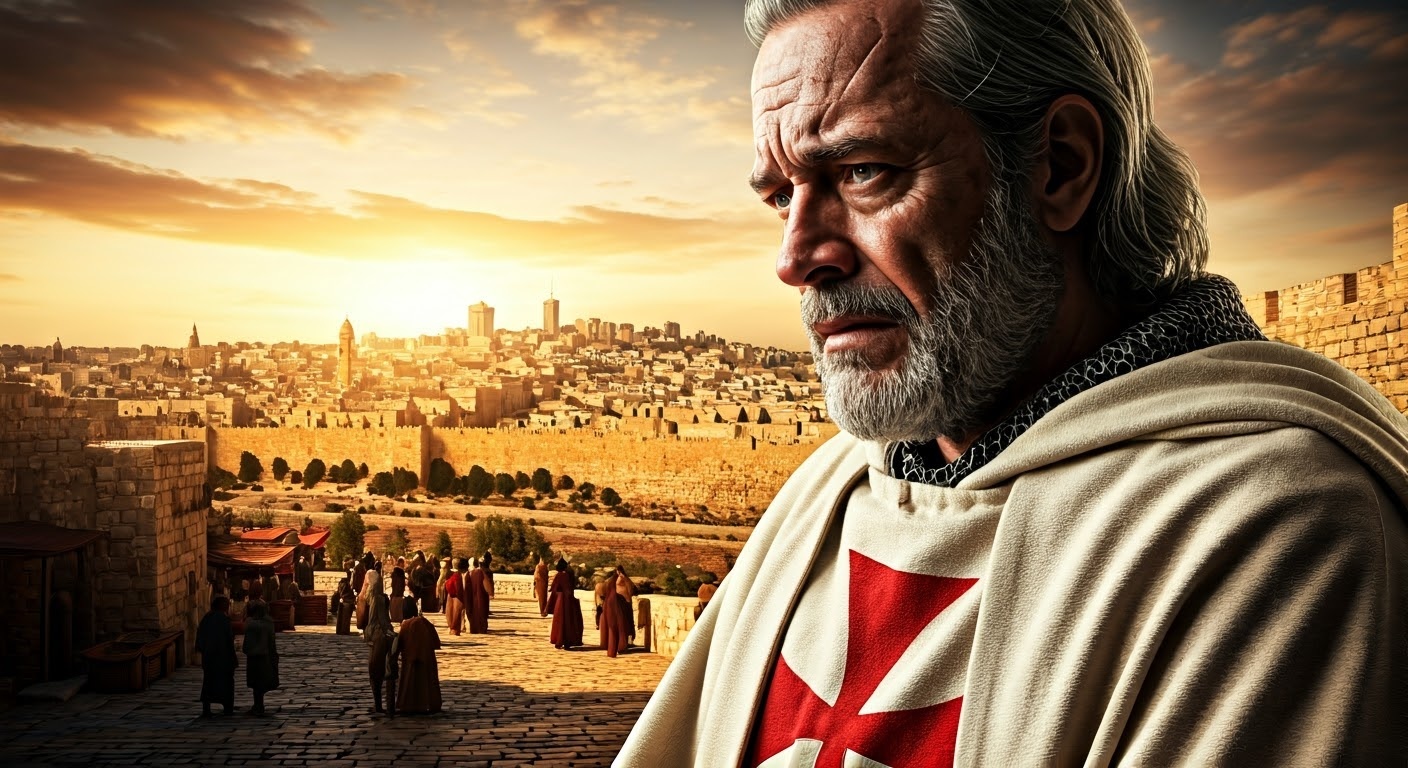
During the Crusades, the holy city of Jerusalem was held for just under a century by Christian forces. It was taken at the start of the First Crusade in 1099 and then lost to the Muslim Saracens in 1187. One contemporary English chronicler, Roger of Hoveden (or Howden) described what happened. How was it that the crusaders lost control of Jerusalem?
After taking Jerusalem in 1099, the city experienced some significant changes. The Temple Mount saw the most noticeable transformation. The Dome of the Rock – previously a Muslim place of worship – now became the Templum Domini, while what had been the Al Aqsa Mosque was renamed the Templum Solomonis. This became the headquarters of the Knights Templar.
The city became a mix of Latin Christian Crusaders, native Christians (Greek, Syriac Orthodox), Muslims (Sunni and Shi’a), Jews, and Samaritans. The Crusaders spoke French, while native Christians and Muslims predominantly spoke Greek and Arabic. Jerusalem became a major destination for Christian pilgrims from Europe, who were exempted from customs duties, further boosting the city’s economy. The Crusaders established a Latin Kingdom of Jerusalem, with a king and a council of barons.
DISCOVER: Saladin the merciful – think again!
But all this came crashing to an end in 1187 as the founder of a new Muslim dynasty, the Ayyubids, united Egypt and Syria, and rallied Saracen forces to drive out the crusaders. The name of his formidable Islamic ruler was Saladin. A century before, it had been the Muslim world that was disunited and the Christians that were united. Now the opposite was the case. Throughout 1187, Saladin inflicted decisive victories against the crusaders, Knights Templar, and Knights Hospitaller – as Roger of Hoveden detailed.
First there was the Battle of Cresson. Hoveden refers to Saladin as the King of Babylon. Under Roman rule, a fortress was built in Egypt called Babylon – its ruins can still be seen in Cairo today. The city of Cairo emerged under later Muslim rule. Hoveden also mentions the hostility on the Christian side between the King of Jerusalem and the neighbouring crusader principality of Tripoli.
In the same year, Saladin, king of Babylon, with an immense multitude of his Turks, on pretext of the disunion which existed between the king and the earl of Tripolis, entered the land of Jerusalem; on which the brethren of the Temple and of the Hospital went forth against him with a great multitude of people, and on an engagement taking place between them, the army of the Pagans prevailed against the Christians, on which the latter betook themselves to flight, and many of them were slain and many taken prisoners. On the same day also, being the calends of May, sixty brethren of the Temple, and the Grand Master of the Hospital, together with sixty brethren of his house, were slain.
The victorious Saladin then marched on Tiberias, whose defence was being led by the wife of the prince of Tripoli. The prince, Raymond, was miles away in Acre. She conceded defeat in what was a hopeless situation.
Saladin, on gaining this great victory, attacked and took a considerable number of the castles, cities, and fortresses of the Christians; after which, returning to his own country, he levied a great army, and, by the advice, it is said, of the earl of Tripolis, who was an enemy to the king entered the territory of Jerusalem, on the Friday after the feast of the Apostles Saint Peter and Saint Paul, with eight hundred thousand men or more; on which he took Tiberias, with the exception of the keep of the castle, to which place the lady of the castle had retreated, together with a few knights.
The king of Jerusalem, the Templars, and Hospitallers then made a last stand against the unstoppable Saladin at a volcanic outcrop known as the Horns of Hattin. The weather was stifling and Saladin lit fires all around the crusader camp to make it even more unbearable. Christian resistance began to crack. The Templars made one last vainglorious charge but the other crusaders sat it out.
Upon this, the brotherhood of the Temple, rushing upon the foe with the bravery of lions, put some to the sword, and forced others to take to flight. The rest, however, neglecting the king’s commands, did not join the battle, or give them any succour whatever; in consequence of which, the knights of the Temple were hemmed in and slaughtered. After this, the troops of Saladin surrounded the army of the Christians, worn out with the fatigues of the march, exhausted by the intense beat of the climate, and utterly destitute of water,- and, in a great measure, of food as well.
Three crusaders in the king of Jerusalem’s retinue – Baldwin de Fortune, Raymond Buck, and Laodicius de Tiberias – defected to Saladin. Roger accused them of being possessed by a “diabolic spirit” for their act of treason. He wrote that they became Saracens instantly, which suggests that they converted to Islam, thereby saving their skins. This was a well recognised way of being spared the executioner’s sword on the battlefield.
After the Battle of Hattin, Saladin executed the captured Templars and moved on to take Jerusalem. The news was badly received in Rome, where the pope dropped dead.
Now when pope Urban heard that in his time the king of Jerusalem had been taken prisoner, as also the Cross of our Lord, and the Holy City of Jerusalem, he was greatly afflicted, and fell ill and died on the thirteenth day before the kalends of November, at Ferrara; being succeeded in the papacy by Albert his chancellor, who was called pope Gregory the Eighth. On this, the cardinals, with the sanction of our lord the pope, strictly pledged themselves to each other, disregarding all wealth and luxuries, to preach the cross of Christ, and that not in word only but by deed and example, and to be the first, assuming the cross, to go begging for succours, and to precede the rest to the land of Jerusalem.
The new pope commanded all Christian princes to be united in future – and stop squabbling – on pain of excommunication!
They also, with the consent of our lord the pope, established a most strict truce between all the princes of Christendom, to last for a period of seven years; on the understanding that whoever in the meantime should commence war against a Christian, should be subject to the curse of God, and of our lord the pope, and the excommunication of all the prelates of the Universal Church.
If you would like to know more about the Knights Templar, then get your hands on a copy of my book: The Knights Templar – History & Mystery. Published by Pen & Sword and available on Amazon, Waterstones, Barnes & Noble, and WHSmith. Don’t miss out on your copy!




Reblogged this on WordPress Report.
Enjoyed the history/geology lesson!
gorgeous architecture 🙂
thanks for sharing