

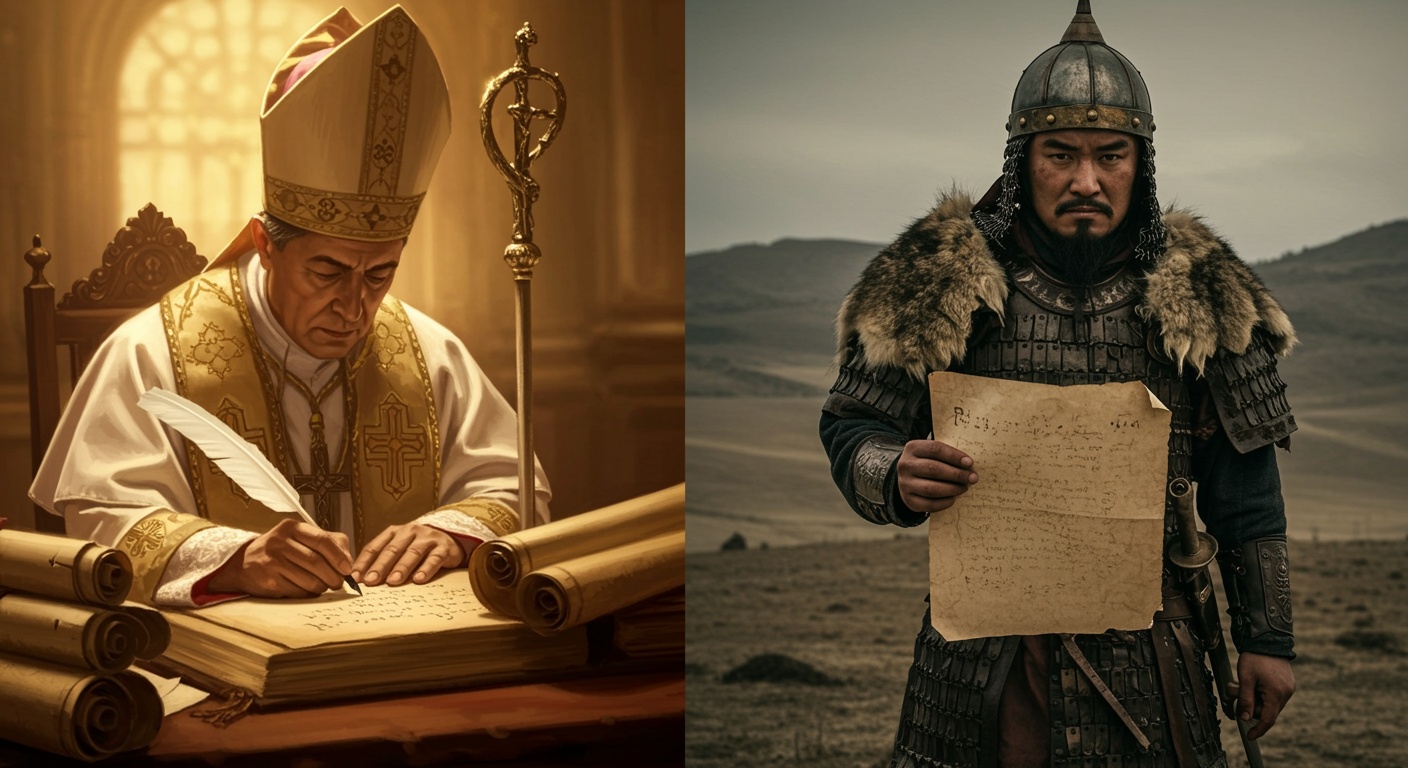
One of the weirdest diplomatic exchanges in history was between the medieval Popes and the invading Mongols from the east. Rome hoped it could convince these fearsome tribes not to attack Christians – and maybe even convert to Roman Catholicism. The Mongols responded with demands that the pope submit to their power. Incredibly, some of the letters from the Mongol khans have been kept in the Vatican Secret Archives for eight hundred years – and can be seen today.
The Mongolian tribes united under Genghis Khan at the start of the 13th century and conquered neighbouring China. They then pushed west at terrifying speed, subduing ancient empires in central Asia and the Middle East. Their lightning attacks on horseback and utter lack of mercy towards defeated peoples struck terror into Europe as they approached.
Centuries before, the popes had negotiated with so-called “barbarians” who menaced the Roman Empire in its later stages. They reprised this role in the mid-1200s, sending out letters to the Mongols, followed up by legates who travelled huge distances to visit the Mongol khans at their court. But this proved to be an enemy that was hard to understand.
The underlying problem with the correspondence between Popes and Mongols was a clash of cultures. The popes wrote measured, legalistic, nuanced missives asking politely about the Mongols’ intentions, and whether a peaceful relationship could be developed. For their part, the Mongols just saw western provocation, insolence, and an unwillingness to bend the knee.
DISCOVER: The Knights Templar in Ukraine
In 1245, Pope Innocent IV drafted a carefully worded document titled Cum non Solum in which he pleaded with the Mongols to stop harming Christians:
We, therefore, following the example of the King of Peace, and desiring that all men should live united in concord in the fear of God, do admonish, beg and earnestly beseech all of you that for the future you desist entirely from assaults of this kind and especially from the persecution of Christians…
This communication was delivered in person by a Franciscan friar and papal diplomat, Giovanni da Pian del Carpine. At 63 years of age, he left France on Easter Day 1245, with the pope’s letter, and arrived in Mongolia on Easter Day in 1246. When he arrived, the ageing friar was not only exhausted from the long journey, but weakened after forty days of fasting for Lent.
Güyük Khan was a newly installed Mongol leader and he kept Giovanni at his court until November of that year. The papal legate then returned home with a reply written in Mongol, which was translated into Persian and Latin. It had a stern and uncompromising message for His Holiness:
You must say with a sincere heart: “We will be your subjects; we will give you our strength”. You must come in person with your kings, all together, without exception, to render us service and pay us homage.
The pope had asked why the Mongols were conquering Christian lands when no Christian had done them harm. The Khan answered it was the divine mission of the Mongol people to conquer the world. And, he pointed out, when the Mongols made first contact with Christian kingdoms, their emissaries were killed. Furthermore, who was the pope to think he could speak on behalf of God?
And when you go on to say, “I am a Christian, I honor God.” How do you think you know whom God will absolve and in whose favor He will exercise His mercy? How do you think you know that you dare to express such an opinion?
Giovanni trekked back to Europe with this uncompromising riposte, arriving in Ukraine by June 1247, where local Catholics were amazed to see him again. He lived another five years. This brave friar was a trailblazer for others who ventured to Mongolia including the legendary Marco Polo.
One of the problems with the huge distances involved was knowing whether messages from the other side of the world were entirely genuine. In 1263, a man named John the Hungarian presented himself at the papal palace, claiming to be an envoy from the Mongol Ilkhanate – part of their empire centred on Iran. Its ruler was Hulagu Khan and John told an amazed Pope Urban IV that the Mongol leader wanted to convert to Christianity.
This isn’t as implausible as it might seem. Christianity had reached the Mongols centuries before, brought by Nestorian missionaries – a form of the faith regarded as heretical by the Roman Catholic church. So when the pope sent legates to Mongolia, the khan was not entirely unfamiliar with the Christian bible. He just didn’t accept that the pope was Christ’s vicar on Earth. It’s believed that Hulagu’s mother and wife, Sorghaghtani Beki and Doquz Khatun, were Christians. However, there is no evidence that he ever got baptised himself.
If you would like to know more about the Knights Templar, then get your hands on a copy of my book: The Knights Templar – History & Mystery. Published by Pen & Sword and available on Amazon, Waterstones, Barnes & Noble, and WHSmith. Don’t miss out on your copy!




Ah! the scandals in the Vatican,more to come no doubt.
Reblogged this on Barbaryalan's Blog and commented:
Absolute Power anyone?
Indeed! And Clement V of course moved the papacy from Rome to Avignon beginning what was described as the “Babylonian captivity” of the popes, under the French king’s thumb for most of the fourteenth century.
And of course at the time of the Templars the Vatican had it’s share of controversy as well with the process that King Phillip IV (the fair) used to unseat the papal authority through his main henchman William de Nogaret (the Kings Counsel), yes he was an attorney. He was the one responsible for kidnapping Pope Boniface VIII and then it was speculated that he also poisoned Benedict XI in order to pave the way for Clement V to become the French Pope and this split the Vatican Cardinal ranks and created the reign of the French Papacy in Avignon. Controversy and corruption is just part of the inner workings of the Holy See it would seem.