

It might amaze you to know that today, several organisations claim to be direct descendants of the Knights Templar. They assert a direct line linking them to the last grand master – Jacques De Molay – who was burned at the stake in 1314. But how many of these organisations – if any – really have anything to do with the Templars?
These modern day Templars tend to divide into Freemasons, so-called ‘neo-Templars’, Roman Catholics, and more disturbingly some extreme political groups that distort the history of the Templars for their own ends. Why would anybody want to be linked to the Templars?
Well, they were an enigmatic band of holy warriors who shone brightly for two centuries before being brutally crushed for reasons that are still not very clear. Ever since, historians and the curious have come up with various explanations for why they were snuffed out creating a fog of mystery around these knights.
Many modern Knights Templar try to claim direct descent from the last grand master, Jacques de Molay, who was burned at the stake in 1314. But others don’t – stating they are simply inspired by the Templar ethos. Let’s take a look at some of those telling us today that they are Templars!
FIND OUT MORE: The modern Knights Templar today
Neo-Templars and the Larmenius Charter
So, was De Molay the last grand master? No – according to the world’s neo-Templars. They date their modern origin to a Frenchman, Bernard-Raymond Fabré-Palaprat (29 May 1773 – 18 February 1838). He started out as a Catholic priest then trained to be a doctor then suddenly in 1804, Palaprat produced a medieval document termed the ‘charter of transmission’ showing an unbroken line of grand masters from 1314 onwards. His name was the last on the list. Not only did he claim to be the current Templar grand master but also set up his own church to rival the Roman Catholic church over which he was the ‘sovereign pontiff’.
His church didn’t survive but his Order of the Temple most certainly did. However, from its earliest years there were splits within this neo-Templar order. And it’s kept splitting ever since. During the Second World War, its assets were moved to Portugal where a local Templar claimed he was the legitimate grand master and should be succeeded by his son. Sparing you all the details, the inheritors of the Palaprat order had a massive meltdown in 1970 with one group under the Portuguese master going one way and another under a Polish military officer going another.
The neo-Templar split today
The Portuguese called themselves the Ordo Supremus Militaris Templi Hierosolymitani (OSMTH), which translated from the Latin means the Supreme Military Order of the Jerusalem Temple. The Polish used the French translation of the same title to call themselves the Ordre Souverain et Militaire du Temple de Jérusalem (OSMTJ). And they have continued splitting ever since.
The OSMTH has spawned the OSMTH-MCO, OSMTH-Magnum Magisterium, OSMTH (Swiss Registry), OSMTH (Willery Line). OSMTH-Magnum Magisterium is the direct continuation of the Portuguese organisation which at one point was the almost sole representative of neo-Templarism, but those days are long gone. The Swiss OSMTH split in 1995 and has enjoyed considerable success building itself into a well regarded organisation that enjoys special consultative status with the United Nations.
The OSMTJ has witnessed a number of schisms where disgruntled senior members have parted company over allegations I don’t wish to get too involved with as I’m sure there are legal ramifications even to the present day. But the result has been about five organisations using the OSMTJ name. Ironically, they often get on better with OSMTH-related Templar bodies than with other OSMTJ Templars. Most of them regard themselves as Christian in an ecumenical sense.
Palaprat’s neo-Templarism was viewed two hundred years ago as a counter-balance to the growing Freemasonry movement. But today, there’s an overlap between the worlds of neo-Templarism and Freemasonry though many neo-Templars remain entirely separate – possibly even hostile.
Masonic Templars today
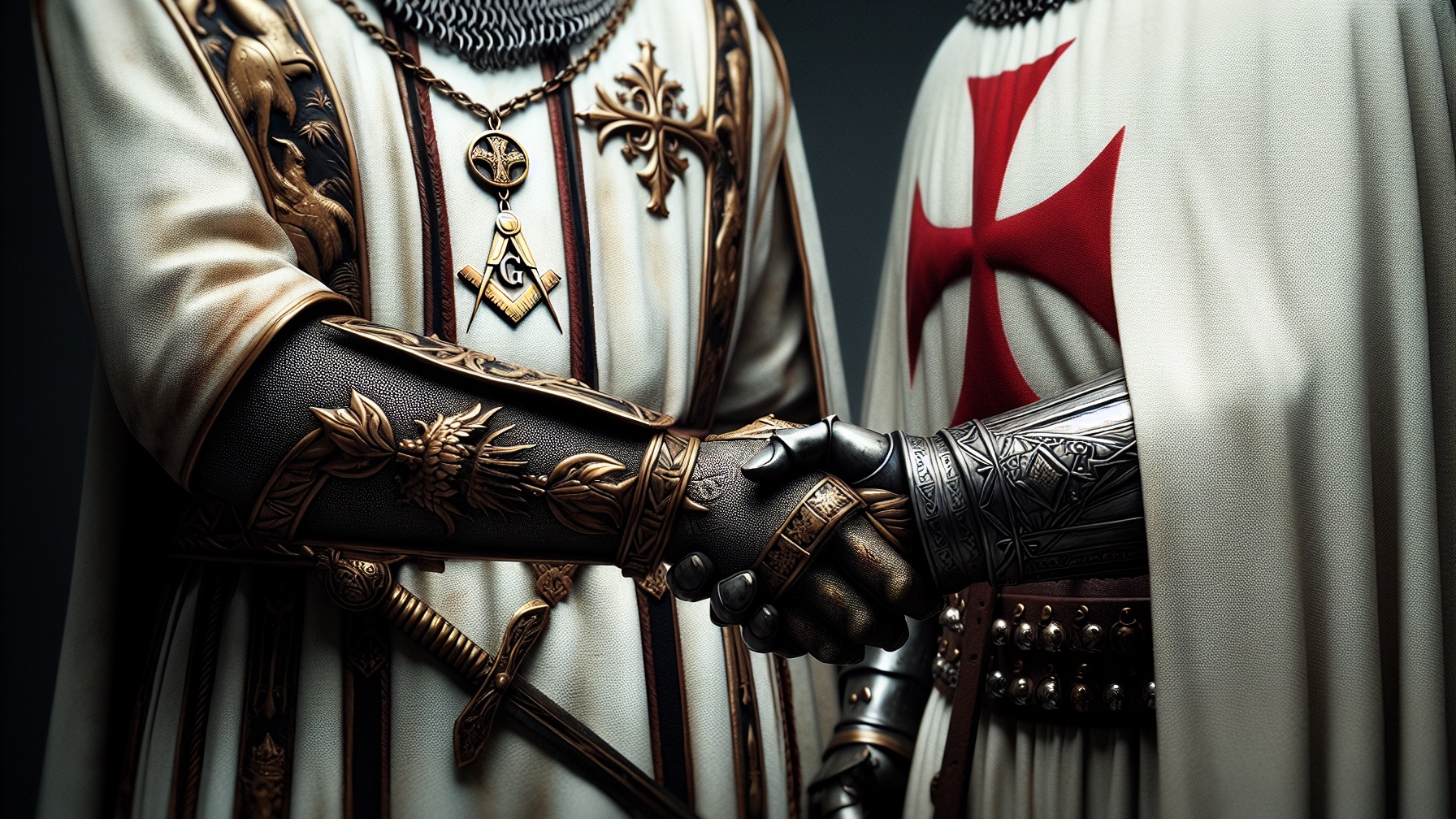
Ask any Freemason today whether they believe their lodges are the genuine continuation of the Knights Templar – an unbroken connection to De Molay – and you will be greeted with a blush and a denial. Yet early Freemasonry did make such a claim. Four hundred years separated the destruction of the Templars from the first recognisable masonic lodges. As they developed the Templar degrees were introduced.
A key figure in developing the Templar-Masonic connection was Sir Andrew Michael Ramsay (1686-1743) – a low-born Scot with aristocratic pretensions who never saw a secret society he didn’t want to join. Known more commonly as Chevalier Ramsay, he spent most of his life in France, converted to Catholicism and supporting the Catholic Stuart claim to the English throne – the ‘Jacobite’ cause. He joined the military order of Saint Lazarus of Jerusalem and his enthusiasm for medieval chivalry meant that as a Freemason, he linked the masonic movement to crusader knights without explicitly mentioning the Templars. But the connection endured and associations with the Templars became entrenched.
Today, the masonic order that claims to have incorporated both the Templars and one-time rivals, the Knights Hospitaller, is The United Religious, Military and Masonic Orders of the Temple and of St John of Jerusalem, Palestine, Rhodes and Malta. It consists of three degrees:
- Knight of the Temple and the Holy Sepulchre (Knight Templar)
- Knight of St Paul
- Knight Hospitaller of St John of Jerusalem, Palestine, Rhodes, and Malta (Knight of Malta)
To become a member of this order, Royal Arch Masons must profess the Christian faith – as opposed to acknowledging a supreme. If a freemason is accepted, they may eventually join a small elite permitted to join the Knights Beneficent of the Holy City.
FIND OUT MORE: Knights Templar and Freemasons – linked or not?
Catholic Templars today
The Catholic Templars is, as its name suggests, a body of Templars who recognise the authority of the pope. They originate from a group of Italian Templars who split from Palaprat when he created his own gnostic church in opposition to Roman Catholicism. So, it is very hostile to neo-Templarism. And it’s also opposed to Freemasonry. Its website states that Freemasons are banned from membership as they have been condemned by the Roman Catholic church on several occasions. They will be subject to ‘immediate excommunication’.
Which leaves the thorny question of how these Templars can be loyal to the pope – when the pope was not loyal to them back in 1307? They firstly get round this by declaring that the organisation today has no direct link to the original Templars. It is not a continuation of the Knights Templar of Jacques de Molay. Therefore it is not part of the banned and disgraced Templars – though it is inspired by their ethos.
“The Association does not therefore pretend to present itself as the Order of the Pauperes Commilitones Christi Templique Salomonis, or as its direct official heir, but draws inspiration for its works and spirituality.“
And secondly, they cite the Chinon Parchment, discovered by author and Vatican librarian Barbara Frale. They say this parchment shows that Pope Clement V ‘granted sacramental absolution to the Grand Master Jacques de Molay as well to the remaining Knights Templars’. They also claim that the papal bull Vox in Excelso which condemned the Templars as heretics and sodomites, was a forgery. So, they cover themselves by stating they have nothing to do with the original Templars but also, they don’t believe the pope condemned the knights in the way described by most historians.
Men and women can become Catholic Templars and they claim to have about 150 clerics and 3,000 lay members.
Plenty of other Templars today!
This is not an exhaustive list of Templar bodies. The Knights Templar of North America is another organisation that does not required interested parties to be Roman Catholic or Freemason though you have to be a baptised Christian of some description. They have their own ‘internal monastic order’.
If you know more about this organisation or any others, do get in touch!