


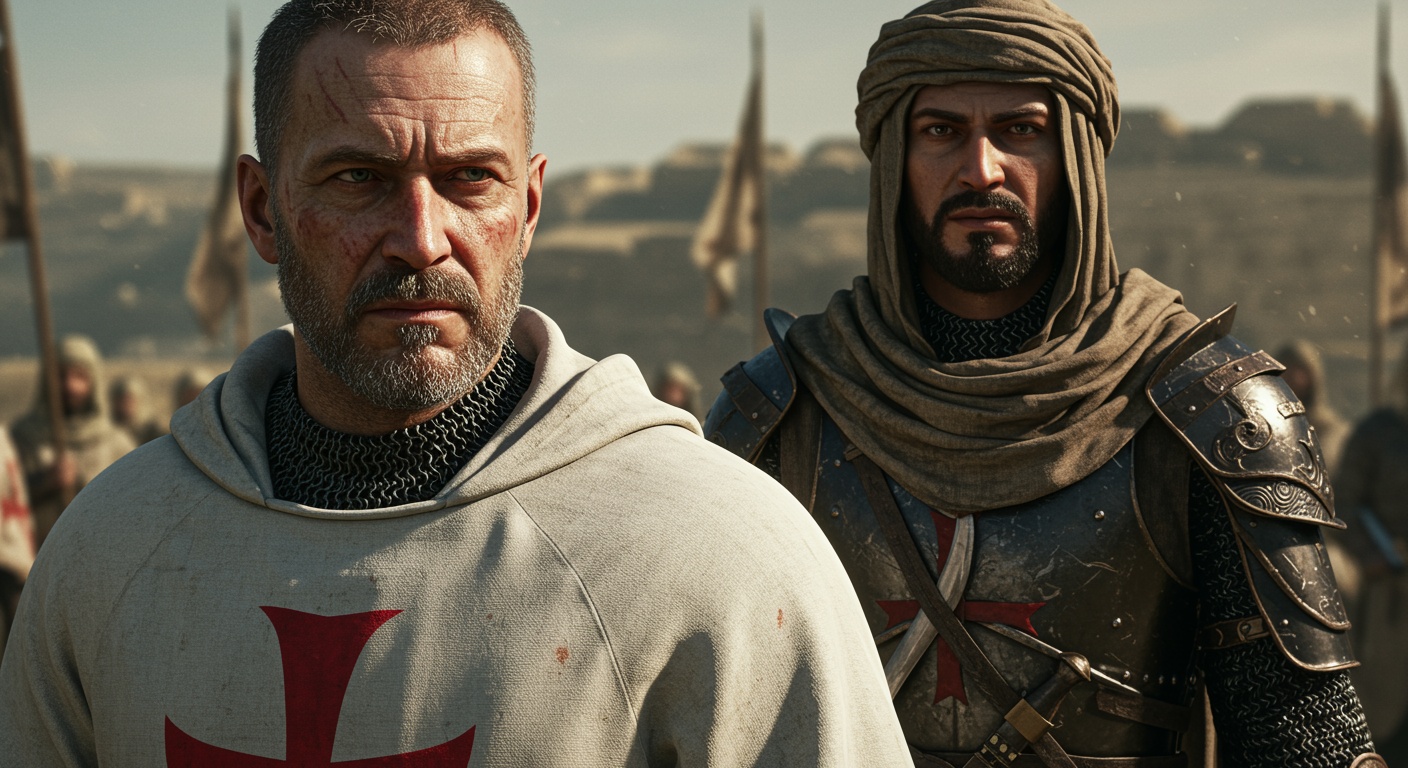
Gaza is in the news right now as Israel and Hamas clash in this relatively small piece of territory that is nevertheless densely populated. A little known fact about Gaza is that it was a stronghold of the Knights Templar during the Crusades.
The city fell to the crusaders in 1100, just a year after Jerusalem had been taken. It was of huge strategic importance being so close to the enemy Fatimid empire, a Shia Muslim realm centred on Egypt. Around 1149, the Knights Templar were tasked with holding the city. Taking Gaza allowed the Kingdom of Jerusalem to encircle nearby Ascalon, which was still under Fatimid control. With Gaza transformed into a Templar stronghold, the supply routes from Egypt to Ascalon were disrupted.
In 1153, Ascalon fell to the crusaders after a victorious siege in which the Templars played a major role. A year later, in 1154, the Muslim chronicler Abu Abdullah Muhammad al-Idrisi conceded that under Templar control, Gaza was thriving and its once severely reduced population had recovered, benefiting from being located on a key trading route. Indeed as Gaza grew, people were encouraged to build homes outside the city wall under Templar protection.

Promoting Christianity was at the centre of the Templar mission. In 1149, a large church was built in the city on top of the ruins of what had been a 6th century Byzantine Christian church then transformed into a mosque, after Muslim armies invaded in the 7th century, but subsequently badly damaged by an earthquake in 1033 that sent the minaret crashing down on to the building.
Going back further in history, like so many churches, the site had originally been a pagan temple. But not just any old pagan temple. This was the Philistine temple to the god Dagon famously toppled by Samson in the bible. The building reverted to being a mosque after the Templars gave up Gaza but traces of the crusader church were still very visible for centuries. However, much of the mosque and its medieval Christian remains were destroyed in an Israeli air strike in December 2023.

In 1170, the Templars completed the construction of a fortress in Gaza. But in that same year, the Saracen leader Saladin – who had unified Egypt and Syria and now posed a huge threat to the crusaders – attacked Gaza. Many of the Templars were not present having been ordered to help King Almaric of Jerusalem defend another nearby town. Gaza was left under the control of a cousin of the king, Miles de Plancy. The medieval chronicler William of Tyre described De Plancy as a degenerate drunk unfit to hold such an important position.
Faced by this surprise assault from Saladin, and with few Templars around to defend the city, De Plancy raised the drawbridge, preventing defenceless inhabitants entering the fortress, which led to their slaughter by Saladin’s soldiers. It seems that De Plancy’s view was that these untrained people should do their best to fight the invaders while he watched from the battlements. What he witnessed was a horrific bloodbath. However, Saladin did not take Gaza that day.
Emboldened, Saladin amassed a huge army and began ravaging the countryside around Gaza and Ascalon in 1177. His troops fanned out over the area becoming a little lax in terms of discipline. Reportedly, there were tens of thousands of Saracens looting and taking supplies all within crusader territory. King Baldwin IV of Jerusalem, the teenage monarch who famously suffered from leprosy, decided to strike back. Together with the Templars he inflicted a stunning defeat on Saladin at the Battle of Montgisard, sending the Muslim leader fleeing back to Egypt – defeated despite his overwhelming superiority in terms of troop numbers.
This was the high point for the Templars in the Holy Land where they evidenced the effectiveness of their battle tactics and incredible discipline, moulded by their spiritual ethos. But – pride comes before a fall. And Saladin learned his lessons well. By 1187, the Templar grand master was the mercurial Gerard de Ridefort who spent a great deal of time immersed in the turbulent court politics of the kingdom of Jerusalem. On July 4 of that year, he led his Templar army to a terrible defeat at the Battle of Hattin, largely because he refused to take advice from crusaders he disliked for political and personal reasons.
De Ridefort was taken prisoner by Saladin but the Templars negotiated his release in return for surrendering Gaza. Not long after, Saladin made a point of destroying Gaza’s fortifications. The city was retaken in a subsequent crusade by Richard the Lionheart but then went back to Muslim rule before being completely flattened by a Mongol army under Hulagu Khan in the 13th century.
DISCOVER: Did Saladin become a Knight Templar?
If you would like to know more about the Knights Templar, then get your hands on a copy of my book: The Knights Templar – History & Mystery. Published by Pen & Sword and available on Amazon, Waterstones, Barnes & Noble, and WHSmith. Don’t miss out on your copy!




DE RIDEFORT today is RUTHERFORD a very old Belgium -Scottish name.
Promoting Christianity (or protecting travelers on the road to Jerusalem) was not the core mission of the Knights Templar. These were the front they held to maintain secrecy of their true mission.