


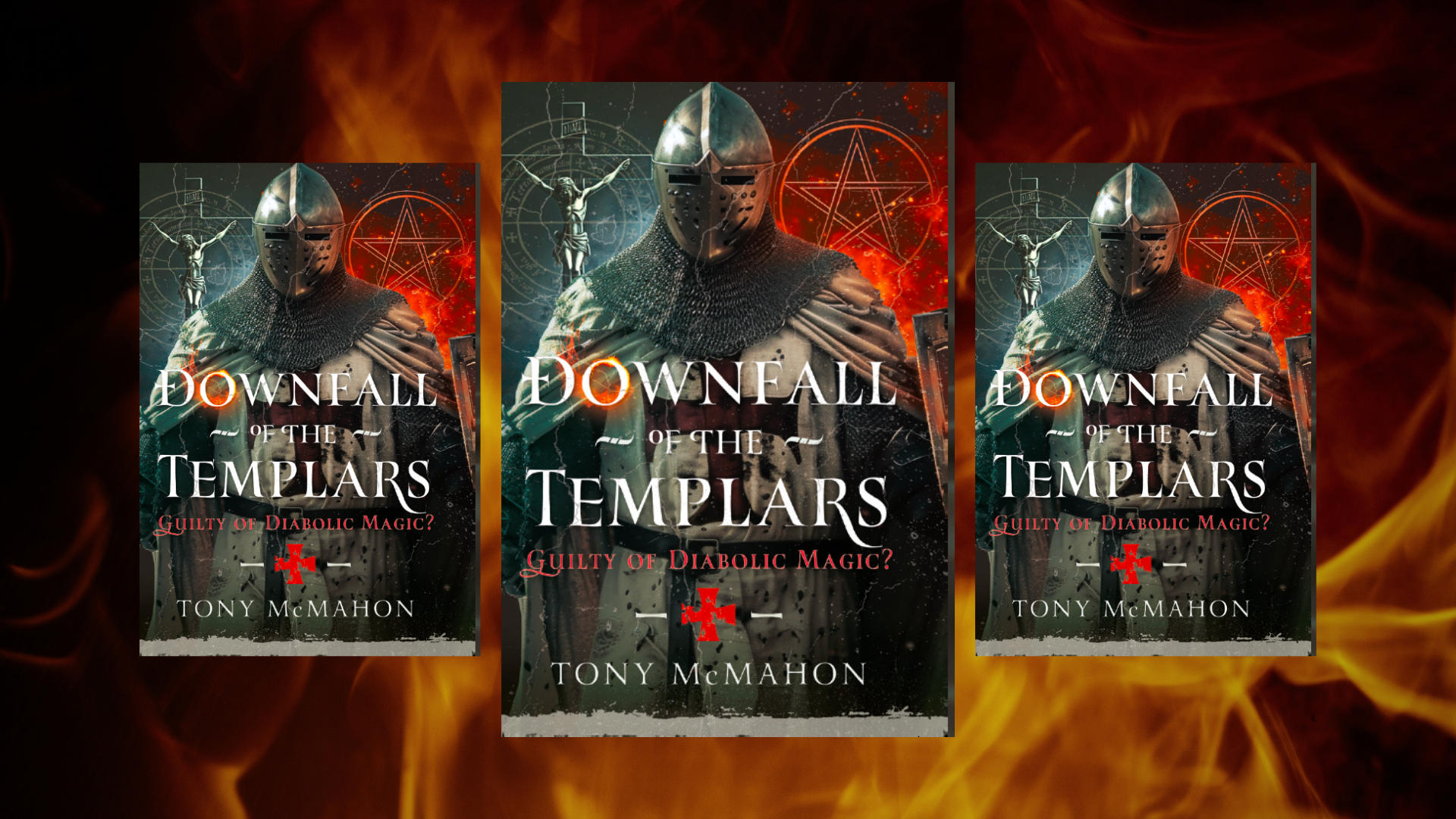
Why were the Knights Templar destroyed in the year 1307 – on that fateful date of Friday the 13th? Was it just because the King of France wanted to get his hands on their wealth or was there more to it? I’ve been investigating and my new book – Downfall of the Templars: Guilty of Diabolic Magic? – is available now on all major book sites. It will make you rethink why the Templars were annihilated and whether the accusations against them were true or not.
In my new book – the second in a trilogy on the Templars published by Pen & Sword – I look at why the Templars were put on trial. These were holy warriors previously regarded as the poster boys of the crusades. Suddenly, the authorities in France vilified them as heretics, sodomites, and diabolists. This was an astonishing turnaround.
From a 21st century secular, rational perspective, we tend to look for cynical, grubby motives. So, for example, the King of France, Philip IV, was just out to get their money to fill his coffers. He had wars against England and Flanders to fund and had already mugged the Jews, Lombard merchants, and monasteries. So, he had form when it came to grabbing available pots of cash. But is this too simplistic?
In my research, I was fascinated to find that at the same time that the Templars were on trial for their lives, the king had also initiated legal proceedings against a group of women called the Beguines, the bishop of Troyes, and a dead pope, Boniface VIII. All of these people were accused of devilish conduct. In effect, we were seeing the very beginning of the witch trials that would explode on to the scene in the next century.
I believe that King Philip sincerely bought into the accusations against the Templars and imagined that he was defending Christendom from the forces of satanism. Much of the rhetoric from the time supports this. His dynasty of kings, the Capetians, saw themselves as enjoying a close relationship with God. And Philip’s own grandfather, King Louis IX, was declared a saint by the church during Philip’s reign. More alarmingly, Philip sought to exercise the powers of a pope within his realm, often overruling the actual pope. I look at the tension that built up between the king and pope in the book.
Philip saw witches and sorcerers everywhere and unleashed top prosecutors against them!
The same inquisitors who were torturing and interrogating the Templars were also extracting confessions from the Beguines, a group of women preachers previously tolerated but now damned as witches. In 1310, 54 Templar knights were burned to death at one of the city gates in Paris. About three weeks later, in the same spot, the leading Beguine – Marguerite Porete – met the same fate. I argue in the book that we must consider the proceedings against both the Templars and Beguines as de facto witch trials.
DISCOVER: Top medieval witch hunters
The aforementioned bishop of Troyes, whose extraordinary trial I describe in the book, was accused of killing the queen of France using potions and spells in collaboration with a known sorceress. Up until this period of history, witchcraft had been considered a rustic affair involving illiterate villagers dunking old women in the local pond.
The church regarded magic and spells as superstitious nonsense that needed to be stamped out as it had no relevance to Christian belief. But in the 13th and 14th centuries, we begin to see the Roman Catholic church weaponising witchcraft to beef up charges of heresy. A growing number of people were challenging the power and obscene wealth of the church and so the charges against these dissenters became ever more lurid.
With the Templars we see the same charges that would be levelled against witches for centuries including indecent kisses, pornographic rituals, sodomy, demon worship, and desecration of holy objects. So, I don’t want to give away all the book’s content here so please, get yourselves a copy and tell me what you think. It’s a gripping read and I thoroughly enjoyed writing it. Downfall of the Templars is now available on Amazon, Waterstones, Barnes & Noble, and other book sites. Enjoy!


