

Let’s go on a Templar Grail Quest!
Contact for broadcast: tonymcmahon@rostraconsulting.org
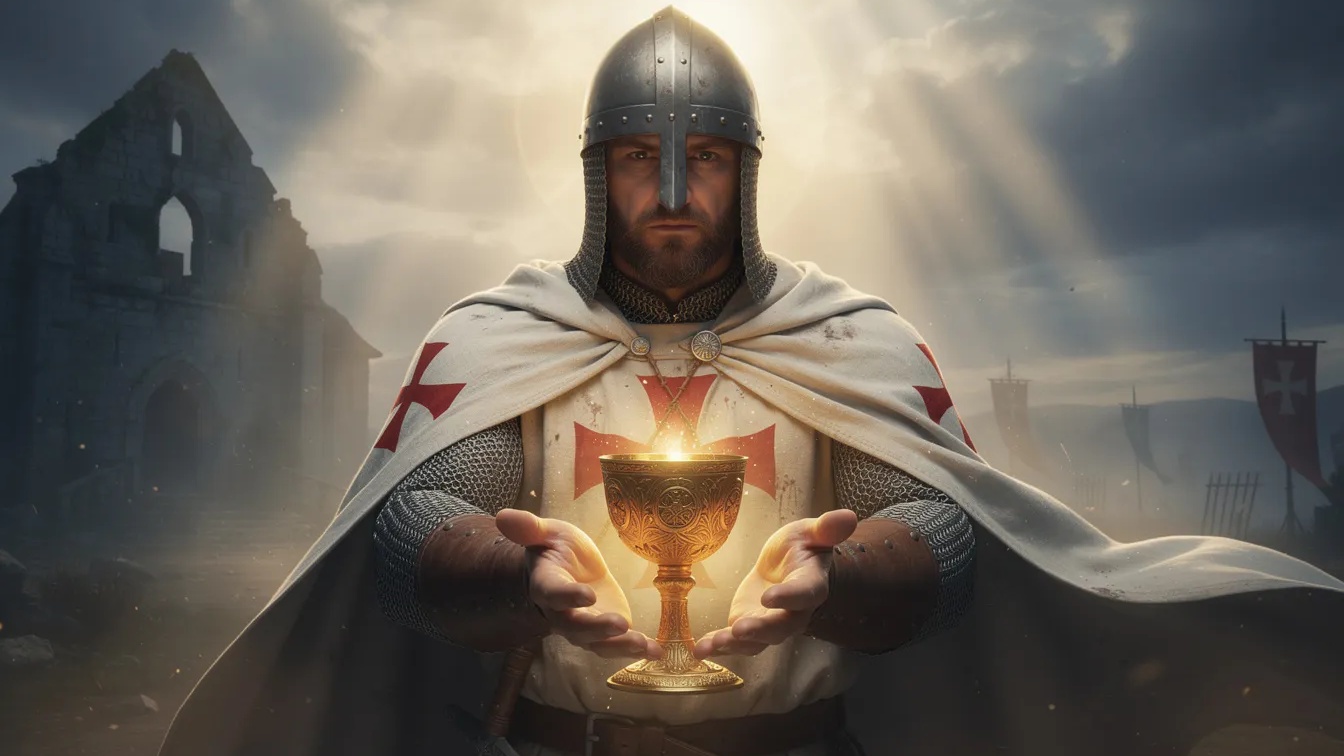
The Knights Templar are intimately linked to the Holy Grail. I went on a grail quest with Dr Alice Roberts in 2025/2026 for the Sky History mini-series Lost Grail with Alice Roberts (produced by 9 of Cups) to find out if the Holy Grail ever existed and whether the Templars were its guardians.

Two things may surprise you at the outset of our grail quest. One is that nobody is really sure what the Holy Grail is supposed to be. Is it a cup? Is it a plate? Is it a stone? Or is it, as Dan Brown would have you believe, the sacred bloodline of Jesus Christ?
The second surprise is that there’s zero evidence the Knights Templar ever possessed it and yet most people assume they did. So, let’s try and make sense of all this.
It all starts with Jesus…
We need to go back to the death of Jesus. Before being crucified, there was the Last Supper with Jesus and his disciples. The Messiah held a cup of wine signifying the sacrifice he was about to make – the blood of the new and everlasting covenant. In the Roman Catholic mass, this moment is relived in the sacrament of communion where the wine is believed to literally become the blood of Christ.
Then at the crucifixion, Jesus bled from the wounds on his wrists and feet as a result of being nailed to the cross. Plus a centurion called Longinus drove a spear into the side of Jesus to hasten his death. A wealthy Jewish man, Joseph of Arimathea, who is the great-uncle of Jesus, approached the bleeding wounds to collect some of the blood in the aforementioned cup.
All these story details, by the way, are a mix of the New Testament and later medieval legends.
The idea of the blood of Jesus being harvested while he was dying is pretty grim if you think about it. It’s illustrated in this Czech painting from the Middle Ages, which I saw in a gallery in Prague last year, where flying angels gather his blood from every wound. Of course this blood was potent stuff. It came from the son of God after all.

Joseph of Arimathea goes on his travels with the Holy Grail
Joseph arranged the burial of Jesus – who then resurrected and ascended to heaven. Having collected some of the blood of Jesus in the cup we now call the Holy Grail, Joseph headed west with a group of disciples and, in some traditions, Mary Magdalene. They were tasked with spreading the news that Christ has risen and they urged people to convert to the new religion.
In non-biblical accounts, Joseph went to Britain. There is a legend that Joseph had visited Britain before with the young Jesus, many years earlier. One village in Somerset, Priddy, claims the duo lived there. The story runs that Joseph was a merchant buying tin and lead from mines in south-west England. This isn’t totally far fetched as English tin was exported to the Roman Empire where it was needed to make large quantities of bronze, especially for weapons.
Now alone, with Jesus gone, Joseph brought the Holy Grail to a mystical place called Avalon – which we know today as Glastonbury. He sat down for a break at Wearyall Hill, planted his staff in the ground, and it sprouted into a bush – the Glastonbury Thorn. As for the Holy Grail, Joseph buried it nearby and the water gurgled up in a spring running red like blood. This red water can still be seen at the Chalice Well in Glastonbury, which sceptical scientists will tell you is due to the iron oxide content, not the presence of the Holy Grail.
Joseph founded the first Christian church in the world at Glastonbury which over the centuries became the wealthiest monastery in England until King Henry VIII shut it down during the 16th century Protestant Reformation. Cynics claimed that the story of Joseph being at Glastonbury and burying the Holy Gail was largely fabricated by greedy medieval monks drumming up business from credulous pilgrims. The monks also claimed to have found the bodies of King Arthur and Guinevere. Here I am standing in the ruins of Glastonbury Abbey.

The Celtic influence on the Holy Grail story
I mentioned that the monks at Glastonbury claimed to have discovered the body of the legendary King Arthur and his queen, Guinevere, in the abbey grounds. A plaque still marks the spot. Whether Arthur ever existed is still hotly disputed. Some think he was a Dark Ages warlord, others believe he was a late Roman general, but more likely, Arthur was meant to personify the perfect crusader king of the Middle Ages – even if he was a less than appealing figure.
The legend of King Arthur developed over a long period of time and in the earliest versions of the tale included magical Celtic influences that were decidedly un-Christian. This included the idea of a magical vessel containing a life-giving potion. Cauldrons were a part of everyday life for Celtic communities, as a cooking utensil, but also feature in fairy tales as items used in sorcery.
I think the analogy with a Stargate works well here – with cauldrons interpreted as a bridge between this world and the mystical realm of the gods. In Irish stories, a cauldron called the Coire Anseasc (cauldron of plenty) provided never ending meals. In Welsh myths, there was a cauldron that could restore slain warriors to life. So, was the Holy Grail a mini-cauldron, invested with magical powers?
Other Celtic influences included the Fisher King, a wounded figure who guarded the Holy Grail. He is comparable to the Welsh giant king, Bran the Blessed. The idea of a Grail castle, where the sacred artefact was kept, was again rooted in Celtic mythical imagery. Irish and Welsh stories also abound with ghostly ladies, as does the Arthurian romances. And then of course there is Merlin, based on the Welsh wizard, Myrddin Wyllt.

King Arthur and his knights become Christian warriors
For centuries, the Christian church in Europe expended a great deal of physical and mental effort stamping out the remaining fires of paganism. That meant toppling monuments, converting communities by force, and preaching against ancient superstitions. But sometimes, the church just incorporated old stories and beliefs, giving them a Christian veneer. Such was the case with the King Arthur and the Holy Grail.
Geoffrey of Monmouth was a Welsh monk writing in the period after the Norman conquest of England who sets down the first comprehensive account of King Arthur, most likely based on existing legends. The story is part of a history of Britain written around the year 1136. King Arthur is described alongside Merlin, Mordred, and Uther Pendragon. But there is no Holy Grail.
It’s a French poet, Chrétien de Troyes, writing in the 1180s, who introduces the Holy Grail in his version of the life of King Arthur: Perceval, the Story of the Grail. But Chrétien describes the Grail as a platter, a serving dish carried in procession at the Fisher King’s castle. It offers constant nourishment to all those present. Perceval, one of Arthur’s knights, witnesses this and it inspires him to go on a quest to heal the Fisher King of his ailments. But the quest is not specifically for the Holy Grail because Perceval knows where that it is already.
Chrétien’s work was unfinished. The German writer Wolfram von Eschenbach took up the story turning the Holy Grail into the Philosopher’s Stone – the ‘lapis exillis’ – in his book, Parzival (centuries later turned into an opera by Richard Wagner). The grail, according to Von Eschenbach, was a magical stone that fell from the crown of Lucifer when he was cast out of heaven, after rebelling against God. It is this version of the grail where contact guarantees immortality.
Like Chrétien’s grail, it is held in a castle but we now get the added detail of guardian knights called the ‘Templeise’. This was a clear reference to the Knights Templar. Both Chrétien and Von Eschenbach worked for crusader nobles and rubbed shoulders with the real Templars when writing their books in the late 12th and early 13th century.
However, their account of King Arthur was not overtly Christian in tone, emphasising chivalry, courtly love, and a rather mystical flavour. That was about to change dramatically. Another French writer, Robert de Boron, began a literary process of Christianising the King Arthur story. To do that, he established that the Holy Grail was the cup used both at the Last Supper and to collect Christ’s blood at the crucifixion. In a trilogy of books – Joseph d’Arimathie, Merlin, and Perceval – he told the story of Joseph of Arimathea bringing the Holy Grail to England and the knights of King Arthur being committed to find it. These knights sat at a Round Table constructed by Merlin for Arthur’s father – a new version of the Last Supper table.
Interestingly, De Boron gives Merlin a bigger role in the story. To most of us, Merlin is a sorcerer in the pagan, magical tradition. But De Boron transformed him into something akin to a Christian prophet. It was Merlin who foresaw that Arthur would become the new protector of the grail and so ensured that he was crowned king after pulling a magical sword from a stone.
Also, De Boron built on a story told by Geoffrey of Monmouth that Merlin was the son of a nun and an incubus-demon who came to her disguised as a handsome man. He was still a half-demon – a “cambion” – but was baptised, freed of Satan’s influence, and still able to prophesy and perform supernatural deeds.

From the Vulgate Cycle to Mallory
From about 1215 to 1235, we get what’s termed the ‘Vulgate Cycle’ of stories about King Arthur, very likely written by Cistercian monks. These different authors took elements from the early stories, where the emphasis was on courtly love, and mixed them with De Boron’s Christian slant. Finding the Holy Grail was now the top priority of Arthur’s Round Table of knights. Percival – a key character for Chrétien and Von Eschenbach – was downgraded to a bit player, replaced by Lancelot and his son, Galahad.
Galahad was pure of heart and fulfiled the grail quest. He was visited by the ghost of Joseph of Arimathea, after which he begged to die. Angels then transported his soul to heaven. In the 15th century, Sir Thomas Malory had the grail appearing to the knights though it could only be seen by the worthy. Galahad achieved the quest, taking the Holy Grail to heaven. But the grail had revealed the shortcomings of the knights and the fellowship of the Round Table fell apart, leading to the death of King Arthur.
Here I am on the Talking Templars podcast with Dr Steve Tibble discussing the Templar-Grail connection.
The Templar-Grail connection continues
Von Eschenbach opened a can of worms by linking the Knights Templar to the Holy Grail. In my 2025 book Downfall of the Templars: Guilty of Diabolic Magic? I describe how the Nazis in the 1930s sent a scholar of medieval history, Otto Rahn, on a futile quest to find the Holy Grail.
Nazis like Heinrich Himmler, head of the SS, and Rahn regarded Von Eschenbach’s Arthurian story as a coded guide to finding this most sacred relic. However, in the end, Rahn returned empty handed and died in rather suspicious circumstances in 1939. He related his weird theories about the Templars and Cathars being engaged in a war against the Roman Catholic church in his book, Crusade against the Grail.
From the 18th century, stories of the Knights Templar digging for sacred treasure under their headquarters on the Temple Mount in Jerusalem proliferated. The sources for these stories were a mixture of masonic historians and those promoting esoteric/conspiracy theory accounts of the Templars. Nothing in the contemporary medieval chronicles supported the idea of the Templars burrowing away, looking for the Holy Grail or the Ark of the Covenant or the head of John the Baptist, etc, etc.
The Templar-grail connection was turbo-charged in the 1980s with the publication of the bestseller, The Holy Blood and the Holy Grail, by Michael Baigent, Richard Leigh, and Henry Lincoln. I examine the claims made by this trio of authors in my 2025 book, Downfall of the Templars. They are largely based on a tissue of lies concocted by a group of French history enthusiasts in the 1950s and 1960s led by Pierre Plantard. Holy Blood/Holy Grail argues that the grail is the sang réal (royal bloodline) of Jesus Christ and that the Templars were formed by a secret society, the Priory of Sion, to protect that bloodline from the Roman Catholic church.
This idea was developed further, but as a work of fiction, by Dan Brown in his novel The Da Vinci Code. Astonishingly, the trio behind Holy Blood/Holy Grail then sued Brown over allegations he had copied their work. The legal action was unsuccessful and the judge’s statement is well worth downloading. Again, I cover all of this in my book, Downfall of the Templars. If you want the full picture on the Knights Templar and the Holy Grail, get my trilogy of books that cover every angle on this fascinating topic.

Thank you for the info Tony ! God Bless !
after visiting Tomar with my wife who is Portuguese everything made sense . Its so simple but so clever….
It’s a beautiful place – my favourite Templar destination!
I’ve just found out that the programme about Tomar will be broadcast in a series called “Buried” that starts broadcasting on the History Channel on 31 January 2018. So I suspect my episode in Tomar will be in mid-February as the series starts in Jerusalem and follows a journey across Europe ending in Portugal and Spain.