


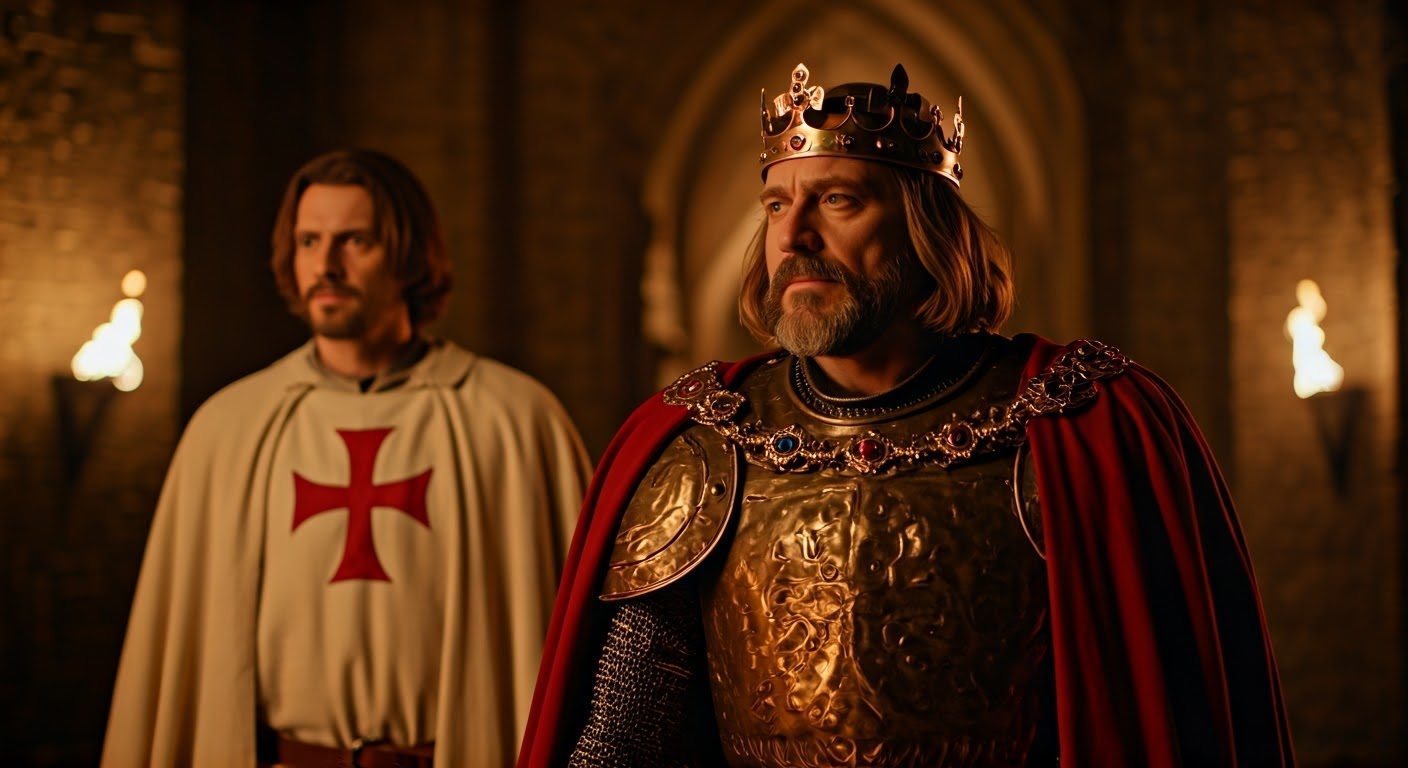
Was it all just about money? When historians examine the reasons for King Philip IV of France crushing the Knights Templar in 1307 – the usual reason given for his extreme action is money. He was fighting England and needed cash to fund his wars. But take a closer look at what actually happened and Philip’s motives become more complex. He may actually have believed the Templars were guilty of heresy, sorcery, and sodomy after all.
Philip-did-it-for-the-money theory
Let’s recap the usual view that Philip arrested the Templars en masse to seize their assets. The argument runs that the king had strained French finances in his bid to push the English out of his kingdom once and for all. He wanted to extend his control to the whole of what we now call France.
In the thirteenth and fourteenth centuries, the south west (Gascony) was still ruled by the King of England – though officially he was a vassal of France. While the south and east of France still had independently minded barons and areas under the control of the Holy Roman Empire. To beef up the French military, Philip had already shaken down the Jews, Lombard merchants, and the church – leading to an almighty bust up with Pope Boniface VIII. By 1307, it was the turn of the Templars.
Their fortress-like headquarters in Paris was hard to miss. There is a story that after devaluing the currency, the king fled to the security of the Paris Temple when his subjects rioted – faced with runaway inflation fuelling sky high prices. While the hated king skulked in the Templar HQ, he couldn’t help noticing the impressive amount of bullion stocked by the order. With the Crusades in the Holy Land all but lost, he wondered why the Templars were sitting on so much wealth, in his kingdom, that he needed badly. It was very unfair.
Something had to be done about it – hence the arrest warrants – years of torture, imprisonment, and executions – and eventual destruction of the Knights Templar. And it is true that in the aftermath of this traumatic episode, the state’s financial condition improved, suggesting that maybe his bloody strategy worked.
But was it just about the money?
Looked at through our 21st century, secular eyes – it seems impossible to take the charges against the Knights Templar seriously. The accusations of heresy and sodomy; the worship of a demon called Baphomet; the pornographic kisses at initiation rituals, etc, etc – were just cynical spin invented by Philip’s ministers – especially the wily Guillaume de Nogaret.
However – it comes as a surprise to discover that while pursuing the Knights Templar between 1307 and 1314, Philip was involved in other legal prosecutions – carrying the death sentence – that also involved accusations of heresy, sorcery, and sodomy. Which leaves the uncomfortable thought that Philip really believed this stuff. That doesn’t negate the financial motive but – as a wise person once said – reality is many sided.
A fraudulent bishop, a female preacher, and a dead pope
While the Templars were tortured and interrogated, the king demanded the arrest and trial of the Bishop of Troyes – accused of killing the queen, Joan of Navarre, through potions and a magical wax doll. Philip was grief stricken when his wife died, seemingly in childbirth. And it took little to convince the king that the bishop, who had been accused of fraud by the late queen, had consorted with a witch to murder the queen. This bizarre case tumbled on in parallel with the Templars – with an overlap of prosecutors – until Philip appeared to lose interest in the case.
Again, at the same time, Philip turned on the Beguines – an order of female lay preachers who lived in communal houses and up until this moment, had been widely respected. One leading Beguine, Marguerite Porete, was burned to death in the same month that 54 Templars met the same fate in 1310. Even by the standards of the time, Philip was adopting an extraordinarily zealous approach to heretics.
READ MORE: Smear campaign that led to the Templars’ downfall
And then there was his determination to prosecute Pope Boniface VIII as a heretic, diabolist, and sodomite. This was the pope who had tried to block Philip’s attempts to tax the church in France. The king had not forgiven his impudence, even though Boniface was now dead and resting in his tomb. Philip assembled a crack legal team to destroy Boniface’s reputation despite feeble protests from the current pope, Clement V.
A king who thought he was a pope
We have to add into the mix that Philip made it known to Pope Clement that within the kingdom of France, he regarded himself as the vicar of Christ. This was stated explicitly to the pope’s face by one of Philip’s ministers. Ironically, Boniface – while still alive – had canonised Philip’s grandfather, King Louis IX, as a saint, in a botched attempt to mollify the volatile French monarch. Instead, it convinced Philip that holy blood really did run in his veins. And why did he have to listen to some pope when he was the divinely chosen king of France?
Philip’s interventions in areas that would once have been the responsibility of the pope has been described as the ‘pontificalisation’ of the French monarchy. And when it came to the Templars, Philip increasingly wondered what an armed body of men were doing inside his kingdom, with enormous wealth, and accountable only to the pope. De Nogaret may have played on his boss’s paranoia with tales of heresy and sodomy – and the evidence certainly points to Philip readily believing in the dark arts, Satanic rituals, and witchcraft.
These themes and many others are explored in The Knights Templar: History & Mystery by Tony McMahon, published by Pen & Sword, available on Amazon, Waterstones, Barnes & Noble, and WHSmith.




One thought on “Why did King Philip of France crush the Templars?”