


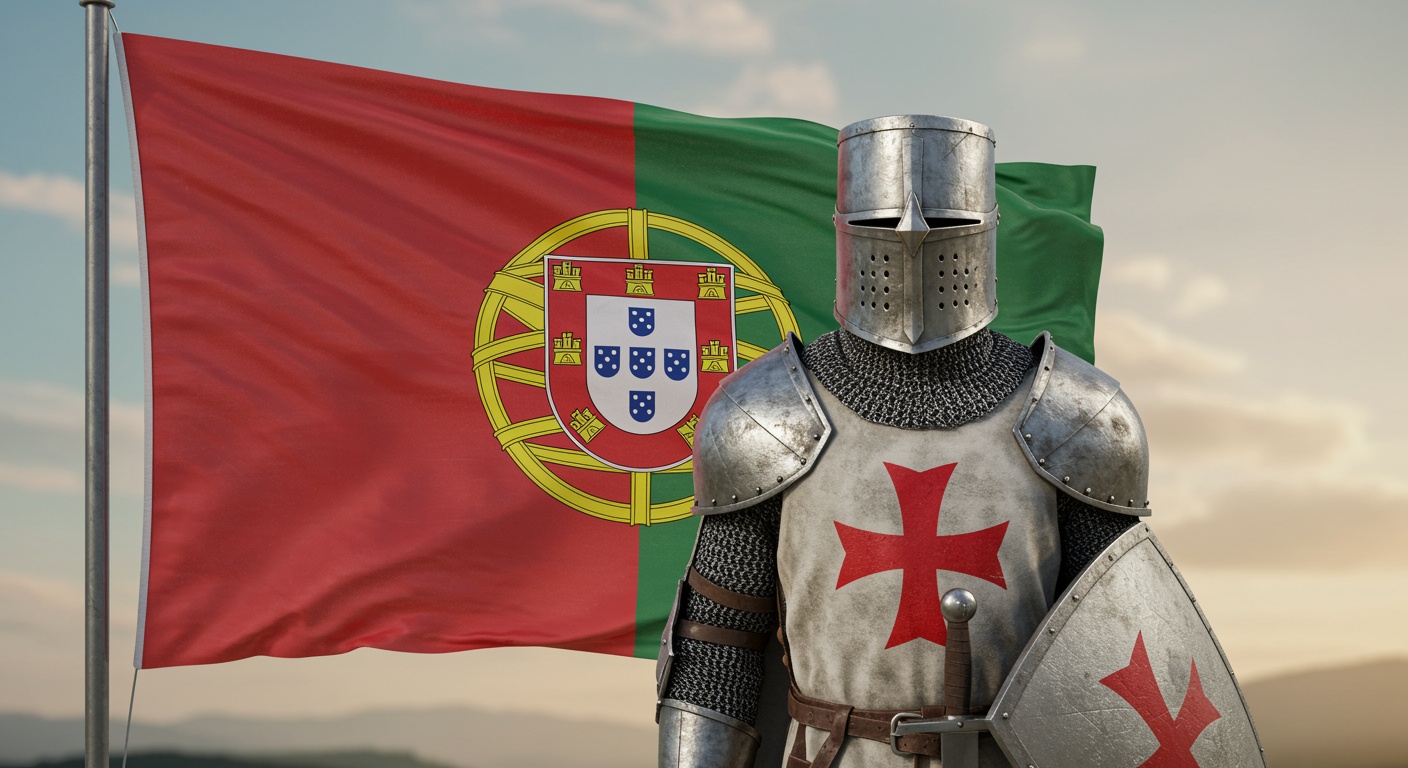
All over Europe, the Knights Templar were crushed by order of the Pope. But in Portugal, something very different happened. The Portuguese effectively nationalised the Templars. The state assumed total control and rebranded the knights as the Order of Christ.
Portugal nationalises the Templars
In 1320, the Knights Templar in Portugal were finally disbanded. But unlike other countries, the King of Portugal, Dinis, created a new order under his direct control into which the Templars were effectively subsumed. This organisation was called: The Order of Christ.
This was a totally different approach to other countries where Templar wealth and lands were gobbled up by the rival Knights Hospitaller, nobles or the church. Portugal went for a totally different strategy that many believe kept Templar ideals alive but under the guise of a new organisation.
The Templars become The Order of Christ
The Order of Christ (Ordem do Cristo) would have a long history in Portugal. And its formation kept Templar lands and wealth largely intact if under a new brand. King Dinis also averted the necessity of rounding up, torturing and executing Templar knights. Instead, there was just a quiet, well organised royal take over.
This allowed Dinis to feign compliance with the pope’s wishes while protecting Portugal’s interests. Dinis didn’t want to see Templar assets ending up with the transnational Hospitaller order. Nor did he want his nobles or local bishops to carve up the Templar estate. Instead, he would take direct control and in future, members of the royal family took leadership roles in the Order of Christ.
The debt of gratitude Portugal felt towards the Knights Templar
In the early 12th century, Portugal as an independent kingdom had struggled hard to come into being. The neighbouring Kingdom of Leon and the Galician nobility saw no reason to allow the Portuguese to determine their own destiny with their own monarch. They regarded Portugal as being just a county of Leon. Meanwhile to the south, there was still a mighty and very wealthy Muslim caliphate, which had once ruled all of Portugal but had now lost the northern and central regions to crusader control.
So, the first kings of Portugal valued the help of the Knights Templar as shock troops in their war with the Muslims to the south. Dom Afonso Henriques, the first Portuguese king, and his mother Teresa, gave the order castles and territory on the frontline with the caliphate.
A mysterious document called the Project of Donation gave the Templars even more land so that by 1130, they possessed a big chunk of Portugal. Though exact details of what the Templars owned is hazy because documents were lost during the reign of Dinis in the 14th century and when Templar archives were moved from Tomar in the 19th century.
Between 1128 and 1144, there is a gap in the history of the Portuguese Templars except for a string of wills and bequests as the rich continued to fill the knights’ coffers. These were years of turmoil for the new kingdom attacked by Leon and the Muslims. In 1144, the Templars re-emerge but not covered in glory. They were thrashed in battle by a Muslim general, Abu Zakaria (Alcaide or governor of Santarem), who attacked the Templar castle at Soure.
The Knights Templar and Catholic church fall out in Portugal
King Afonso was content initially to just keep the Muslims to the south at bay but after 1143, he decided to expel them entirely from southern Portugal. This meant taking the fight beyond the river Tagus – along which the Templars had established a string of fortified positions. Afonso took Santarem and then stormed what would become his capital at Lisbon.
But as Afonso took more Muslim domains, the Templars and the church clashed more frequently over who should own and control these new territories. The arguments became so heated that they were even referred to the pope. Increasingly, the kings of Portugal seem to have decided that the more they supported the Templars against the church, the more they could retain control over the new kingdom.
Astonishingly, the Templars were granted a third of the new lands south of the Tagus. There was still a very real threat from Muslim armies plus the Christian kingdoms of Leon and Castile to the east thought these newly acquired lands should belong to them. The Templars built castles that turned over time into fully fledged towns. So the Knights Templar effectively created many of the urban centres that still exist today.
Templars come increasingly under royal control
In the 13th century, the king of Portugal insisted that both the Templars and the Hospitallers should not come under a single master in charge of knights across Portugal, Leon and Castile. He asked the pope to ensure that both orders had a local Portuguese master with loyalty only to that kingdom. This is interesting because it suggests that the King of Portugal sometimes suspected the loyalty of Templar knights.
This trend towards bringing the knights under greater royal control started as early at the 12th century with Afonso’s insistence that rents collected by the Templars from Portuguese lands should not be shipped off to crusades in Palestine but used for the crusade against the Muslims in Portugal.
When the Templars were arrested across Europe, the Portuguese very noticeably dragged their feet. Something they also did when it came to persecuting the Jews. However, the church in Portugal had no such qualms. As the writing on the wall became clearer and the Templars faced certain doom, the bishops began attempts to seize Templar property.
How to protect the Knights Templar? Rebrand them as The Order of Christ!
Initially, the Portuguese king supported the Templars. Then seemed to turn against them. Then tried to stop the Hospitallers taking their wealth. Then played a very astute diplomatic game with the church right up to the pope. So, what was going on? In short, the king was making sure that Templar wealth in all its forms stayed intact so that he could create a new order – the Order of Christ – that would take it all over. And this order would be 100% loyal to him.
It took over the old Templar castles and continued the work of defending them from Muslim incursions and hostile Christians. And what happened to the Templars? There is evidence that some joined the Order of Christ including Portugal’s last grand master.
The death of pope Clement V, who had suppressed the Templars made it easier for the Portuguese to create a new order. Pope John XXII recognised the Order of Christ and it was eventually headquartered in Tomar – which had also been the Templar HQ.
Henry the Navigator – leader of the Order of Christ
A hundred years later, its Grand Master would be a son of the then Portuguese king. This man was Henry the Navigator who would instigate two hundred years of Portuguese ‘discoveries’ from Brazil to India and give birth to a vast maritime empire.
The cross of the Order of Christ would be emblazoned on the sails of the caravels that plied the seas from Goa to Salvador. It’s often been said that Portugal’s mastery of international trade and commerce in this period was in no small way due to the Templar spirit imbued within the Order of Christ.
By the middle of the sixteenth century, the revenues of the Order of Christ were huge. Four hundred and fifty commanderies oversaw annual revenues of a million and a half livres. The papacy often believed it had the right to appoint new members of the Order, a move resented by the Portuguese kings who insisted that the Order fell entirely under their control. Bizarrely, this dispute still rumbles on and on the Vatican website, the Holy See today indicates that it is reticent to appoint new members of the Order even though it would like to.
If you would like to know more about the Knights Templar, then get your hands on a copy of my book: The Knights Templar – History & Mystery. Published by Pen & Sword and available on Amazon, Waterstones, Barnes & Noble, and WHSmith. Don’t miss out on your copy!




One thought on “From the Knights Templar to the Order of Christ!”