

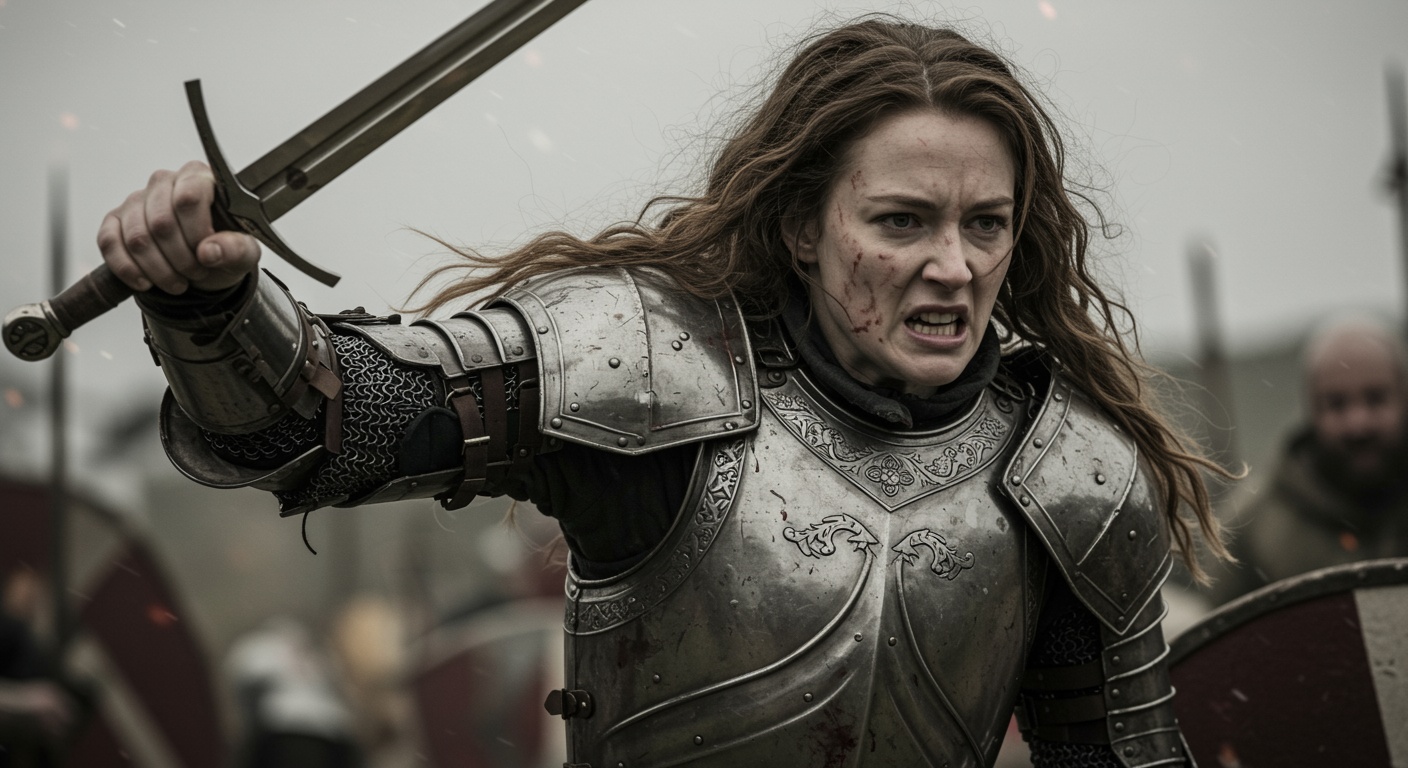
Women were not wilting wallflowers in the Middle Ages, avoiding military duty in favour of more genteel pursuits. When medieval battles needed to be fought, a woman could be seen wielding a dagger, a sword, or pouring boiling oil from the battlements on to the heads of menacing besiegers. And they had a particularly potent line in taunts as we will see!
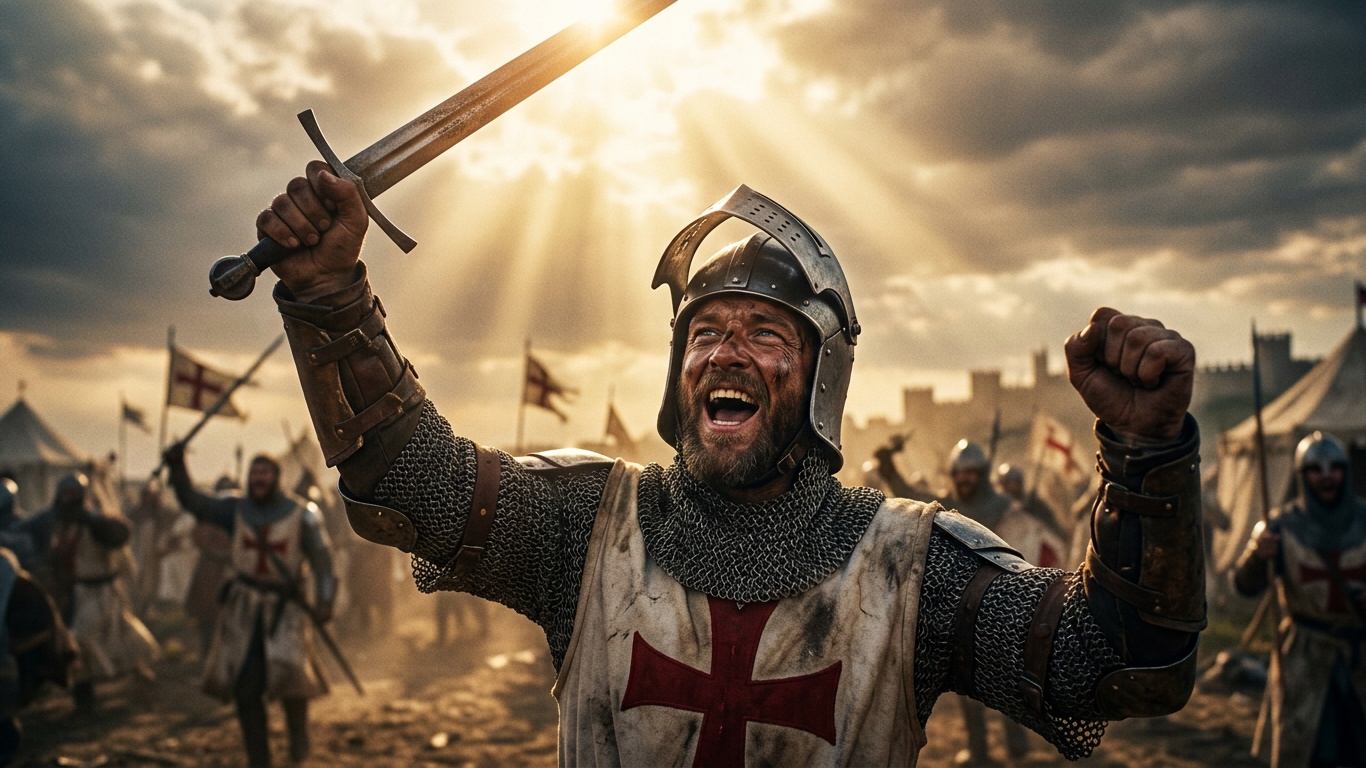
Quick note first on the Templars. It’s often stated as an absolute fact that women were banned from the Knights Templar. That’s not entirely true. Women were received as “sisters” in the order, though subject to a degree of separation similar to nuns in a convent. There’s also a telling reference to Templars being forbidden to act as godfathers – ‘and godmothers’ – to children. Wealthier women were funders of the Templars, in their role as ‘donatas’, and seemed to have behaved like groupies on occasion. But in battle, the Templars were an all-male affair.
That said, in the wider medieval world, when a city or castle was being besieged, women weren’t cowering in their homes doing needlework. They turned up on the frontline out of dire necessity. The allegorical scene below, from the 14th century Peterborough Psalter, depicts women violently defending the Castle of Love, so is not a literal depiction of a historical event. However, there is evidence that women did take to the ramparts alongside the men to halt invaders as will be evidenced further down.

Deu-la-Deu Martins – female Portuguese warrior
In the 1970s, my family had a beach house in northern Portugal near the medieval walled town of Monção – which looks out over the river Minho to neighbouring Spain. In the 14th century, this region of Spain was part of the kingdom of Castile and for several years, the King of Portugal, Ferdinand I, claimed the crown of Castile after the murder of its king, leading to the Fernandine Wars. In 1369, Monção found itself besieged by a large Castilian army and things were looking grim for the defenders.
That was until a local noblewoman, Deu-la-Deu Martins, came up with a cunning plan. Both sides, besiegers and besieged, were running out of bread. So she instructed the citizens of Monção to use what little flour was left to bake several loaves. She then paraded along the walls, throwing the bread down to the hungry Castilians below and yelled:
For you, who could not conquer us by force of arms and wanted us to surrender through hunger. Thank God, we are well provided for and seeing that you are hungry, we send you this help and we will give you more, if you ask!
Believing the city was well stocked with provisions, the army from Castile gave up and went home. From the day forward, Deu-la-Deu Martins became a national hero in Portugal. She had shown how women could play a decisive role in medieval battles.
Gwenllian ferch Gruffydd – Welsh warrior martyr
Between 1138 and 1153, the Norman rulers of England and Normandy were embroiled in a bloody civil war between Stephen of Blois, who had seized the English throne, and Empress Matilda, daughter of the previous king, Henry I. During this disruption, the Welsh sought to reclaim lands taken by the so-called Norman “Marcher Lords” – who guarded the border between England and Wales.
This military campaign met with considerable success and the slaughter of hundreds of Normans. Gwenllian’s husband was Gruffydd ap Rhys, prince of the southern Welsh realm of Deheubarth. Here’s a map to help explain how Wales was divided up during this period of independence, prior to being swallowed up by England.

Prince Gruffydd was in Gwynedd, to the north, seeking an alliance against the Normans – to take full advantage of their relative weakness as they tore themselves to pieces over the English succession. But unfortunately, while Gruffydd was away, the Normans launched a full-blown attack on Deheubarth. Gwenllian was forced to raise an army and retaliate quickly.
She focused her offensive on Kidwelly Castle, owned by the Norman Marcher Lord, Maurice de Londres. Sadly her army was routed and Gwenllian was captured along with her son, Maelgwyn. Another son, Morgan, had been killed during the action. Maurice displayed the characteristic Norman lack of mercy and had Gwenllian and Maelgwyn beheaded. Their heads would then have been displayed as an object lesson to all Welsh rebels.
Yet in death, Gwenllian became a potent figurehead for the Welsh. At the site of her execution, a spring magically gurgled out of the ground and the area was named Maes Gwenllian, or the Field of Gwenllian. Gwenllian is considered the only woman documented in medieval Wales to have directly commanded an army. Gwenllian’s story continues to be remembered in Kidwelly, with a school, a street, a community hall, and a hotel named after her.
Women in medieval battles – and at home
There are numerous examples of women donning armour through history – and I’m avoiding mention of Joan of Arc as she will feature elsewhere. Women did also perform more familiar roles that were critical for the success of a medieval army. They nursed the wounded (long before Florence Nightingale!), supplied food and clothing, carried supplies, and even provided emotional support.
And let’s not forget those women left back at home who had to run the family estate, while the husband was away, often dealing with hostile attempts to seize their estates. There is plenty of evidence that they were canny administrators with a keen nose for business. Medieval society was patriarchal but women were not without legal rights and through sheer force of character, protected family assets during wartime.
If you would like to know more about the Knights Templar, then get your hands on a copy of my book: The Knights Templar – History & Mystery. Published by Pen & Sword and available on Amazon, Waterstones, Barnes & Noble, and WHSmith. Don’t miss out on your copy!


Hello,
I often found this an interesting subject, especially in it’s relation to the Knights Templar.
If I recall the Latin Rule correctly, I don’t remember anything specific in them not being allowed to wash themselves, although they are described as *Men’s MEN!* by Bernard de Clairvoux, who seems eager to distinguish them as different from the more vain knight, who sets his hair and wears expensive clothes.
I am sure I’ve read that they were not to be punished if late for dinner or mass if they had just washed their hair.
Bathing in the medieval times was a society activity, which one did in groups and as these monks/knights were under such strict rules, such as not being allowed to kiss their own mother, I’m sure social bathing was not even considered an option.