


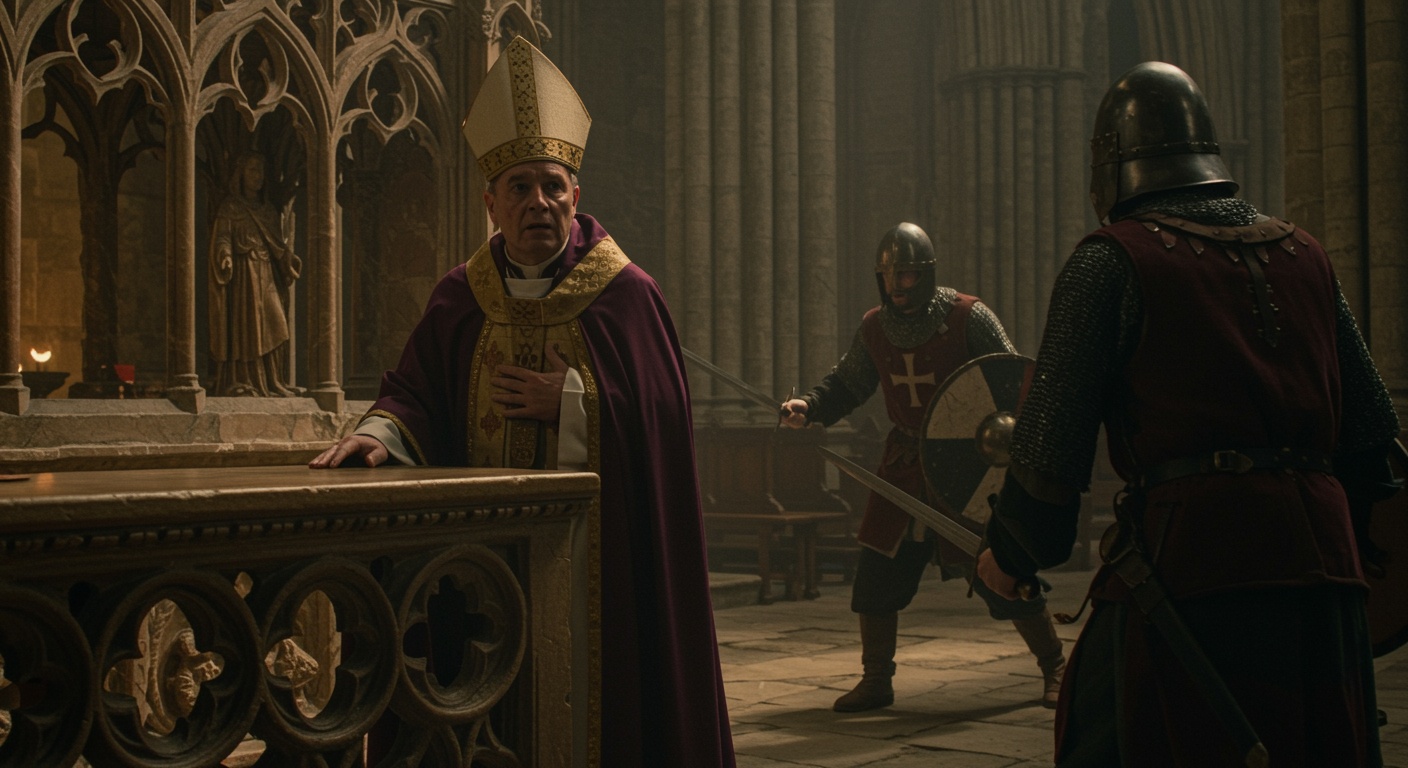
Just days after Christmas in the year 1170, an unthinkable event happened at Canterbury Cathedral. In front of the altar of this holy place, the archbishop was cut down by four knights. The murder was done with such ferocity that they sliced the top off his head. Thomas Becket – head of the church in England – slain in front of God. The whole Christian world was shocked.
Just over two years later, Pope Alexander III declared Thomas a saint. He was venerated as a martyr throughout Europe and pilgrims from many countries thronged continuously to his shrine. They prayed fervently for cures and hope. Even today in Canterbury Cathedral, you can see the worn down stone steps up which they trudged to see the exact spot where the archbishop was struck down.
It didn’t have to be like this. Becket’s career had started out full of promise. He was an ambitious and intelligent young man – likeable by all accounts – who was a second generation Norman immigrant to England. His parents, Gilbert and Matilda, had sailed across the English Channel to build a new life, essentially as migrants, after the Norman conquest of England in 1066.
Thomas and Henry – best of friends
Becket went to school at Merton Priory and was bright enough to earn a place at the University of Paris – the foremost centre of academic excellence in Europe. On his return, he got a plum job as a clerk to the then Archbishop of Canterbury, Theobald. His powerful employer recommended Thomas to King Henry II as the new Chancellor of England. At just 35 years of age, Thomas was propelled to the top of government.
Luckily for him, he got on very well with the king. They were two men who enjoyed hunting, gaming, and travelling around England. There was no signs of a saintly lifestyle. Becket threw raucous parties and decorated his residence very sumptuously. He was having the time of his life.
The king then hatched a cunning plan. When the position of archbishop of Canterbury fell vacant, Henry thought: why not get my good mate Thomas to fill both positions at once? That way, the king could exert control over both church and state. Like all medieval monarchs, he wanted all the resources in his realm, in his hands. Thomas obliged and was crowned archbishop in 1162. But then something very odd happened – Thomas took his new role seriously.
Thomas falls out with Henry
Firstly, he resigned his post as Chancellor without asking the king’s permission. Then he fled to France when the king ordered him to hand over all his private property. While he was away, as a calculated snub to Thomas, Henry had his eldest son crowned as a kind of junior king by the archbishop of York. Following this, Thomas was assured he could return to England with the king’s protection but rather unwisely, Thomas responded by excommunicating the archbishop of York for being so disloyal in his absence.
Thomas was back in Canterbury and possibly thought he was safe behind the cathedral walls. But the archbishop of York, and other bishops, made their way to Henry’s court and complained about their excommunication. Henry’s empire, by the way, spanned England and the greater part of what we now call France. He was in Normandy when the churchmen arrived to have a good moan. At this point, Henry is supposed to have exclaimed in anger: will nobody rid me of this turbulent priest?
Thomas is assassinated
Four knights took Henry at his word. They were Reginald FitzUrse, William de Tracy, Hugh de Morville and Richard le Bret. Packing their bags, and best swords, they made their way to Canterbury. When the knights arrived, they attempted to arrest Thomas in his palace but he scurried quickly to the cathedral where, one assumes, he believed the knights would respect this space. After all, churches and cathedrals had traditionally been places of sanctuary where the state’s writ did not run.
But the knights were no mood for the finer points of church law and custom. As they brought their swords down on Thomas, he clung to a pillar. The first blow sliced the crown off the top of his head “so that the blood turned white from the brain, and the brain equally red from the blood”. This account comes from a monk who was standing nearby – the appropriately named Edward Grim. He was injured in the fracas but lived to write down the account, which became a medieval bestseller.
I recently visited Canterbury Cathedral and is this is the exact spot where Thomas was slain.

The archbishop’s body was left on the floor of the cathedral for several hours. Several people timidly approached the dead Thomas and dipped bits of cloth in his blood. There seemed to be an instinctive awareness among the faithful that Thomas was bound for sainthood. Very soon, religious folk were claiming that prayers to Thomas were affecting cures. His tomb soon became a focus for pilgrimage.
The British Museum staged an excellent exhibition on Thomas Becket’s life and death that included contemporary artefacts illustrating how the killing of Thomas became an iconic visual. Here we see it on the side of a medieval font.

DISCOVER: Thomas Becket’s sister – the leper healer
Murderers forced to become Templars
The four knights responsible for the murder requested an audience with Pope Alexander III to show penitence. They got their wish but His Holiness wasn’t impressed. He ruled that they serve for 14 years in the Knights Templar in the Holy Land. After that, they were to return to Rome. Another account says the pope demanded they visit all the sacred places in Jerusalem barefoot, wearing hair shirts, and then live the rest of their lives at a monastery on Black Mountain, near Antioch.
All four reportedly died in Jerusalem and were buried in front of the Templar headquarters on the Temple Mount. However, other accounts disagree with this story. Whatever the truth, the knights faded into well deserved obscurity.
Thomas falls foul of another Henry
In 1220, fifty years after his death, the body of Thomas was moved to a golden casket covered in jewels behind the high altar. For the next three hundred years, this was one of the major pilgrim attractions in Europe. It was immortalised in The Canterbury Tales, written by Geoffrey Chaucer between 1387 and 1400. In this fictional collection of stories, we meet a disparate group of pilgrims who tell some rather raunchy stories as they ride towards Canterbury.
But all good things come to an end. And three hundred years later, another King Henry of England smashed the shrine of Thomas Becket to pieces. Henry VIII had proclaimed himself head of the church in England, ending the supremacy of the pope. To him, the memory of Thomas was a political embarrassment. After all, the truculent archbishop had questioned the authority of King Henry II in his own realm.
That king’s descendant – Henry VIII – decided the cult around him had to end. The tomb was dismantled, the ashes scattered, and it’s claimed that Henry had a ruby from the tomb mounted on a ring, which he wore on his finger – no doubt glancing wistfully at it. As I found on a recent visit to Canterbury Cathedral, there is no sign of the tomb today – just a lone, mournful candle.

If you would like to know more about the Knights Templar, then get your hands on a copy of my book: The Knights Templar – History & Mystery. Published by Pen & Sword and available on Amazon, Waterstones, Barnes & Noble, and WHSmith. Don’t miss out on your copy!



The Kings Knights – were they Templar Knights, or just protectors of the King. Very important to explain the difference.