

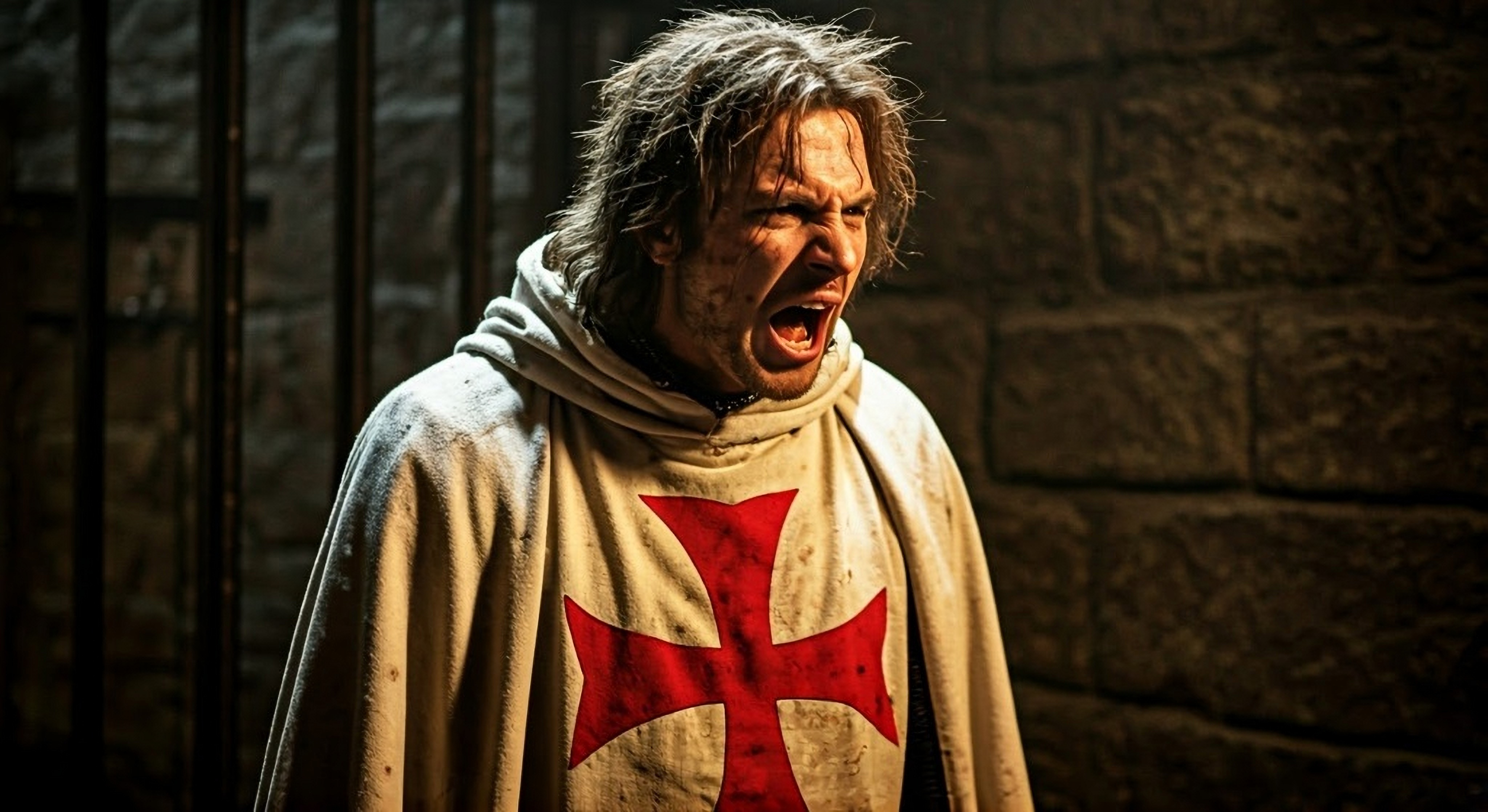
When the Knights Templar were arrested in 1307 across France, torture was soon used to extract confessions rapidly. So, how were people tortured during the medieval period. It wasn’t as common as you might imagine, but these sadistic methods were used increasingly in the late Middle Ages. The emergence of the Inquisition, the growing witch hunting mania, and concerns over heresy drove this nasty trend.
In the year 1252, Pope Innocent IV issued a ‘bull’ – a legal document – outlining the church’s new stance on torture. It was needed to “root up from the midst of Christian people the weed of heretical wickedness, which infests the healthy plants”. He commended the great work of the Dominican order of friars who were busy eliminating “heretical wickedness” across Italy – specifically in Lombardy, Marchia Tervisina and Riviera di Romagnola. The Dominicans – also known as the ‘black friars’ – played a leading role in the inquisition.
FIND OUT MORE: Top ten heresies against the Roman Catholic church
The church already had the power to excommunicate people and put entire kingdoms under an “interdict” – which meant that mass could not be said and a whole population was unable to receive holy communion. But this was clearly not enough. Heretics in the community needed to be identified and then seized with all their possessions taken. Anybody defending them, no matter how high their rank, were to be treated in the same way as the heretic. This snuffed out all opposition to the activities of the inquisition as a climate of fear prevailed.
The local ruler was to authorise the use of torture immediately “provided he does so without killing them or breaking their arms or legs”. The aim was to discover “whether the heretics celebrate rites in secret gatherings, or scoff at the common life of the faithful, and their customs”. Anybody could give evidence against a heretic – including convicted criminals…and other heretics! The word of the condemned carried no weight in legal proceedings. Once denounced, a heretic was assumed to be guilty with no presumption of innocence. They were expected to admit their guilt and then name others.
Officially, heretics were to be tortured only once – though further sessions were explained away as a continuation of the first torture session. A bit of semantics no doubt lost on the prisoner. It was essential that torture did not result in death, childbirth, or mutilation. It’s hard to see how mutilation could have been avoided, given the methods used. The fact that childbirth is mentioned suggests that pregnant women were submitted to torture.
The ghoulish methods of torture used have been recorded. The Strappado involved tying the prisoner’s arms behind their back and then pulling them up using a rope and pulley. Weights were sometimes attached to the ankles. Once the unfortunate person was suspended above the ground, the shoulders would dislocate.
The Donkey was a long triangular piece of wood with a sharp angle pointing upwards. The prisoner was then forced to sit or lie on it with weights applied to the hands and feet. A more targeted version of this torture was the Judas Chair where a triangular block of wood was fixed to the seat of the chair. The victim was then sat on the point of the triangle damaging the anus, scrotum, or vagina.
There were other forms of torture directed at the anus and genitals – such as the Pear of Anguish and Crocodile Shears – that are too revolting to describe here.
The Rack is probably the best known form of torture where the prisoner was stretched to breaking point. Within a long frame – like a bed frame – were several rolling pillars. Ropes were tied to the prisoner’s wrists and ankles and pulled in opposite directions. Dislocation, snapped ligaments, and finally broken bones were the inevitable result as tension was slowly applied. Those racked were often permanently disabled.
The Knights Templar were subjected to torture after their arrest in 1307. One of the most notorious incidents was a knight who had animal fat applied to his feet, which were then set on fire. When he appeared before a legal hearing, he produced his own toe bones from his pocket to complain about his treatment in prison!
If you would like to know more about the Knights Templar, then get your hands on a copy of my book: The Knights Templar – History & Mystery. Published by Pen & Sword and available on Amazon, Waterstones, Barnes & Noble, and WHSmith. Don’t miss out on your copy!




Reblogged this on The 9th Templar Story and commented:
I love it… another Knights Templar mystery to make them even more infamous…. enjoy!
Another great Templar conspiracy story
Fascinating! I will have to read the Davinci code! I’ve seen the movie but no comparison I know!