

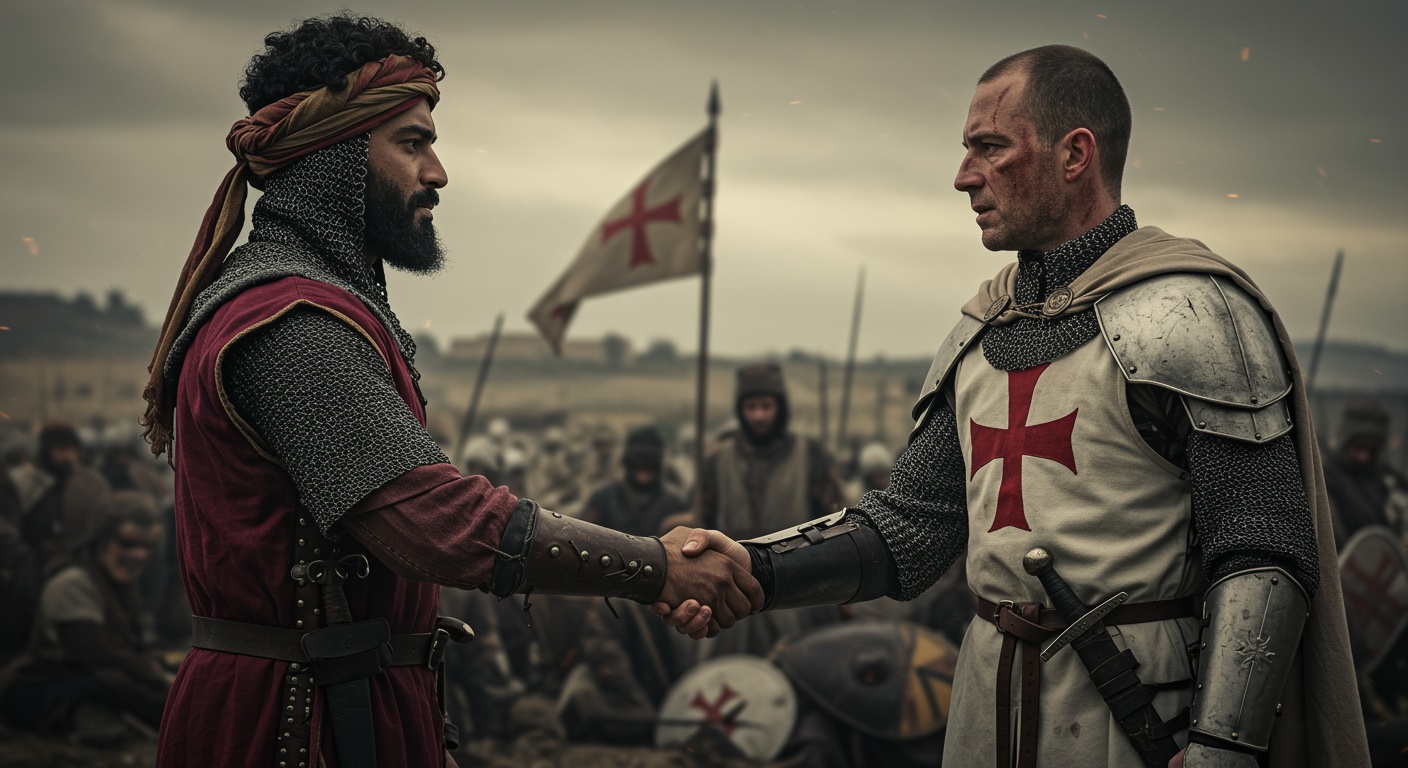
During the Crusades, Muslims and Christians were both friends and enemies. It was a complex relationship. In most parts of Europe and the Middle East, they lived in close proximity. Forget today’s religious divisions, because you might be surprised where Muslims and Christians could be found in the same neighbourhoods.
Let’s look at the demographics
Let’s go back to the year 1100. This is when the First Crusade got underway. And the religious breakdown of some of the key countries is not what you expect:
- Egypt: In the early medieval period, the percentage of the Egyptian population that was Christian was possibly as high as 25%. Up until the 7th century CE, Egypt was almost entirely Christian. Then the forces of Islam invaded, seizing it from the Byzantine Empire. The number of Christians reduced as a punitive tax, the ‘jizya’, was levied on them. Many poor ‘Coptic’ Christians simply converted to Islam to lighten the financial burden.
- Syria: Despite Syria falling to Muslim control in the 7th century CE, Christians were still a majority in Syria and Palestine up until the 12th century – though there was a steady shift towards Islam. The cathedral in Aleppo only became a mosque in the year 1124. Even by 1350, 10% of the population was still Christian – 100,000 out of a million inhabitants.
- Byzantine Empire: Within the Byzantine Empire, which covered much of modern Turkey, the Balkans, and Greece, Christianity was by far the dominant religion – though this was the eastern orthodox faith and not Roman Catholicism.
- Spain and Portugal: The Iberian Peninsula presents a very interesting picture in the Middle Ages. Invaded by Muslim armies in 711 CE, the majority of the population remained Christian for the first hundred years. But then in the 9th and 10th centuries, there was a steady process of Islamisation and Arabisation in Muslim-controlled Al-Andalus – most of central and southern Spain and Portugal. This was reversed from the 1100s onwards as the northern Christian kingdoms of Aragon, Castile, and Leon pushed south, retaking territory from the Muslims.
- Sicily: This island at the tip of Italy was essentially a land of three faiths and languages. It had been ruled by the Greek-speaking, eastern orthodox Byzantine Empire, then the Islamic caliphate, and then the Normans. So, the west of the island was majority Muslim while the east was majority eastern Christian with a smaller group of Roman Catholics.
Christian heroes turn out to be mercenary sell-swords
So, get rid of the idea of a Christian “west” fighting a Muslim “east” in the Crusades. The battle lines between the faiths stretched from the Algarve on the Atlantic coast to Damascus in the Levant. Christian kings and Muslim emirs could be found in what is now Spain, Portugal, Italy, Israel, Jordan, Lebanon, etc. And there were warriors who cheerfully sold their services to either side of the religious divide.
For example, the Spanish medieval soldier Rodrigo Díaz de Vivar – better known as El Cid – is held up as an exemplar of Christian sword-wielding piety. The reality is that he fought for both Muslim and Christian rulers. He served under the Christian King Sancho II of Castile and later under King Alfonso VI. However, he was then exiled and served the Muslim ruler of Zaragoza, leading a combined Christian and Muslim army.
El Cid was not alone in working for both Muslim and Christian paymasters. In the early 13th century, two sons of the Christian king of Castile, Ferdinand III, rebelled against their father and then, after failing to topple him, defected to the Muslim ruler of Tunis, Sultan Muhammad I Al-Mustansir.
In the same century, in Portugal, the son of King Sancho I – Peter, Count of Urgell – became a mercenary in the service of Yusuf I, the Almohad caliph. The Almohads were a revivalist Muslim movement, creating an empire that dominated north Africa and the southern half of the Iberian Peninsula.
These men were happy to enrich themselves working for either Christians or Muslims.
Sicily – melting pot of Christians and Muslims
Last year, I was in Sicily. I’d never been before. But years ago at an exhibition on Sicily at the British Museum I was struck by how that part of Italy was a multi-cultural melting pot at the time of the Knights Templar. So much so that when the king issued a proclamation, it was inscribed in Latin, Greek and Arabic.
But boy, was I in for an even bigger surprise when I got to the Sicilian capital of Palermo. I walked into the medieval jewel that is the Palatine Chapel of Roger II, the Norman monarch of Sicily. It is a total mash up of Byzantine, Norman and Arabic styles. The pictures below will show you exactly what I mean. The ceiling of the church is pure Fatimid era Arabic. There are even references to the Koran – in a Catholic church. But this was because the craftsmen were….Muslim Sicilians.
The mosaics wouldn’t have been out of place in Constantinople. Why? More than likely the artists had studied under Byzantine teachers or even worked in the capital of the Byzantine empire – or were brought over by Roger from that great city.
And then we have the Norman arches and shape of the chapel. An early Gothic construction that could be anywhere in Europe at that time – if you ignore the aforementioned Byzantine mosaics and Arab ceiling.
Why this odd mix of styles? Well, Sicily had been part of the Greek world in ancient times. Even under Roman rule, it retained its Greek identity. And ironically, the Roman empire – in its Byzantine guise – became increasingly Greek in language and culture. So, Sicily basically never ceased to be Greek at heart.
DISCOVER: Five Templar hotspots to visit
Then along came the Muslim invasion of the 9th century and Sicily was transformed into an emirate. Conversion and invasion increased the Islamic presence on the island. Until the Normans landed. These European Christian invaders originated in Scandinavia and then established a foothold in northern France – in what we now call Normandy. The word “Norman” is a corruption of North Man.
The Normans were in expansion mode in the 11th century and at the same time that they conquered England – they also took southern Italy off the Byzantines and Muslims. And so we end up in Sicily with this strange hybrid of Greek culture, Islam and the Normans. Yet it seemed to work for a while. Below are images of the Palatine Chapel’s Byzantine mosaics and Arab roof – a really eclectic mix!


Spain and Portugal – Muslim, Christian and Jewish
What we now call Spain and Portugal was divided in two halves for most of the Middle Ages. The south was an Islamic caliphate ruled by quarrelsome emirs. The north was a patchwork of Christian kingdoms like Leon, Castile, Navarre, Aragon and Portugal.
Bit by bit these Christian kingdoms edged the caliphate back but it took a full seven hundred years for the whole peninsula to revert to being ruled by Christians. And by then, the influence of both Islam and Judaism was hard to ignore. Not just the architecture but language, customs and behaviour.
DISCOVER: Medieval chroniclers who hated the Knights Templar
We think of the Spanish Inquisition imposing a single religion – Catholicism – on the whole peninsula. But actually for the greater part of the medieval period, there was a complex interaction between Muslims, Jews and Christians. And they weren’t solid, unchangeable blocks of people. Because there were conversions – enforced, voluntary and opportunistic. Plus waves of immigrants from as far away as Yemen – who came to live in one of the wealthiest parts of the Muslim world.
And the stories of three individuals illustrate to me how charismatic and bright people could very literally bounce between the Islamic and Christian halves of the Iberian peninsula. One moment serving Christ and the next Allah. And they changed sides like you might change a shirt!
Muslim serving Christian and Christian serving Muslim
Below is a curious tomb I found last year in the Portuguese city of Coimbra – in a medieval cloister. This chap was the first Christian governor of the city of Coimbra after it was conquered from Muslim control. His name was Sisnando Davides and his life story is completely typical of the mixed up biographies of people at that time.

He is often desribed as a “Mozarab” – that is a Christian living under Muslim rule who adopted their dress and customs. However, at his tomb in Coimbra he is described as having been Jewish. And his name indicates that to me. What is certain is that he grew up in the Islamic city of Cordoba in southern Spain. But at some point he went into the service of the northern Spanish Christian kingdom of Leon and began fighting those he had lived amongst.
And he was very effective. So much so that when Coimbra was taken, the king of Leon let him govern it and the surrounding area. It’s not surprising that Sisnado Davides knew the legendary El Cid – a contemporary. Because both of them had very comparable lives.
Davides and El Cid show through their lives how easy it was for people to drift from the caliphate to the Christian kingdoms and in the case of El Cid, backwards and forwards until both sides got heartily sick of him. It didn’t seem to matter whether their paymaster was Christian or Muslim – just so long as they got paid.
Another example of this would be the Portuguese adventurer Geraldo “Sem Pavor” (without fear). He lived and fought in the 12th century. His party trick in battle was severing the heads of Muslim enemies with wild abandon – men, women and children. So much so that the emblem of the city of Evora in Portugal, which he took from the Moors, has two severed Moorish heads on it! See below if you think I’m kidding…

Now – with that record of brutality, you’d think he could never skip over from the Christian to the Muslim side. And they would never accept this war criminal. But hey – that’s exactly what happened. Geraldo fell out in some style with the Christian side in Iberia and defected over to the Muslim caliphate. His reward was a governorship in Morocco.
Though, he then decided he’d made a mistake and hatched a plot with the Christian king of Portugal to invade Morocco. This crazy scheme was intercepted and Geraldo was put to death by his very irate Muslim bosses.
From Constantinople to Istanbul – from Christian to Muslim rulers
And if ever there was a fluid boundary between Islam and Christianity – it had to be the Byzantine Empire. In the first century of Islam, armies stormed out of Arabia and took the entire Levant off the Byzantines. That is modern Lebanon, Jordan, Israel, Syria and a big chunk of Turkey. They also invaded Egypt and all of north Africa, which had been under Roman rule since Cleopatra was playing with her asp.
The Byzantine empire – which was really the remnants of the Eastern Roman empire but with a heavy Greek influence – lasted for a thousand years up to 1453. During that time, it was reduced at one point to the area around the capital Constantinople before surging forward and retaking much of its lost territory. Watching the empire’s boundaries is rather like gazing at the tides – in and out they went.
And the enemies of the Byzantines were Christians to the west and Muslims to the east. But it was the Muslim forces – the Ottoman Turks to be precise – that would eventually be their undoing.
I adore Istanbul and have been there three times in the last eighteen months. The Hagia Sofia is always top of my list to visit. Built in the sixth century AD by a Christian Byzantine emperor – Justinian – it was a church up until 1453. Then it was converted into a mosque for nearly five hundred years after the Ottomans overthrew the Byzantines. For the last eighty years, it’s been a museum though there are ongoing attempts to turn it back into a mosque. Here I am pictured below in the Hagia Sofia in February 2020.

The relationship between the Byzantines and their Muslim foes was very complex. At the very end, faced with the choice of accepting help from the Pope with massive strings attached or taking on their Muslim enemies, one Byzantine commented ruefully:
Better the sultan’s turban than the papal tiara!



The problem is actually relatively simple: the world has become too crowded. Yes, Christianity and Islam have been rubbing shoulders (sometimes sorely) for centuries. But their adherents, along with practitioners of Judaism, keep forgetting that they all worship the same deity. They call Him (or Her) by different names. But it’s the same Supreme Being. They have many other things in common, such as honoring one’s parents; respecting our neighbors; and understanding that murder is a sin. But our contemporaries also boast a sense of paranoia; a sense that the world is out to get them. So they often resort to brutal tactics to establish not so much their authority, but their rightful place in society. In that respect, nothing has changed from the medieval Knights Templar and present-day extremists.
Regardless, I have little faith that any of them will learn to cohabit peacefully in the near future. There’s too much historical animosity. I was raised Roman Catholic, but I abandoned that years ago. I’m purely spiritual now and I find myself at greater peace.
Article très intéressant, Tony. Je souhaite une intense participation des lecteurs. Il faut poser la question car il y a trop de groupes néo-templiers qui ignorent l’histoire de l’ordre du Temple et se cantonnent dans un anti-islamisme primaire. Me permets tu de publier cet article en Français sur la page Facebook « Les Nouveaux Templiers », si j’arrive à en faire une traduction que je te demanderais évidemment d’approuver ?
J’en profite pour souligner ton excellent travail pour faire connaître les Templiers.
Salutations fraternelles,
Guy Lavoie , magister humilis, Les Nouveaux Templiers 450, rue Sherbrooke Est, suite 1407 Montréal, QC, CANADA H2L 1J8 514-229-2094
Date: Mon, 28 Dec 2015 14:00:28 +0000 To: templiers.montreal@hotmail.fr