

Scotland was once home to the Knights Templar. Very early on in their history, the first grand master, Hugh de Payens, went north of the border with England to meet King David the First who showered gifts on the order. Many think that when they were crushed in the year 1307, some fled to Scotland – knowing they would be well received.
In recent years, I’ve appeared on several TV documentary series asked to discuss whether the Knights Templar got to Scotland with the Holy Grail. The idea being that they fled France in 1307 with their treasure, escaping the arrest warrants put out by King Philip and sailed up to Scotland. There, they were protected by local nobility and possibly sailed on to the New World.
I’m tackling this story in great depth in a trilogy of books on the Templars I’m writing for the publishers, Pen & Sword. The first volume is already out in hardback so get your copy to discover the history of the Knights Templar. I look at their presence in Scotland, how important they were, and whether they really fled north when they were arrested and imprisoned in France.
The Knights Templar had two key bases in Scotland. One was their main commandery at Balantrodoch, which is now called Temple in Midlothian. The other base of operation was at Maryculter in Aberdeenshire. There was once a Templar property at Turriff town hall, on land granted to the Knights Templar in the mid-twelfth century – and there is a forest nearby known as Temple Brae.
In an edition of my YouTube series, Templar Knight TV, I cover my travels to Rosslyn chapel, the ruins of Kilwinning Abbey and Abercorn church. These three places have been linked to the Templars but that link is disputed. However, I explain the connection in my video below.
I also spent time in the Scottish capital Edinburgh and visited the medieval cathedral of Saint Giles. That cathedral was once run by the Order of Saint Lazarus. They fought alongside the Templars in the Holy Land and had a special responsibility for the care of lepers.
DISCOVER: Mysterious bodies at Rosslyn are not Knights Templar
Rosslyn chapel and the Knights Templar in Scotland
The most famous Scottish connection to the Knights Templar is Rosslyn chapel – even though it’s also a disputed link. How did this story arise? It’s something I’ll be covering in a forthcoming book, Downfall of the Templars, the second volume in my Templar trilogy. In a nutshell – the Templars were arrested in France in 1307 by order of King Philip IV and Pope Clement V. Some believe that a group of knights escaped with the order’s treasure and headed for Scotland. Why? Because the Scottish king, Robert the Bruce, had been excommunicated by the pope. So – any enemy of the pope was a friend of the Templars.
It’s even been suggested that the Scottish victory against the English at Bannockburn in June 1314 was because a band of Templars stormed on to the battlefield, scattering the invaders. It certainly would have surprised the English given that the last Templar grand master, Jacques de Molay, had been burned at the stake in Paris just two months before.
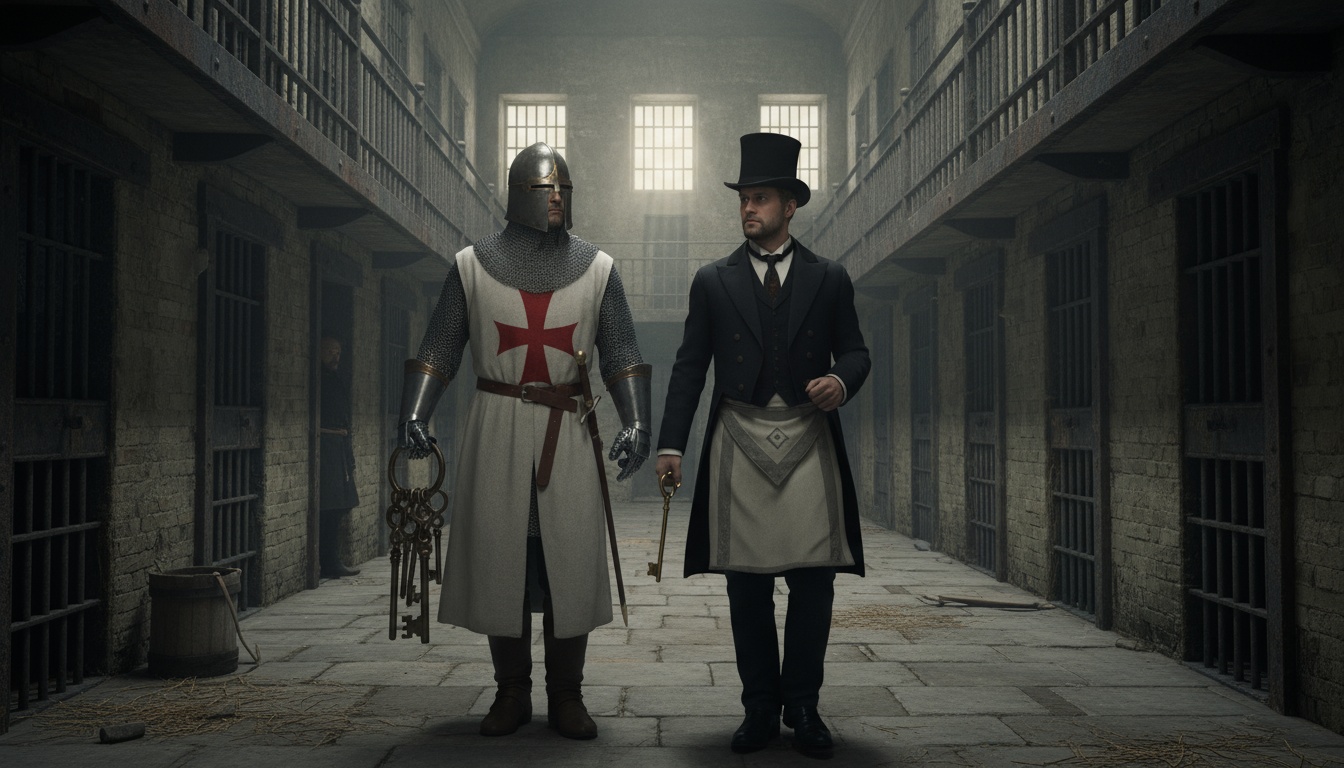
Without divulging the entire content of my books, the Templars were said to have been sheltered and protected by Scottish stone masons – especially at Kilwinning. According to Masonic accounts, this resulted in a kind of blending between the Templar knights and the stone masons that created the Freemasons. Hence Kilwinning boasts the ‘mother lodge’ of global Freemasonry.
The Dan Brown novel, The Da Vinci Code, revived an old story that the Templars forged a very close relationship with the Viking-Scottish St Clair family – also spelt Sinclair. A hundred years after the suppression of the Templars, they built Rosslyn chapel. Some argue that the curious carvings in the chapel indicate that the Templars, together with Lord Sinclair, got to the New World a century before Christopher Columbus. Unable to survive in the old world – they crossed the Atlantic and reached the New World.
At their trials in France – which went on for five years between 1307 and 1312 – Templars who had been imprisoned and tortured made all kinds of lurid confessions. One knight, Jean de Châlons, told the judges that the order had been tipped off about the arrests in advance and loaded their treasure on to eighteen galley ships, which set sail from the French port of La Rochelle. In the 18th century, it was alleged that some of these ships had headed for Scotland.
This has led to a hypothesis that Rosslyn was built specifically to conceal Templar holy relics. So, there is a theory that the Holy Grail is under the nave – or even the head of Jesus or John the Baptist. And even the Ark of the Covenant is hidden away at Rosslyn. If you find it on your next visit – don’t open the lid. You know what happens next!
If you would like to know more about the Knights Templar, then get your hands on a copy of my book: The Knights Templar – History & Mystery. Published by Pen & Sword and available on Amazon, Waterstones, Barnes & Noble, and WHSmith. Don’t miss out on your copy!



2 thoughts on “Scotland, the Knights Templar and the Holy Grail”