

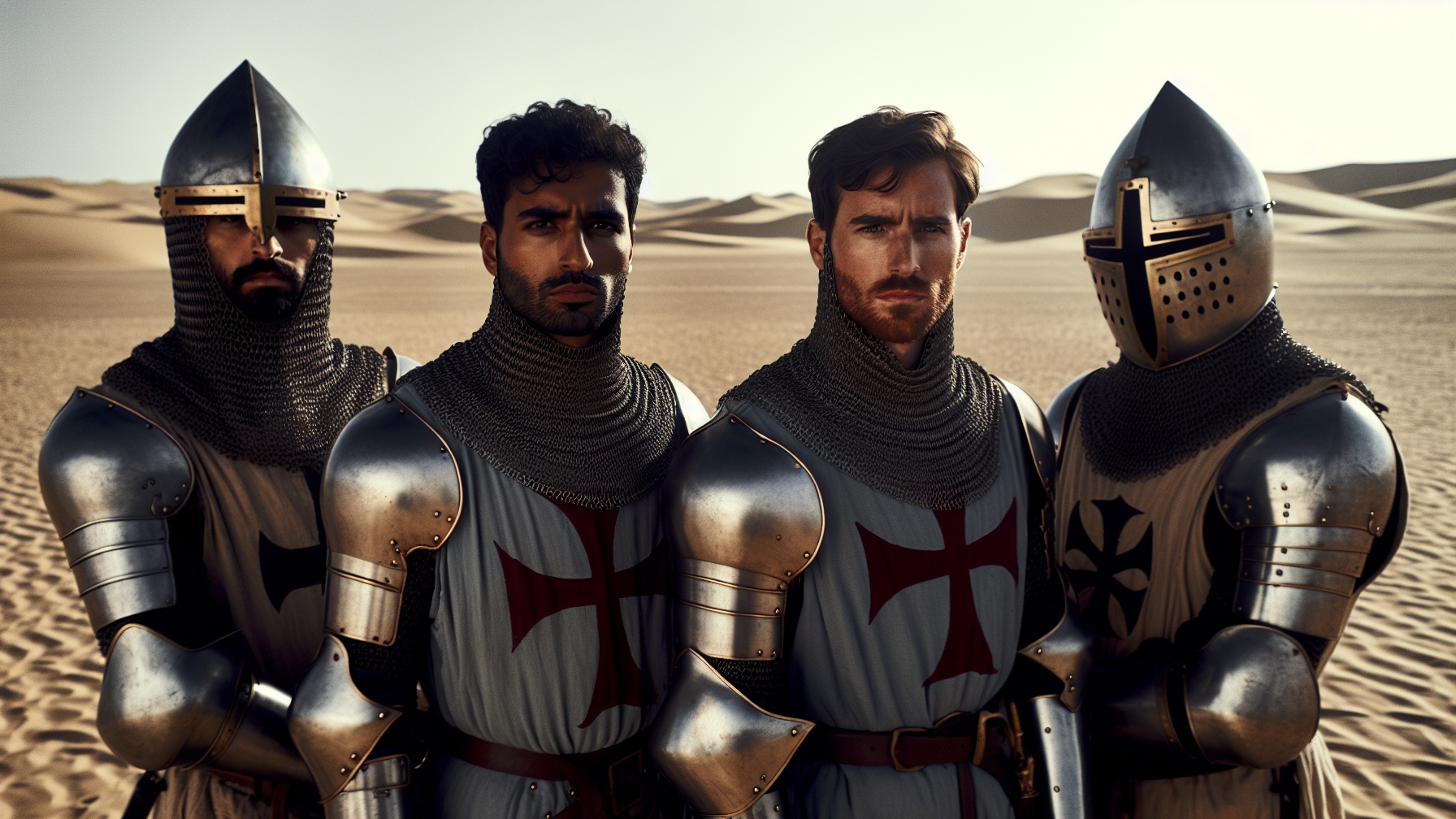
In the year 1095, Pope Urban II called for a new kind of Christian holy war against Muslim armies, mainly in Asia Minor and the Levant. With his stirring sermon at Clermont, the crusades were born. But should we blame Christians alone for the crusades? Some historians think not.
Blatant money grab?
A familiar take on the crusades is that this was a blatant money and land grab by uncouth westerners into overwhelmingly Muslim lands that led to an orgy of bloodshed. The Christians were very much the aggressors and the Muslims the victims. This is usually combined with a narrative that Catholic Europe was incredibly backward compared to cities of north Africa and the Middle East.
Without getting drawn into unpleasant rows about ‘woke’, this is more about questioning some of the assumptions to get a more balanced view. Otherwise, we’re just telling fairy stories about goodies and baddies. And that infantilises both sides in the crusades.
DISCOVER: The Twelve Days of Christmas explained
Crusades – the blame does not lie with Christians?
Taking a long view of the history of the Middle East – what would become the main theatres of combat – modern Egypt, Syria, Lebanon, Israel, Palestine, Jordan – were Christian up until the 7th century CE. There were different forms of Christianity – from Monophysites to Nestorians – but they all believed in the resurrected Christ.
Fast forward one hundred years and a new religion – Islam – had thundered out of the Arabian desert and overwhelmed the region, destroying the Sasanian Empire (centred on Iran and Iraq), and nearly snuffing out the Byzantine Empire, with its capital in modern Istanbul – capital of Turkey. But the forces of Islam did not stop there.
In the year 711CE, they jumped across the Straits of Gibraltar and into the Iberian Peninsula, invading modern Spain and Portugal. Then these armies pressed on into France and Italy. In the 9th and 10th centuries, they menaced the Papal States and even ransacked the old St Peter’s Basilica, built under the Roman emperor, Constantine.
The Franks (in modern France) managed to halt the advance of Muslim armies there while the Byzantines eventually recovered their strength and in the 10th century sought to reclaim lost territory in the Levant including part of Syria. However, a new threat emerged when the Arabian Muslim armies were pushed aside by a new wave of Islamic converts from central Asia: the Seljuk Turks.
It was their counterattack into the Byzantine Empire that resulted in the emperor in Constantinople sending a desperate plea for help to the west (though some believe that letter was forged). That in turn led to Urban’s rousing speech at Clermont in 1095.
Christians start to fight back
But even before that, Italian military forces had sacked a town on the north African coast in 1034 and began the reconquest of Sicily, which was under the rule of a Muslim emir. While in Spain and Portugal, Christians in the north had begun to slowly push back the Muslim ‘Moors’ and by the time the crusades were in full flow, they were retaking cities like Toledo and Seville. Though the demographic and religious profile of southern Spain and Portugal had changed a great deal by then with a large domestic Muslim population.
But it was the Byzantines who were in big trouble at the hands of the Seljuks. While the tide was turning favourably for Christians in the Iberian Peninsula, France and Italy – it was going in the other direction in Asia Minor. In 1071, the Byzantine emperor was captured by the Seljuks after a devastating defeat at Manikert. This sent alarm bells ringing across Europe.
Very soon, Seljuk forces were parked right outside the walls of Constantinople. Worse, they had seized the nearby city of Nicaea where a church council had framed the Nicene Creed in the year 325CE – a prayer recited in Christian churches still today.
The argument then, from those who say the blame for the crusades do not rest solely with Christians, is that Christians had been on the backfoot for three centuries before Pope Urban opened his mouth. I’d be curious to know what you think.
If you would like to find out more about the Templars then to read my latest book: The Knights Templar – History & Mystery – published by Pen & Sword – and now available on Amazon, WHSmith, Waterstones, and Barnes & Noble.