

The Turin Shroud is a Catholic passion relic allegedly depicting the dead body of Jesus. Believers claim it’s a two thousand year old shroud on which the body of Jesus was miraculously imprinted. But some argue a more bizarre view – that the shroud image is that of the last Templar grand master: Jacques de Molay.
READ MORE: Knight Templar links to the Cathars
What is the Turin Shroud?
The so-called Turin Shroud is claimed to be the burial shroud of Jesus Christ, cast aside when he resurrected. It is one of the Passion Relics – holy items associated with the crucifixion and resurrection of Jesus. It measures about fourteen feet long and has the imprint of both the front and back of a dead man who appears to have been crucified.
His facial features – including beard and long hair – fit our familiar image of Jesus. It’s claimed that the stains on the cloth match the wounds inflicted on the Messiah after being nailed to the crucifix and speared in the side. The shroud image looks like a photographic negative and has an undeniably unsettling impact on those who see it.
The Templar connection to the Turin Shroud
The first person to exhibit the shroud was a French noble, Geoffroi de Charney, who in the 1350s donated the sacred item to the church in Lirey, which was part of his domains as lord of Lirey, Savoisy, and Montfort. For thirty years, the shroud was shown to a growing stream of pilgrims with claims it had once wrapped the dead body of Christ. But as early as 1389, a local bishop was complaining bitterly to the pope that the shroud was a painted forgery.
In 1314, another Geoffroi de Charney was burned at the stake alongside the last Templar grand master: Jacques de Molay. This De Charney had been a senior official in the Templar order who paid the ultimate price for his loyalty. For those wanting to prove that the shroud was once in the possession of the Templars, they need to prove a familial connection between the Geoffroi de Charney burned with De Molay in 1314 and the Geoffroi de Charney who displayed the shroud decades later. But there’s simply no strong genealogical evidence to support this.
Could the Turin Shroud be the image of a Templar?
If it’s difficult to prove that the shroud was owned by the Templar Geoffroi de Charney – there is another way to forge a Templar connection. Claim that the image on the Turin Shroud is not Jesus Christ but that of Jacques de Molay. But hang on? Wasn’t De Molay burned to a crisp in front of Notre Dame cathedral in 1314? How could he have left an image on a burial shroud?
Robert Lomas and Christopher Knight explain in their book The Second Messiah: Templars, the Turin Shroud and the Great Secret of Freemasonry that while in jail, De Molay was subjected to a horrific mock crucifixion. This involved being nailed to a wooden door, in a contorted position, and that door was then repeatedly opened and shut to cause De Molay appalling pain. At the point of death, he was taken down and then wrapped in a suffocating shroud as a mockery of Christ’s burial.
The extreme heat and perspiration De Molay experienced was enough to leave an imprint through something called the Volckringer Effect. When a body is under extreme stress, such as torture, lactic acid is released from muscle tissue. This causes an unstable reaction that forces oxygen atoms apart, giving off pinpricks of atomic energy.
The heat, sweat, acids, and oxygen-free radicals scorch the cloth, creating an image that’s similar to a photographic negative. In this way, an image of the very much alive De Molay was left on the shroud. Later, he was dragged out of prison to be burned at the stake.
If you would like to know more about Templar mysteries like this – then get a copy of The Knights Templar – History & Mystery – published by Pen & Sword – available on Amazon, WHSmith, Waterstones, Barnes & Noble, and other online bookstores.

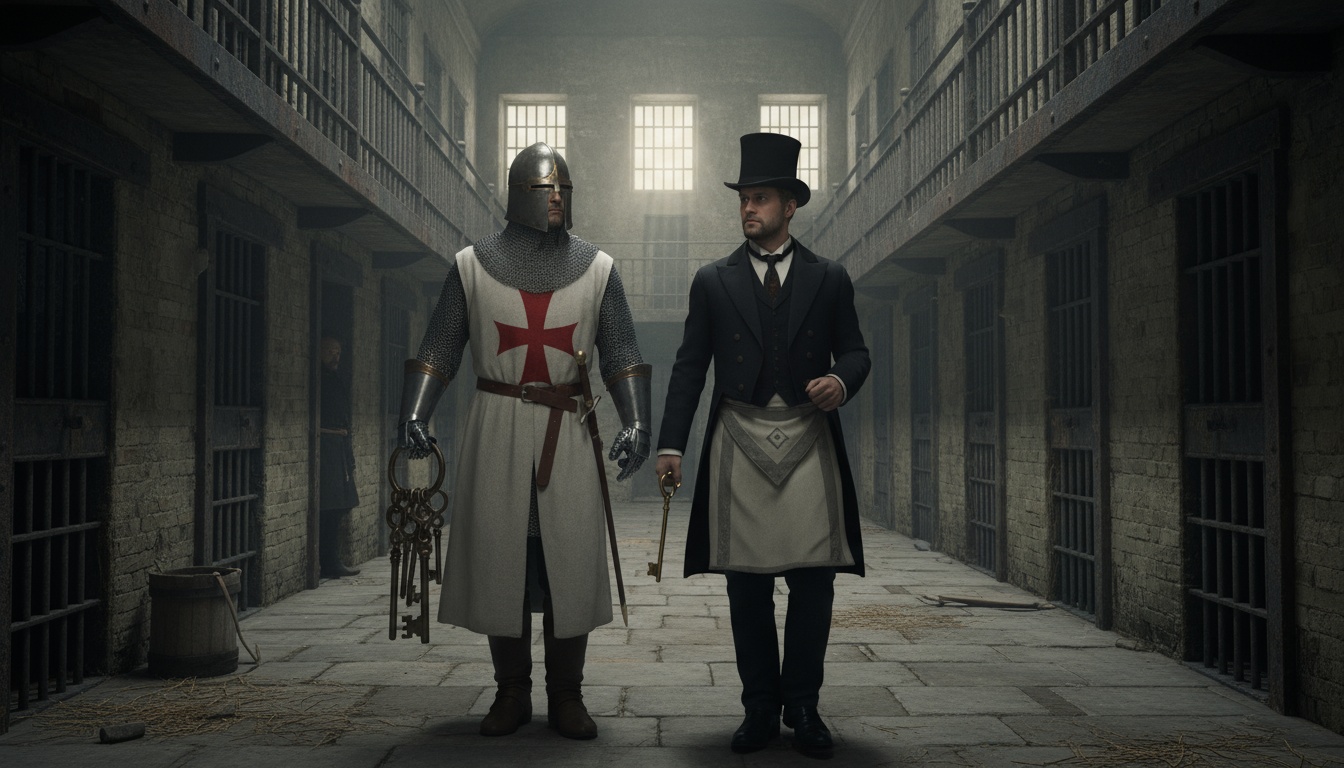


After the Templars were rounded up, de Molay was tortured into a confession by mocking the death of Jesus – a crown of thorns and he was crucified – but not until death. He was then taken from the cross after confessing and laid down, supposedly covered in the shroud – the blood filled with lactic acid and his sweat from torture stained the cloth and reacted with the frankincense used to whiten fabric at the time, causing the image. Following torture he was taken by de Chancy to recover (who’s family is the first known owners of the shroud). He was burnt at the stake many years later after retracting his earlier confession. This is the theory from the book ‘The Hiram Key’ – it’s a very good read!