

If you wanted to control a region in the medieval period, then you had to take over key castles or walled towns. This meant surrounding them and deploying siege weapons. And in the Middle Ages – there was quite a range of weapons to choose from.
Battering ram: A heavy log carried by multiple people to break down walls or fortifications. A battering ram siege refers to a military tactic where an attacking force uses a battering ram, a heavy wooden beam with a metal tip, to repeatedly strike and break down the gates or walls of a fortified position during a siege, essentially battering the structure until it gives way and allows access to the enemy territory; it’s a classic method of breaching defences in ancient and medieval warfare.
Siege tower: A tower-shaped structure that protected attackers and ladders. A siege tower is a tall, wooden tower on wheels used to attack castles and fortifications. Often rectangular with four wheels, sometimes higher than the wall to allow archers to shoot from the top, and covered with iron or fresh animal skins to protect from fire.
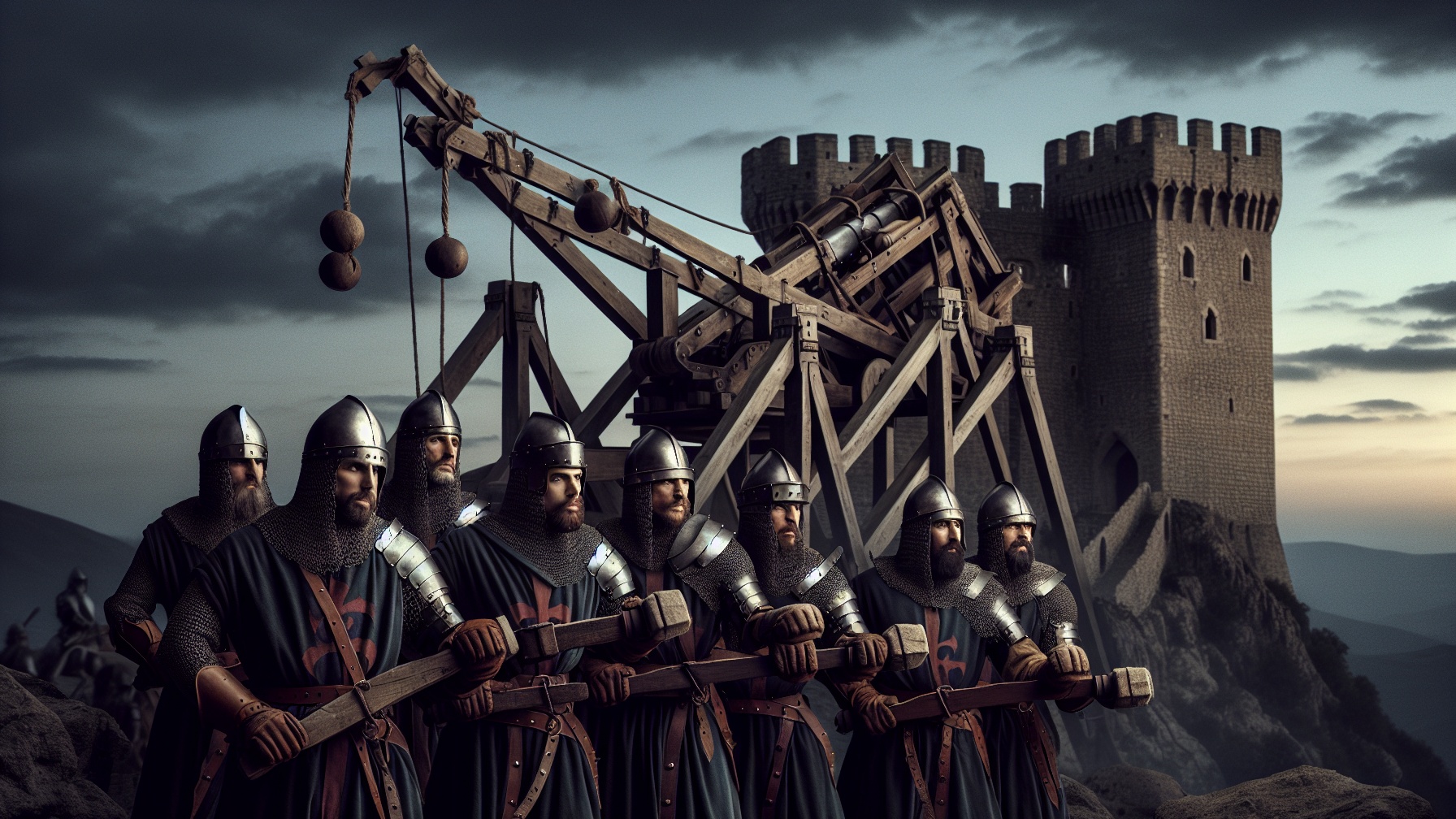
Trebuchet: A trebuchet is a military machine that uses a sling to launch projectiles at targets. It was a common siege engine in medieval Europe, used to destroy castle walls. A trebuchet uses a counterweight to create force that launches the projectile. The counterweight is a heavy object that is raised and then dropped. The sling is attached to the tip of a rotating arm. The trebuchet’s design allows it to launch heavier projectiles and further than a traditional catapult.
Ballista: A siege weapon that launched large bolts at targets in the distance. It was a combination of a crossbow and a catapult. The ballista had two wooden arms that were connected to ropes. When the arms were pulled back, the ropes twisted around a wench, building tension. When the arms were released, the ropes unwound and launched the object.
Mangonel: A siege weapon similar to a catapult, used to throw projectiles at castle walls. The mangonel was operated by pulling on ropes attached to a lever. The larger the machine, the larger the stones it could hurl. The mangonel was also known as the traction trebuchet. The counterweight trebuchet replaced the mangonel as the primary siege weapon in the 12th and 13th centuries.
Warwolf: A siege engine used by the English during the Scottish Wars of Independence. The Warwolf was a medieval siege engine, or catapult, used to throw stones and other missiles at castles. It was built by order of King Edward I of England in 1304 to break the siege of Stirling Castle in Scotland. The Warwolf was possibly the largest trebuchet ever built. The Warwolf was built by five master carpenters and 50 workmen and was estimated to have measured as much as 90 m (295 ft) in height with its arm fully extended.
Springald: A mechanical artillery device used for throwing large bolts. It was also known as an espringal or skein-bow. The springald used twisted silk or sinew to power two bow-arms. In Western Europe, springalds became popular in the 12th and early 13th centuries. Rectangular springalds on wheels were used to besiege fortifications while mounted springalds were used to defend castles.
Greek Fire: Greek fire was a secret incendiary weapon used by the Byzantine Empire in naval warfare from the 7th to 14th centuries. It was a highly flammable liquid that could be sprayed or thrown in grenade-like containers. Byzantine ships were equipped with pressurised nozzles to spray Greek fire onto enemy ships. The exact recipe for Greek fire was a closely-guarded state secret. Historians have speculated that it was based on petroleum, resins, sulfur, or quicklime. Among the medieval siege weapons – this was the most terrifying.
Sapper: It was very common to dig under the walls of an enemy castle and the brave people who did this were called sappers. A medieval sapper was a soldier who dug trenches, or ‘saps’, to approach enemy fortifications. The term ‘sapper’ comes from the French word sappe, which means ‘spadework’ or ‘trench’. So while the invading army attempted to advance at ground level – the sappers were burrowing away unseen below ground. They built shelters to protect themselves while they worked and set fires in the trenches to weaken the walls. It was incredibly dangerous work.
Other medieval siege weapons you could have expected to see during a battle would have included:
- Ladders
- Siege hooks
- Flaming barrels of tar
- Containers of hot liquids
- Piles of dung
- Dead and diseased animals
- Dead people
All of this either catapulted over the walls by the besiegers or thrown from the walls by the defenders. The medieval siege was a decidedly messy business.
If you want to know more about the Templars and their medieval siege weapons – get a copy of this book: The Knights Templar – History & Mystery – by Tony McMahon – published by Pen & Sword – available on Amazon, Barnes & Noble, Waterstones, WHSmith, etc.