


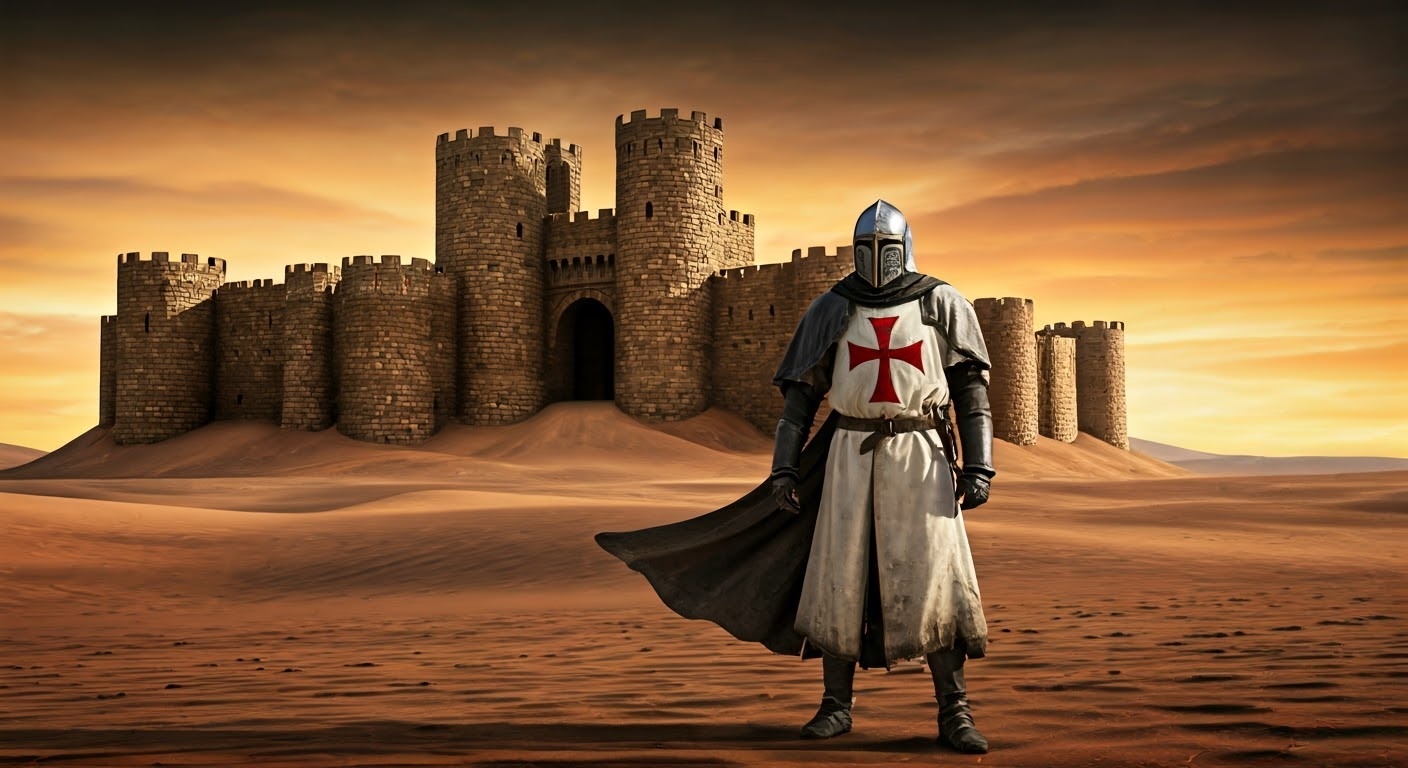
The Knights Templar had a big presence in Syria – at the heart of the Levant – and the crusader kingdoms that formed what was called ‘Outremer’. Evidence of the Templar presence in Syria can still be seen. Some of their key battles and events happened in that country.
Let’s have a look at some key Templar sites in Syria:
- Tartus/Tortosa – served as a fortified base and Templar headquarters from the 1150s to 1188, and held until 1291. The Cathedral of Our Lady of Tortosa is still located there. The Citadel of Tartus was one of the most important fortresses in the County of Tripoli.
- Chastel Blanc/Safita – A medieval structure built by the Knights Templar during the Crusades, located on the middle hill of Safita’s three hills. It offered a commanding view of the surrounding countryside, including the Templar strongholds at Tartus and Ruad Island.
- Arwad Island/Ruad – Occupied by the Templars in 1300-1302, serving as a last major battleground before their expulsion from the Holy Land. The Templars attempted to launch a counter-strike against the Mamluks on the mainland from the island, but failed.
- Areimeh Castle – Built to protect the crusader route to Tortosa from attack. Areimeh was built before 1149 and after 1177 entrusted to the Templars based in Tartus.
- Trapessac Castle was built by the Templars to protect the so-called Syrian Gates – a key passage between the coastal kingdom of Cicilia and inland Syria. It fell to Saladin in 1188. In 2023, it was badly damaged by an earthquake.
- La Roche-Guillaume – another Templar fortress located at the Syrian Gates. After losing it, the Templars reclaimed the castle in 1237 and retained it until 1298 or 1299, making it one of the last bastions of Templar control on the mainland of the Middle East.
Massive and decisive battles were played out in Syria between the Knights Templar and the Saracens. These great clashes happened in a land where many civilisations have flourished and fought. From the Babylonians to the Assyrians, the Hittites and the ancient Greeks.
DISCOVER: Knight Templar battle tactics
Syria – from ancient Rome to the Knights Templar
It was one of the richest provinces of the Roman Empire and if you were going to be a governor, Syria was a plum though often troubled posting. Antioch was the key city – or mega-city by the standards of the time with a six figure population. Not only was it a centre of great learning but also the seat of powerful Christian patriarchs who rivalled Rome, Constantinople and Alexandria for influence over the early church.
However, like most of the Levant – Syria fell under Islamic control in the seventh century AD. The eastern Romans, or Byzantines as we call them, were pushed out. Not forever though. So integral did the eastern Romans feel that Syria was to their world that they pushed hard to take it back and in the 10th and 11th centuries, Byzantine rule was re-established over cities like Antioch and Tarsus. But the onslaught of the Seljuk Turks saw that undone and Syria once more became part of the caliphate.
But its challenged ownership and history explain why modern Syria is such a patchwork of religious beliefs and tribal loyalties. The Assad regime currently in control has always argued that its strong arm tactics are required to keep order among all these groups – like a dictatorial ringmaster. Clearly this argument is not holding water anymore as ordinary Syrians demand that curious fruit called democracy.
Templar Syria – a jewel of medieval Europe
The Knights Templar knew Syria well and its seaboard fell under the control of different crusader kingdoms during the 11th century. The Principality of Antioch, the County of Edessa, the County of Tripoli and the Kingdom of Jerusalem all impinged on modern Syria. The inland areas including Damascus remained under Seljuk control though there were repeated attempts to take Damascus by the crusaders.
Indeed, many speculate whether the Knights Templar and crusaders should have taken Damascus before Jerusalem to secure their control of the region. If they had done, the history of the crusades and the modern Middle East might have been dramatically different.
Templar forts in Syria include one on the island of Arwad. This was something of a staging post for crusaders between the mainland and Cyprus. By the 1290s with the loss of Jerusalem and the Saracens closing in, the pope gave control of Arward to the Templars to defend to the last man. That’s pretty much what they ended up doing.
FIND OUT MORE: Did most people think the Knights Templar were guilty?
An alliance with the Mongols didn’t save them as their allies failed to show up on time whereas the Seljuk Turks landed and overran the fort. A promise of safe conduct to the surviving Knights Templar was broken and many died in Cairo prisons – refusing to convert to Islam for their freedom.
Modern Tartus in Syria was known as Tortosa to the Knights Templar who ran the town from the 1150s as a fortified base. The cathedral of Our Lady of Tortosa is still there and other antiquities that the French government has been generous in funding to restore. For all the Templar efforts though, Tortosa fell to Saladin in 1188.
DISCOVER: Did the Knights Templar get to America?
A diminished number of Knights Templar did manage to hold on in their castle there for another hundred years but the game was essentially up for the order in Syria.
If you would like to know more about the Knights Templar, then get your hands on a copy of my book: The Knights Templar – History & Mystery. Published by Pen & Sword and available on Amazon, Waterstones, Barnes & Noble, and WHSmith. Don’t miss out on your copy!




3 thoughts on “The Knights Templar in Syria”