

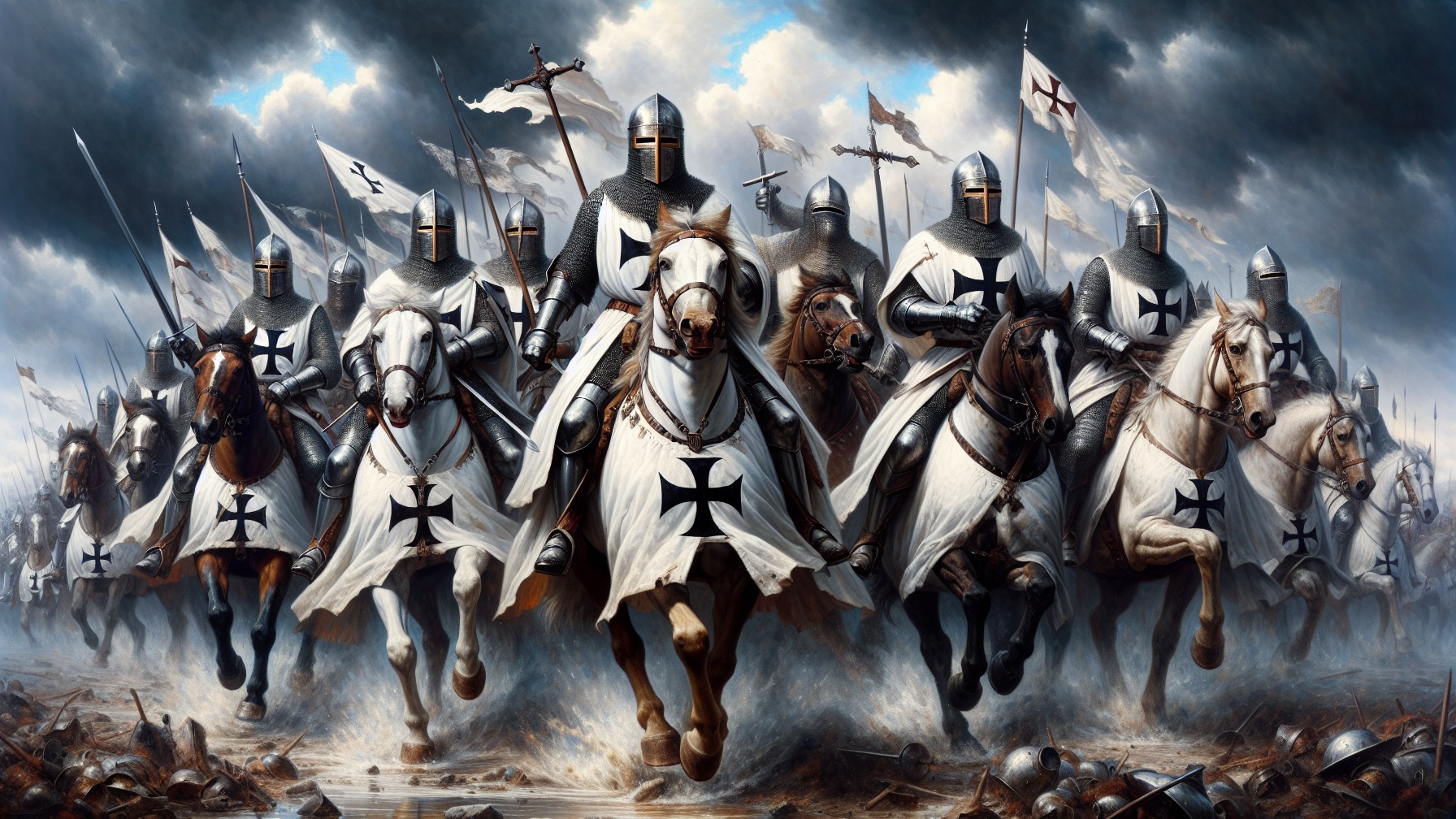
The Order of the German Brothers of Holy Mary in Jerusalem – better known as the Teutonic Knights – emerged decades after founding of the rival Templars. They would become a formidable force of Christian holy warriors in northern Europe fighting pagans and non-Catholic eastern orthodox Christians. And like the Templars, they faced charges of heresy – only they survived.
The Teutonic Knights were founded in Acre around 1190, during the Third Crusade as the Orden der Brüder vom Deutschen Haus der Heiligen Maria in Jerusalem. Initially, they focused on providing aid to Christian pilgrims and establishing hospitals in the Holy Land. But following the trail blazed by the Templars for over seventy years by then, they petitioned pope to become a fully-fledged military order.
In the 13th century, the Teutonic Order shifted its focus to Eastern and Central Europe, particularly Prussia and the Baltic region. They embarked on a “Prussian Crusade” to convert the pagan Prussians to Christianity, leading to a long period of warfare and territorial expansion. The Teutonic Order established a state in Prussia, known as the Teutonic Ordensstaat, which became a major power in the region.
FIND OUT MORE: How the Soviet Union viewed the Knights Hospitaller
Charges of heresy against the Teutonic Knights
Their expansion and control of territories like Pomerelia led to conflicts with Poland and other powers, including the Papacy, who sought to mediate or reverse these territorial gains. The Teutonic Knights seized Gdańsk on November 13, 1308, resulting in a massacre of its inhabitants, an event known as the Gdańsk Massacre or Gdańsk Slaughter.
There are contested claims that the knights slaughtered ten thousand people in Gdańsk – which would have been a huge figure for the time. The city has not forgotten this atrocity. In 1969, the city authorities in Gdańsk erected a monument titled Tym co za Polskość Gdańska (For those who fell for Gdańsk’s Polish identity), citing the massacre of 1308. The pope heard the protests of Polish nobles and acted.
In 1312, an investigation, ordered by the Pope, into the Teutonic Knights’ actions, resulted in their brief excommunication by a papal official, Francis of Moliano, on behalf of Pope Clement V. This was the same pope ordering the banning of the Templars. Similar to the Templars, the Teutonic Knights were accused of engaging in pagan rituals. But unlike the Templars, they got off the charges.
If you would like to know more about the Knights Templar, then get your hands on a copy of my book: The Knights Templar – History & Mystery. Published by Pen & Sword and available on Amazon, Waterstones, Barnes & Noble, and WHSmith. Don’t miss out on your copy!



These kinds of historical puzzles are really easy to solve, all you have to do is figure out how a certain organisation started and then you know why they ended.
The Templars are part of what I call the The Catholic Empire: a European-wide political entity that united the people of Europe, unified the law and regulated foreign affairs and defence.
When that empire crumpled the new powers (kings) removed all resistance, like the Templars. Once you understand that then you can see that almost all the reasons you cite above are more or less correct; you only missed the historical context.
“The thing that hath been, it is that which shall be; and that which is done is that which shall be done: and there is no new thing under the sun.” — Ecclesiastes 1:9