

Saint Francis of Assisi was a holy man desperately seeking martyrdom. Like many Christian saints, he yearned to be put to death in a brutal manner and worshipped forever after as a martyr for the Roman Catholic church. The trouble is – nobody would oblige. He remained worryingly alive until dying in bed. Still – some of his followers had more luck.
Franciscans martyred in Morocco
At the church of Saint Francis in Porto (Igreja de São Francisco) – the second city of Portugal – there is a gory altarpiece depicting the martyrdom of a group of Franciscan friars by Muslim soldiers in Morocco. While their leader failed to get himself executed in the name of Christ, they succeeded admirably.
Little wonder the church is not keen on visitors to take photos but for you, dear reader, I whipped out my iPhone and took this sneaky shot. One friar is already lying on the ground headless, another is in the process of losing his head, while the rest are in joyful anticipation of a scimitar slicing through their neck.

Saint Francis was a medieval trust fund kid who led a jet-set life partying and singing with traveling minstrels until he became thoroughly jaded. To the disgust of his father, a wealthy silk merchant, he took to begging, then experienced religious visions, and finally established a religious order that promoted the ideal of poverty.
His followers, who became Franciscan friars, were encouraged to reject the material world and welcome the prospect of martyrdom. Torturing one’s own flesh became a hallmark of the Franciscans with Francis leading the way by displaying the marks of Christ’s crucifixion on his body – the so-called ‘stigmata’.
Franciscans getting martyred
One group of friars, eager to please their master, resolved to travel to the Muslim domains, preach the gospel, and hopefully get killed. They were led by another rich kid turned poor friar, Saint Berard of Carbio, who spoke fluent Arabic. With him were two priests, Peter and Otho, and two lay brothers, Accursius and Adjutus.
In some accounts, they were to be joined by a monk, Vitalis, yet another scion of a wealth family who chose poverty instead of riches. But he got ill and had to make do with dying peacefully. Though due to his earlier licentious lifestyle as a teenager, he is the patron saint of diseases affecting the genitals. His skull was auctioned a few years ago and is now in California.
So the band of five friars made their way to Morroco in the year 1212 with the blessing of Saint Francis. They arrived in Muslim-controlled Seville where their loud preaching got them moved on pretty quickly. In effect, they were deported to Marrakesh in Morocco, which was the capital of the same Islamic empire ruling southern Spain: the Almohad caliphate.
The Almohad ruler, Yusuf II (c.1203-1224), referred to by chroniclers as the “sultan”, was in no hurry to murder any friars. Instead, he let them carry on preaching. This tolerance was clearly irksome for the friars who resolved to go for all-out provocation:
The Sultan received the five, granting them permission to preach. With his permission, the five preached in the marketplace with little success. However, many of the people were greatly upset by their presence, and requested their arrest. To avoid arresting the friars, the Sultan arranged for them to live with a Christian friend and prince, Dom Pedro Fernandez. This they did, but continued travelling into the city to preach. Eventually, they were again arrested, beaten, and bribed in attempts to get them to desist in their preaching and return home. When offered power, riches, and position, they replied, “We despise all those things for the sake of Christ
Sultan Yusuf was left wondering what to do with these very rude Franciscans. His advisers had no doubt on the matter. Reportedly, the five were “scourged till their ribs appeared bare, having burning oil and vinegar poured into the wounds, body rolled on sharp stones and potsherds, then their heads split by a sword”. Problem solved.
Their grisly deaths appealed to writers for centuries afterwards including the English Romantic poet Robert Southey (1774-1843) who wrote a dreadful poem about their martyrdom titled: Queen Orraca and the Five Martyrs of Morocco (almost sounds like an Enid Blyton novel). I’ll inflict two verses on you:
All naked in the sun and air/Their mangled bodies lie/What Christian dared to bury them/By the bloody Moors would die.
That on a dunghill they should rot/The bloody Moor decreed/That their dishonoured bodies should/The dogs and vultures feed.
That’s enough poetic punishment for now!
Francis desperately seeks that martyrdom
While Francis was delighted by the news, his nose was also out of joint. His mere followers had earned the ‘palm of martyrdom’ while he was still irritatingly alive. Something had to be done about that. With almost suicidal glee, he embarked on the Fifth Crusade, which was focused on taking Egypt. Though the crusader campaign was foundering badly.
The Ayyubid ruler of Egypt, Al-Malik al-Kamil Nasir ad-Din Muhammad (c.1177-1238), offered fairly generous peace terms to the crusaders but the papal legate, the pope’s man on the ground, had rejected everything. Egypt was going to be taken and Jerusalem seized back from the Muslims. Well, that was the objective – but things were not going to plan.
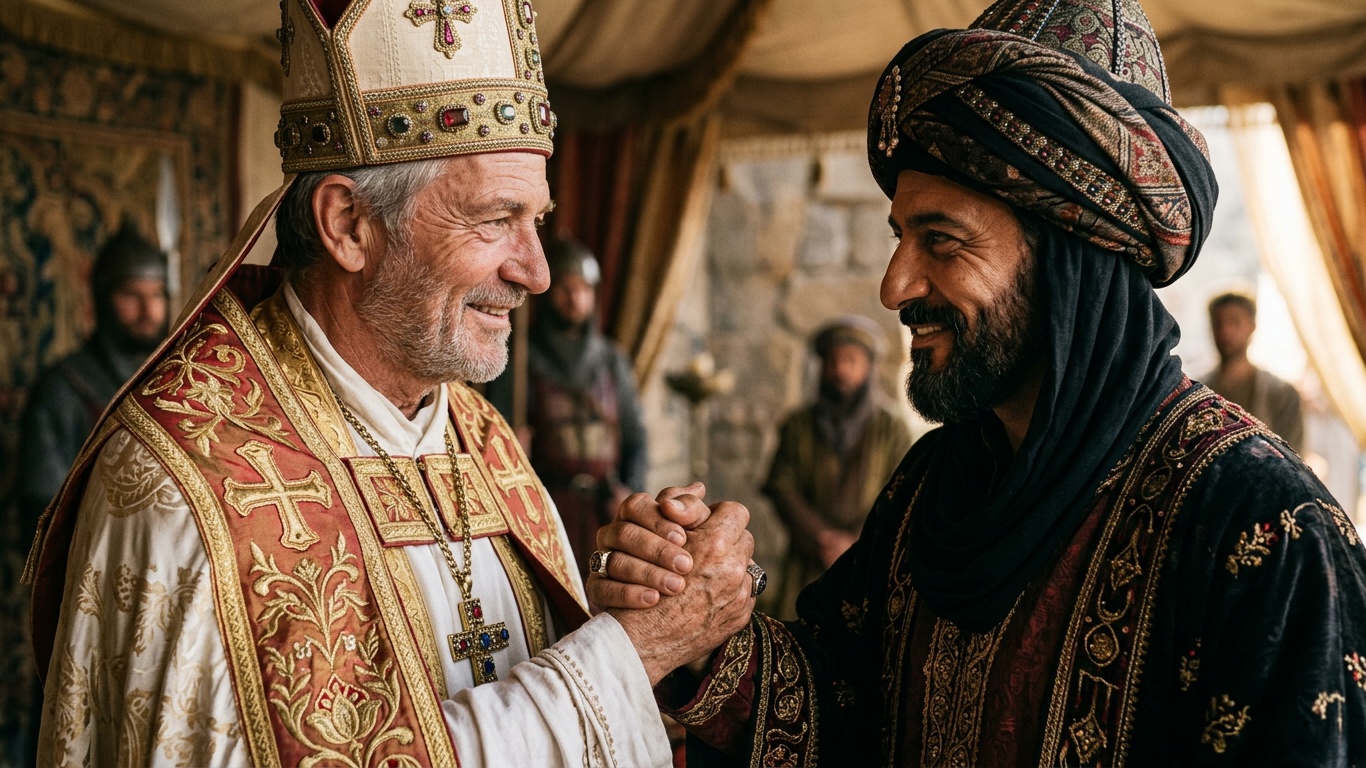
Al-Kamil (shortened name of the Egyptian ruler) combined diplomacy with warfare and was not averse to meeting Christian representatives to see what could be achieved without having a battle. In that spirit, he agreed to meet Saint Francis. It was certainly an eventful encounter and Francis adopted a belligerent stance from the outset. At one point, he challenged Al-Kamil’s Muslim religious advisers to walk through a fire pit alongside him to prove whose God was better. Al-Kamil responded on their behalf:
I do not think that any of my priests would expose themselves to the flames just to defend their faith or suffer any kind of torture.
He then offered Francis some gifts which the petulant friar dismissed as “dung”. There was some strained inter-faith dialogue that involved Al-Kamil explaining that converting to Christianity would lead to his own immediate death – and he rather liked being alive. With due courtesy, Francis was given safe passage back to the Christian crusader forces with little to report. Martyrdom was to elude Francis to the very end of his life.
If you would like to know more about the Knights Templar, then get your hands on a copy of my book: The Knights Templar – History & Mystery. Published by Pen & Sword and available on Amazon, Waterstones, Barnes & Noble, and WHSmith. Don’t miss out on your copy!