

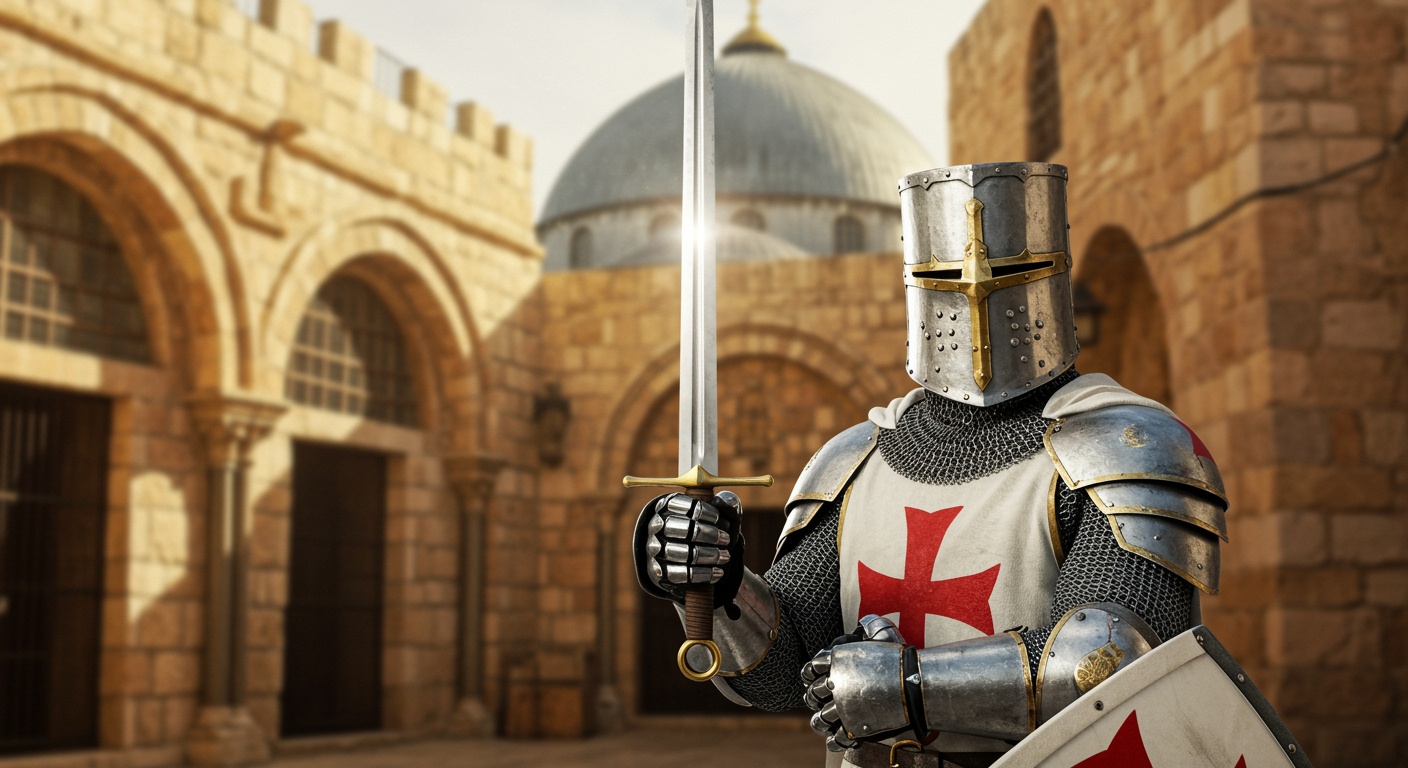
The Holy Sepulchre in Jerusalem was the most sacred place to the Knights Templar. They built churches across Christendom that resembled its circular shape. From London to Segovia to Tomar and the Middle East, you can find Templar places of worship inspired by the Holy Sepulchre. So, what does it signify?
FIND OUT MORE: Passion relics of the crucifixion discovered!
The walls of the Holy Sepulchre are believed to cover the exact location where Jesus was crucified, buried, and resurrected. That may seem implausible – and many Protestants dispute the claims – but for centuries the faithful have flocked here.
Clashes between Christians at the Holy Sepulchre
Because of its importance to all Christians, the Holy Sepulchre is divided between different Catholic and Christian orthodox denominations. So, you will see Ethiopian orthodox priests on the roof and Greek orthodox priests in the nave. Sometimes, they have been known to fight each other in very unholy turf wars. In 1902, twelve Greek orthodox monks were sent to imprison for attacking Franciscan friars near the tomb of Jesus. This report below from The Washington Post in 1902.

A hundred years later in 2002, priests from the Ethiopian Orthodox church fought monks from the Coptic church of Egypt for control of the roof. Back in 1902, it was the Muslim Ottoman authorities keeping rival Christians apart. Now, that job falls to the Israeli police and military. Ethiopians had put huts on the roof in recent decades, having been booted out of the main church. An Egyptian who moved his deckchair out of the sun was deemed to have infringed the long standing “status quo” agreement between the rival Christian denominations, and all hell broke loose. Report below from The Ottowa Citizen in 2002.

There is even a wooden ladder that has been propped up against a wall since the year 1728. The so-called “immovable ladder” is located on a ledge and attached to the right window of the second tier of the facade, owned by the Armenian Apostolic Church. Under the agreement between the denominations, they cannot touch each other’s property. So the ladder has stayed in place for nearly three hundred years (although it was moved sneakily in 1997 and 2009).
History of the Holy Sepulchre
In the fourth century CE, the Roman emperor Constantine adopted a policy of toleration towards Christianity and began a process where this cult became the state religion of the empire by the end of that century. He funded the construction of several Christian churches including the Holy Sepulchre. The site in Jerusalem had previously been occupied by a temple to Venus, dedicated by the emperor Hadrian in the second century CE, following the crushing of the second Jewish revolt against Rome.
It was destroyed by Sassanian Persian invaders in 614CE and then rebuilt by Abbot Modestus in 626CE. In 1009, it was flattened by the Fatimid Caliph al-Hakim, known as the “Nero of Islam” – a deranged monarch assassinated after banning dogs from the city. A new church began to be constructed after his death and building work picked up after Jerusalem was invaded by the crusaders in 1099.
In 1810, the current structure of the Edicule was built in an Ottoman Baroque style after a fire in 1808 that destroyed almost the entire structure. There are still parts of the building that date back to the crusades including a wall with crosses carved by pilgrims. A massive stone slab, part of a long-lost medieval altar, was recently identified within the church, featuring Cosmatesque ornamentation, a style using inlaid marble and glass, popular in the 12th century.
These images are from my visit to the Holy Sepulchre in 2012 when I journeyed all over Israel. I’m looking forward to returning again very soon.


If you would like to know more about the Knights Templar, then get your hands on a copy of my book: The Knights Templar – History & Mystery. Published by Pen & Sword and available on Amazon, Waterstones, Barnes & Noble, and WHSmith. Don’t miss out on your copy!



Great photographic eye. And this looks like an interesting place.
Thank you for your kind comment – I was inspired by the Templars of course!