

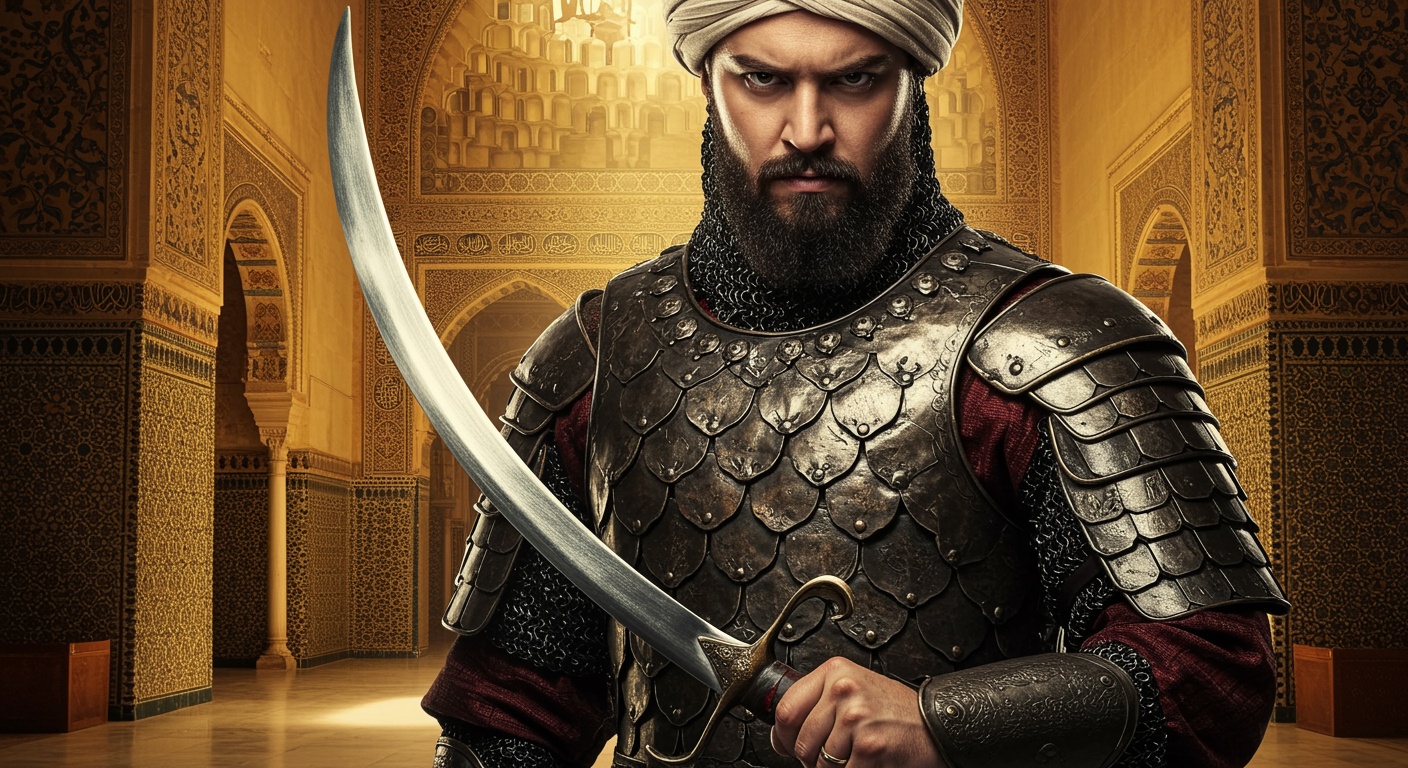
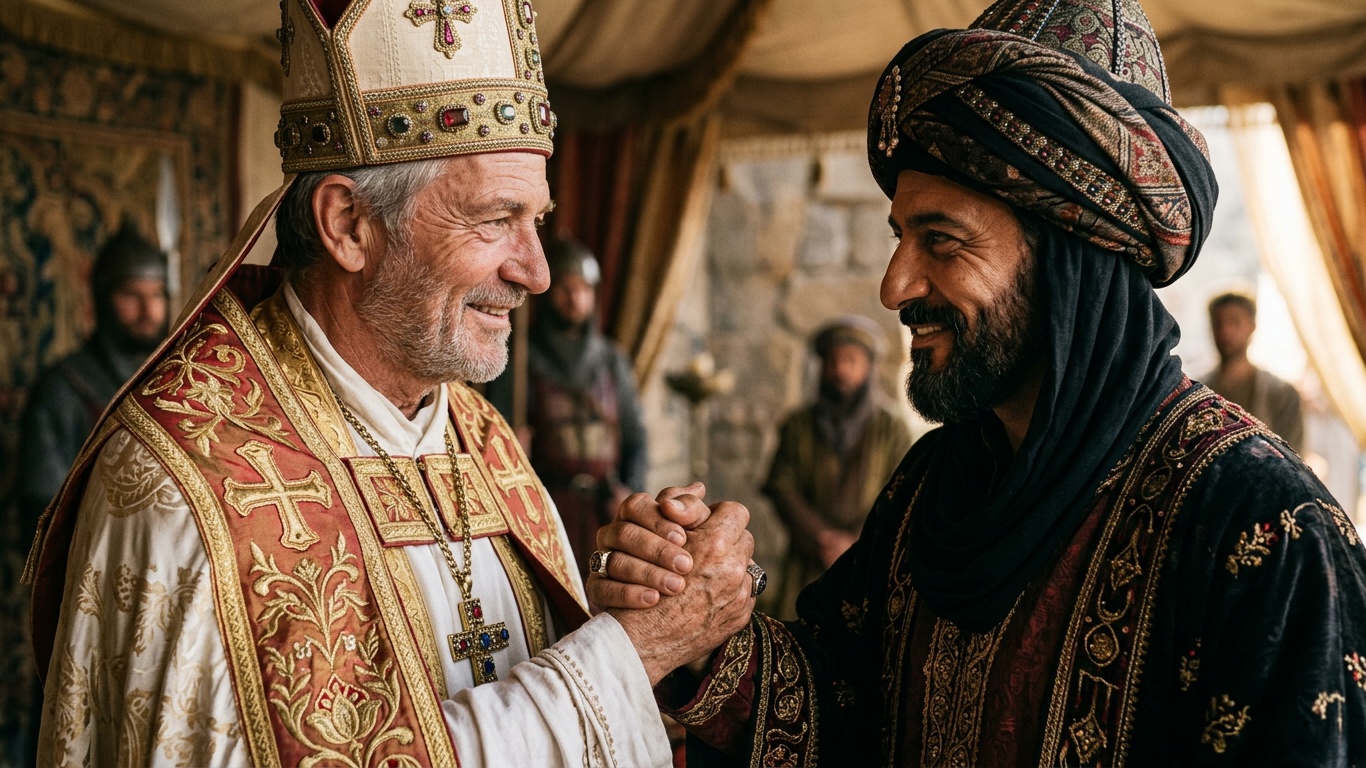
Saladin was the fearsome Saracen leader who struck terror into the crusader forces and beat the Knights Templar at the Battle of Hattin, taking back Jerusalem shortly afterwards. You might assume that Saladin would therefore have been hated across Christian Europe. But think again. He was so heroised that many thought he was a Christian noble who had gone rogue and even…that he was the secret lover of Eleanor of Aquitaine. Will the REAL Saladin please stand up!
A two paragraph biography of Saladin
Salah ad-Din Yusuf ibn Ayyub (c.1137-1193) is better known to us as Saladin. An ambitious ethnic Kurd who served the Zengid rulers of Syria. They sent this capable soldier to Fatimid-ruled Egypt on a delicate mission. The Zengids were interfering in Fatimid court politics, hoping to instal their favoured candidate as vizier (chief minister) to the sultan. Instead, Saladin ended up taking complete control of Egypt, bringing the centuries old Fatimid empire crashing down, and creating his own Ayyubid dynasty.
He followed that up by absorbing Syria into the new Ayyubid realm, thereby uniting the Muslim Middle East. At the same time, he began a relentless campaign against the crusader states that had been established along the eastern Mediterranean coastline after the Christian seizure of Jerusalem in 1099. In the year 1187, Saladin’s forces marched into Jerusalem ending crusader control of the city. Nobody could doubt the strategic brilliance and ruthless determination of Saladin.
And that’s when he started to become the stuff of legend.
Who was the real Saladin?
When an enemy bests your side at every turn, a sneaking regard for your foe can develop. European chroniclers, from the Middle Ages onwards, saw in Saladin the qualities they believed their own leaders lacked.
A modern analogy is the way in which some today admire Vladimir Putin (I don’t by the way). They contrast the murderous Russian autocrat – positively – with their own democratic, liberal, politicians, characterised as bumbling fools. A similar kind of thinking in the Middle Ages posited Saladin as a Saracen strong man with a clear vision and sharp focus who achieved his objectives with methodical precision. Though in reality, he messed up on several occasions but from afar, Saladin looked invincible.
A recurring theme was Saladin as a leader who displayed boundless mercy and compassion. It was said he showered gifts on Christian leaders in the west, and sent his best physicians to cure them of various ailments. But why would a Muslim do this? Some chroniclers were convinced Saladin harboured doubts about Islam. He might even have converted to Christianity behind closed doors.
Saladin was so chivalrous, medieval tongues wagged, that he was very likely the bastard grandson of a French noble. Only a westerner could be so well behaved. If he wasn’t the scion of some European aristocrats, then at the very least he was having a steamy affair with a Christian princess – Eleanor of Aquitaine was mentioned. Eleanor was often the target of the medieval equivalent of tabloid gossip, with unfounded rumours that she had bedded her uncle. Tales of Eleanor jumping into bed with Saladin may have been yet another attempt to tarnish her reputation.
First impressions of Saladin
Saladin was not initially liked in the west. After taking Jerusalem in 1187, he was condemned as a low-born murderer, cuckold, and degenerate. Some Christian writers warned that Saladin was a plague unleashed by God as a punishment for the lax morals of the crusaders. It was even said that he started out in life as a pimp running brothels, addicted to gambling and frequenting taverns (this was stated in the book Itinerarium Peregrinorum et Gesta Regis Ricadi I).
There was an early divergence in opinion between church chroniclers and crusaders. The priests and bishops who wrote the history of the crusades in Latin had little good to say about Saladin – he was the wrath of the Christian God rained down on the sinful. But amongst crusaders, whose stories circulated in English and French, there was grudging praise for Saladin. Gradually, their view moved into the ascendant.
Saladin – Christian convert?
The first accounts of the taking of Jerusalem painted a picture of cruelty and bloodshed inflicted on the surrendering population. But that gave way to a thousand acts of kindness by Saladin. On his deathbed, Saladin asked a priest, rabbi, and imam to debate the relative merits of Christianity, Judaism, and Islam. He was so impressed by Christianity that he pledged the greater part of his inheritance to the church. Only the intervention of his nobles stopped this happening.
Or, in another tale, Saladin was knighted by Hugh of Tiberius. Incredibly, Edward Gibbon – author of the magisterial The History of the Decline and Fall of the Roman Empire – repeated this bizarre claim. The Saracen leader then went on a fact finding tour of Christian Europe. French chroniclers reported that on his travels, Saladin secretly converted to the Roman Catholic faith. This was highly unlikely as the punishment for a Muslim leaving his religion – an act of apostasy – was death. So why did Europeans invent stuff like this, which was so obviously incorrect?
The evidence points to Saladin being a Muslim ruler who fought for his faith – and embraced the concept of jihad. The reason for stories of a clandestine conversion is that the west needed to account for his victories. How could an Islamic ruler have defeated armies and knights sanctified by the pope and fighting for Christ? Claiming Saladin had become a secret Christian offered an explanation – if a rather confusing one.
The Legend of Saladin continues
The legends surrounding Saladin continued to develop over the centuries – long after his death. The Florentine poet Dante Alighieri (c.1265-1321) penned The Divine Comedy – a journey through hell that featured many celebrities of the Middle Ages – including Saladin. The Ayyubid leader is placed in hell but among those who, through no fault of their own, died un-baptised. To be clear, Dante was not sympathetic to Islam as he depicted the Prophet Muhammad in diabolic agony. Dante was depicting Saladin as a unique figure in the Islamic world who deserved special recognition – but he was an exception.
During the 18th century Enlightenment, great thinkers like Voltaire criticised Christianity and the church in a way that would have got them burned at the stake a hundred years before. For these writers, Saladin became an anti-Christian icon. He was cultured, refined, and civilised. In contrast, figures like Guy de Lusignan – the crusader king of Jerusalem – became figures of fun. Boorish, philistine, and bigoted.
In the 19th and 20th centuries, themes around imperialism, race, and nationalism informed how Saladin was viewed – in a way that was entirely alien to the reality of the Middle Ages. His Kurdish ethnicity was erroneously contrasted to perceived Arab decadence in Egypt and Turkish wickedness in Syria. There was an implicit argument that the Kurds were closer to being European than Arabs or Turks. This racialised the identity and achievements of Saladin in a very disturbing way.
Saladin the Arab nationalist (even though he’s Kurdish)
The anti-colonial movements in the Middle East during the 20th century gave rise to pan-Arab nationalism with Gamal Abdel Nasser (1918-1970), President of Egypt, calling for unity among Arab nations against the West. Nasser used Saladin as a symbol of Arab resistance and national pride.
He drew parallels between Saladin’s military campaigns against the Crusaders and his own fight against Western influence in the Middle East. Nasser’s creation of the United Arab Republic, a union of Egypt and Syria, was also seen as a modern-day echo of Saladin’s vast empire. In 1963, the Egyptian movie Saladin the Victorious rammed home this message with the Ayyubid leader portrayed as a medieval Nasser.
More startlingly was the use of Saladin’s image by the Iraqi dictator, Saddam Hussein (1937-2006). He compared himself to Nebuchadnezzar, king of the Babylonians, and Saladin. Both Saddam and Saladin were born in the town of Tikrit. But the comparison was tortuous. Nebuchadnezzar was neither Arab, nor a Muslim. While Saladin was Kurdish and Saddam treated the Kurds in a horrific manner. Below is an image of Saddam and Saladin from propaganda created during the former’s dictatorship in Iraq.

If you would like to know more about the Knights Templar, then get your hands on a copy of my book: The Knights Templar – History & Mystery. Published by Pen & Sword and available on Amazon, Waterstones, Barnes & Noble, and WHSmith. Don’t miss out on your copy!

Great shots! as an author setting a book in historical London, I envy you your home. Question: is there a standard or expected layout for a Templars temple? I’ve visited the temple in London, but expect it’s different from how it might have been. Any pointers to Temple architecture or interiors would be appreciated!
Many Templar churches were supposed to be based on the Holy Sepulchre in Jerusalem but if you compare, say, the Temple church in London with the Charola at Tomar or the church of the Vera Cruz in Segovia – they’re so different. Either memories of Jerusalem were fuzzy or the builders had never been there. In my book – Quest for the True Cross – I mention the Templar church in London but I’m referring to an earlier church that stood near what’s now Chancery Lane tube station. As I’m sure you know, the church you now see in London was built in the late 12th century and unfortunately was heavily damaged in the Second World War. But it’s still got enough of its original medieval structure to give you a good idea of what a Templar church looked like.
Thanks for sharing. Can you tell me what the statue in 2nd row 1st picture is?
I love the colours in the 1st picture of the last row. 🙂
I was inspired!
Wow great pics!
And thx for the follow 🙂