


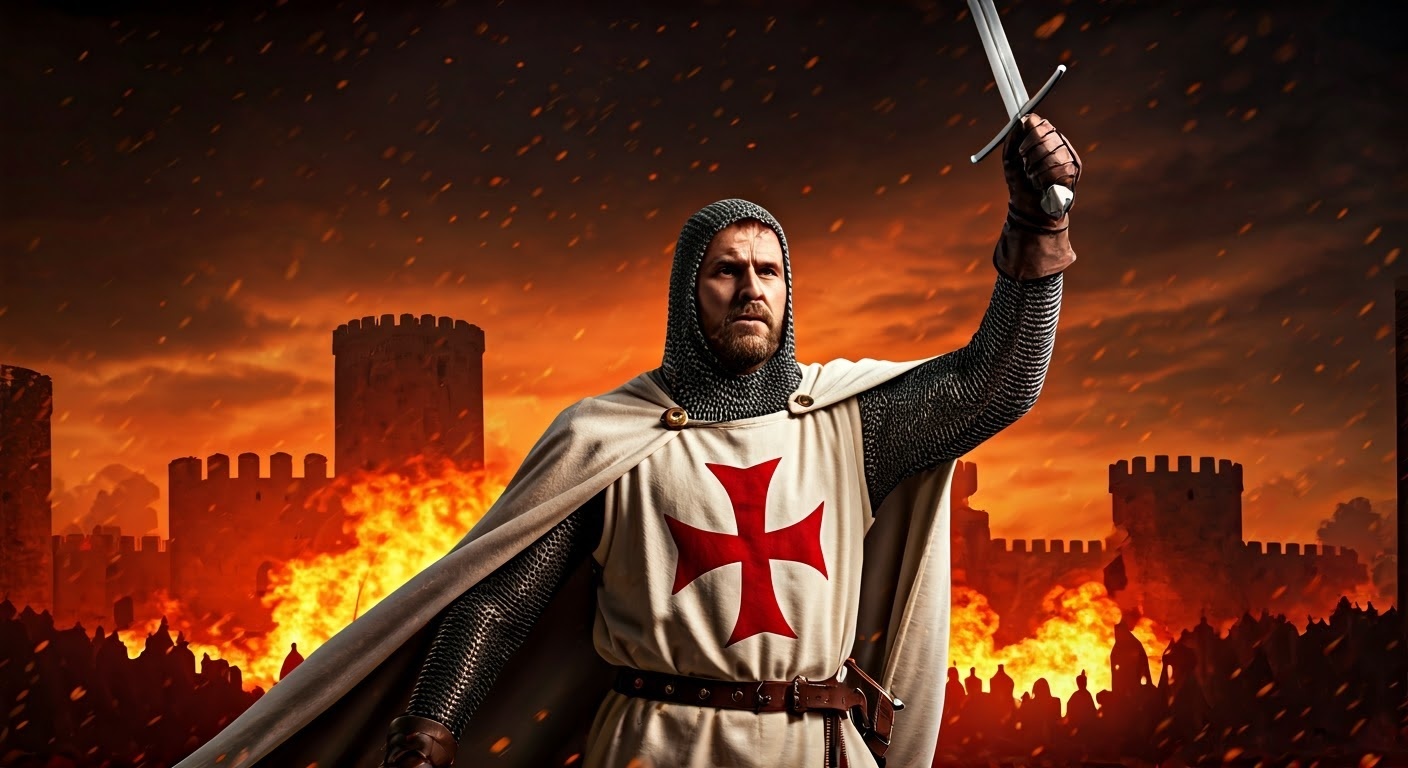
The Siege of Acre in 1291 marked the decisive end for The Crusades – a two hundred year military project initiated by the Pope to retake the Holy Land for Christ. Not even the Knights Templar could stop the city of Acre being taken by the Saracens. So – what went wrong?
Situated on the coast of the eastern Mediterranean, Acre (now called Akko, in modern Israel) was a major port in the Holy Land, enabling the Crusader states to import supplies and trade with Europe. It had a deep, natural harbour, making it a safe and strategic location for ships. It was a well-fortified city, and its capture and defense were key battles in the Crusades. The earlier Siege of Acre in 1189-1191, led by Saladin and later the Third Crusade, highlighted the city’s importance.
After the Third Crusade, Acre became the capital of the Latin Kingdom of Jerusalem and the headquarters for several Crusader orders, including the Knights Templar, Hospitallers, and Teutonic Knights. In the lead up to the final 1291 siege, the crusader controlled city became more vulnerable as Christian forces lost control of other cities and towns in the Levant.
The fall of Tripoli (1289) and Lattakia (1278), significantly weakened the Christian position in the region, reducing overall strength. Frantic efforts to forge an alliance between Europe and the Mongols failed, leaving the Crusader presence isolated.
Meanwhile, Mamluk-run Egypt was growing mightier. The Mamluks were originally enslaved soldiers from central Asia. They became a powerful military class within the Ayyubid state, founded by Saladin. They held high positions and were increasingly influential in the government. As the Ayyubid dynasty weakened, internal power struggles and the Mamluks’ increasing military strength created an opportunity for them to take control. They successfully deposed the Ayyubid ruler and established their own dynasty, known as the Mamluk Sultanate.
Sultan Qalawun, and then his son Al-Ashraf Khalil, consolidated Mamluk power in the region, aiming to eliminate the last remaining Crusader stronghold of Acre. They amassed a large army with a variety of siege engines, including powerful catapults, to batter down the city walls. The Knights Templar and Hospitaller took over the defense of the most vulnerable parts of the city, particularly the northern walls around Montmusard.
Frantic last minute efforts to forge an alliance between Europe and the Mongols failed. So, the crusader forces were left to face the Mamluks on their own. Sultan Khalil’s Mamluk army arrived at Acre on April 6, 1291, followed by Syrian contingents two days later with siege engines. The walls of Acre were breached by May 18, leading to the Mamluks entering the city. Some Franks (Christian residents of Acre) sought refuge in the fortified compounds of the Templars and Hospitallers, but the Templar citadel collapsed on May 28, and the Hospitallers were betrayed and slaughtered.
The loss of Acre meant the fall of the last major Crusader stronghold, ending the era of European-controlled territories in the Levant. Within weeks, the remaining Christian cities and outposts were abandoned, including Tyre, Beirut, and Sidon, leaving no further Christian presence in the region. The Mamluks, who had been victorious in the siege, took control of the coastal regions, razing them to the ground and preventing any future Christian attempts to regain control.
The Knights Templar and Hospitaller orders relocated their headquarters to Cyprus, establishing a new base of operations. While the idea of a new crusade to retake the Holy Land persisted, there was no effective effort to do so. Instead, the focus shifted to campaigns against the Ottoman Empire, attempting to check their advance into Europe.
For the Knights Templar, the loss of Acre was a disaster. I’ve found evidence that the Templars continued to receive funds and new recruits so the order was still functioning after the loss of all crusader territory on the mainland. But their long term position was very precarious. Why should they have loads of land and money if their mission was essentially over. Although it continued in Iberia – but the Holy Land had always been the primary focus. It only took one monarch – King Philip IV of France – to move against them, and the game was over.
In 2012, I visited the ancient town of Acre in modern Israel. It’s still dominated by the castle built by the Knights Hospitaller and underneath this mighty medieval construction is a secret tunnel – its purpose still shrouded in mystery.


If you would like to know more about the Knights Templar, then get your hands on a copy of my book: The Knights Templar – History & Mystery. Published by Pen & Sword and available on Amazon, Waterstones, Barnes & Noble, and WHSmith. Don’t miss out on your copy!


I’m thinking of hanging the lamp from the ceiling.Winter is a cold season.It is Just what I need.Whichever you choose, you won’t be satisfied.I’m not guessing£¬I really know.It’s a secret between you and me.It’s a secret between you and me.Not yet.Another cat came to my house.Combining exercise with the diet may be the most effective way to lose weight.
These pictures are beautiful, thanks for sharing! 🙂