


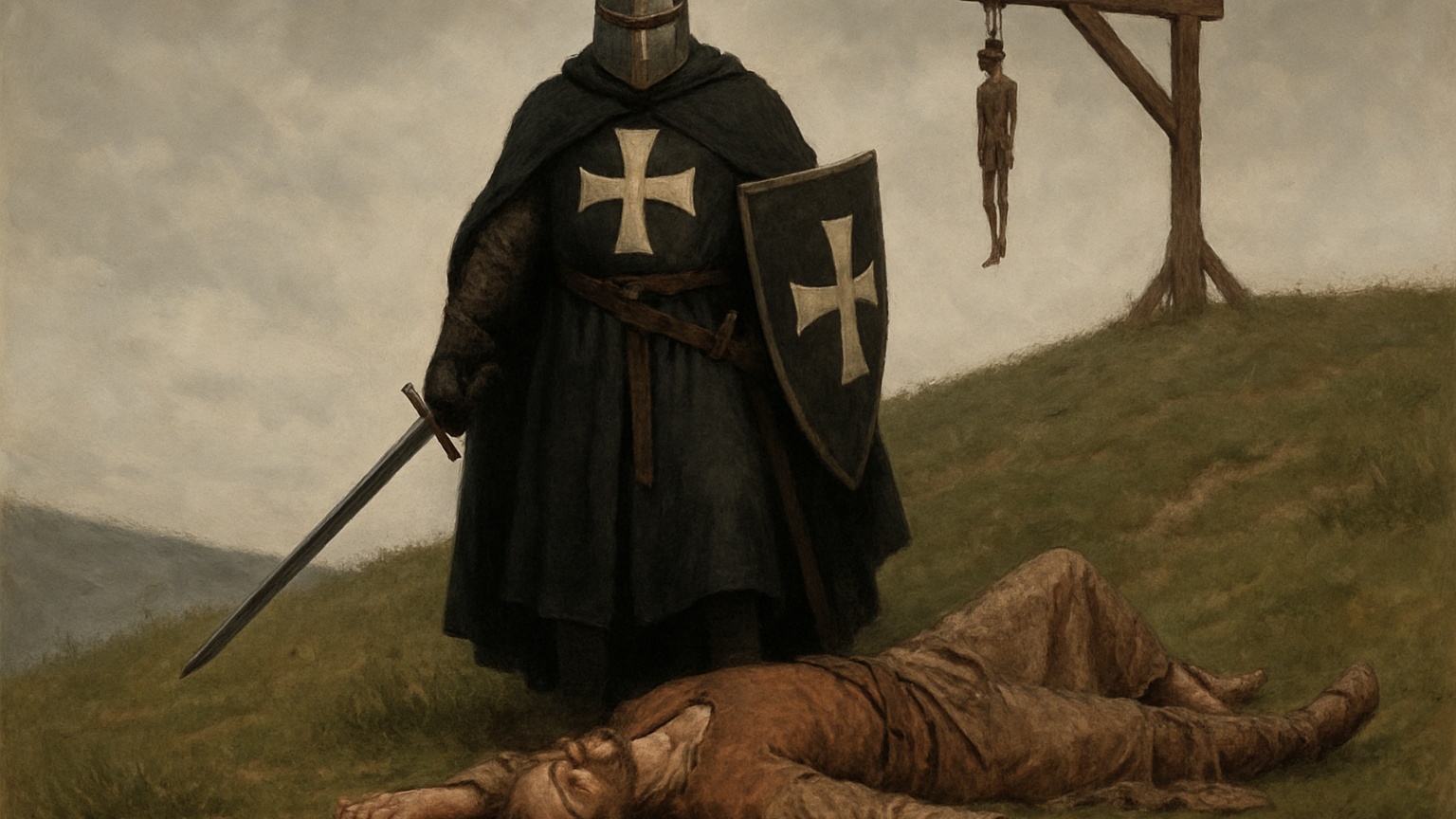
This is a strange story about how the Knights Hospitaller developed a sideline as medieval funeral directors – only the bodies kept coming back to life!
The weird stuff you find out while researching medieval history. It appears that up until the Protestant Reformation in the 16th century in England, the Knights Hospitaller had a sideline as Funeral Directors, morticians, undertakers…whatever your preferred terminology. Basically, they took it upon themselves to retrieve and bury the bodies of executed criminals. And given that people could be hanged for a large number of offences in the medieval period, they were kept busy.
In 1276, some thieves were hanged at Ilchester, in the south-west of England. Theft was a capital offence and those executed could expect to meet their end at a gallows, or gibbet, normally located at a crossroads, entry point to a town, or a land boundary. In the early Middle Ages, the gallows was more common – a central beam supported by two poles. Otherwise, a tree was used.
Bodies were often buried in a pit near the gallows. What the Hospitallers were offering was a Christian burial in a graveyard. But at Ilchester, when they came to pick up the corpses, the “tithing men”, who were supposed to stick around and officially hand over the bodies, had disappeared. These local people were chosen to keep order centuries before police forces were created. Yet at Ilchester, the tithing men decided they had something better to do and left the scene.
FIND OUT MORE: Difference between the Hospitallers and Templars
Most likely, the local tavern beckoned. Or maybe the Hospitallers were late. But by the time the Hospitaller retainers showed up, they found the hanged thieves lying lifeless on the ground – scattered like human debris.

Furious at the conduct of the tithing men, the Hospitallers carted the bodies off for burial at St Olave’s churchyard in Ilchester. However, as they arrived at their destination, one of the bodies sprang to life. Clearly waiting to be within staggering distance of the church, the thief leaped off the cart and ran into St Olave’s, thereby able to claim sanctuary. He was now beyond the reach of the law.
The local sheriff was so appalled by this turn of events that he imprisoned some of the Hospitallers, though they were released very soon after. To be clear, these were not knights but servants or sergeants who were part of the order, but not fully fledged, sword wielding, crusading knights.
Given that their preceptories were not always very close to the gallows concerned – up to thirty miles in one case I’m mentioning here – they must have been tipped off by those with local intelligence. One theory is that the Hospitallers kept itinerant friars, who travelled around a lot, on their payroll, to alert them to upcoming hangings.
Knights Hospitaller and bodies coming back to life
Criminals coming back from the dead turned out to be a recurring problem for the Hospitallers. In 1280, a pardon was granted to a man hanged for theft in Yorkshire. It came too late as he danged from a rope. But as the Hospitallers were transporting his body for burial at St James’s church in York, he revived.
In 1284, a woman hanged at Lincoln and cut down suddenly opened her eyes. The Hospitallers took her to the nearby Lincoln leper hospital of the Holy Innocents where she fully recovered, was pardoned, and lived for at least two years. Two years later, a seemingly dead man being taken by the Hospitallers to Aylesbury church recovered and mustered enough energy to escape. Though later he was recaptured and hanged again.
All of which suggests that many local executioners were entirely unqualified for the job. Hangings didn’t yet involve a long drop and for the most part, the guilty were just pushed off a beam and left to kick around for a while as they asphyxiated. The Hospitallers must have regretted becoming medieval funeral directors when they were faced with yet another resurrection.
In 1299, two men were taken from Norwich gaol to the gallows for hanging. So imagine the coroner’s surprise when they walked past him some time later near St Margaret Fyebridgegate, in central Norwich. It turned out that the Hospitaller at the hanging had cut the gallows ropes prematurely, before they were fully dead. He was fined for this screw up.
Looking through the records, the cases just keep popping up – much like the supposedly dead felons! So, in 1310, the Hospitallers claimed a criminal for burial as he had been associated with the order in some capacity – most likely a farm hand or servant. They body was taken to the graveyard of the chapel of St John Lee, a mile from Hexham. Again, this one started breathing and fled into the church demanding sanctuary. This lucky man got a pardon.
Knights Hospitaller and the Pardon churchyard
The Hospitallers had their grand priory Clerkenwell, just beyond the city walls of London. Next to the priory was the Pardon Churchyard where the bodies of suicides and executed criminals were interred. The bodies would be collected by the Hospitallers and taken, heaped high, in a cart covered with a black cloth bearing the distinctive white cross of the order. The churchyard, busy in the 14th and 15th centuries, was obliterated in the 18th century as London expanded.
One nagging question does remain about all of the above – why did the Hospitallers provide this service? It might have been because of the order’s historic roots as an organisation providing medical services to pilgrims in the Holy Land. And that they buried these felons – the very dregs of society – as an act of Christian charity. Or was it that they collected dead criminals who had a previous connection with the Hospitallers? They may have been ‘contratres’ who contributed funds to the Hospitallers or had asked to be buried by the order.
There are two cases, in 1310 and 1365, were it’s possibly the criminals concerned were ‘confraters’ and some believe the woman in Lincoln in 1284 was a Hospitaller ‘consoror’, or co-sister. Another scenario is that a criminal knowing they were going to be hanged asked to see a Hospitaller chaplain for a final confession and promised a gift to the order in return for burial.
If you would like to know more about the Knights Templar, then get your hands on a copy of my book: The Knights Templar – History & Mystery. Published by Pen & Sword and available on Amazon, Waterstones, Barnes & Noble, and WHSmith. Don’t miss out on your copy!




I love “The Name of the Rose.”