


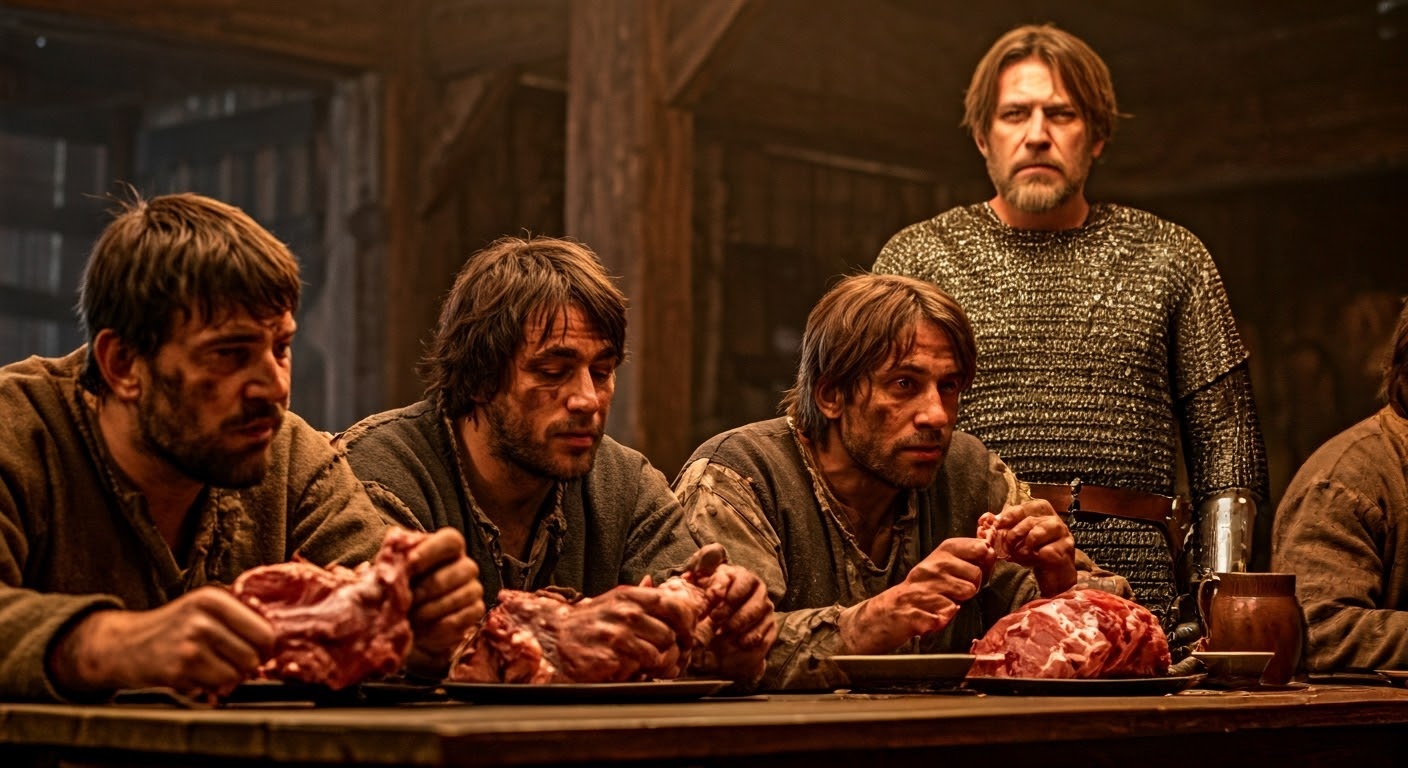
One of the most shocking war crimes from the Crusades is an allegation – from multiple sources – that there were incidences of cannibalism. Could it possibly be true that human flesh was eaten by soldiers and was this just due to starvation or were there more dubious motives?
The scene of the crime was the town of Ma’arra in Syria – today called Ma‘arrat al-Numan. In late November/early December 1098, Raymond IV of Toulouse and Bohemond of Taranto led a crusader army besieging Ma’arra. The town was on the southbound road to the city of Damascus, which was in crusader sights. So, taking it was essential. On December 11, a siege tower was successfully wheeled up the walls and Ma’arra was taken.
More than a dozen accounts claim that crusaders devoured Muslim corpses during the siege – or possibly after the siege. That is an important detail to confirm. During the siege points heavily to starvation among the troops. After the siege, when the town’s supplies could be looted, suggests another motive. Some historians have floated the idea that Ma’arra’s dead defenders were literally consumed as a morbid form of psychological warfare. As if to say: we won’t just fight you – we’ll eat you too!
It defies credulity. The idea that cannibalism could be used to cow the enemy into submission. In the early 2000s, after the 9/11 attack in New York, it emerged that Osama bin Laden was in part inspired by accounts of the First Crusade that included the cannibalism incident at Ma’arra. The story had been largely forgotten in the west – save for a few academics – but in the Middle East, it was still remembered. That does not, of course, justify the appalling deeds of Al Qaeda in the 21st century.
So – who ate whom? Let’s look at what chroniclers wrote in the years after the event. In the Gesta Francorum, there is a one line reference to a siege at Ma’arra. Food was so scarce that the crusaders ate the flesh of dead Muslims. Abbot Guibert of Nogent’s account – Gesta Dei per Francos – was written a decade after the siege. He accused a group of thugs within the crusader ranks referred to as ‘Tafurs’.
These were depicted as dirt poor, shoeless wretches. The sort of people who would think nothing of eating human flesh. But what were they? Irregular soldiers? Pilgrims? Were they in some way organised with their own leader?
Fulcher of Chartres was a priest who participated in the First Crusade. He had some unpleasant details about the cannibalism at Ma’arra:
I shudder to tell that many of our people, harassed by the madness of excessive hunger, cut pieces from the buttocks of the Saracens already dead there, which they cooked, but when it was not yet roasted enough by the fire, they devoured it with savage mouth.
By the middle of the 13th century, a poetic account of the First Crusade – The Song of Antioch – transformed the Tafurs into something very disturbing to the modern mind. A group of pious Christians whose violence was in the service of God. Not only were they cannibals, according to the Song of Antioch, but rapists as well. And none of this seemed to be very problematic for the writer. In fact, one begins to wonder whether the cannibalism is being heroised.
Was Richard the Lionheart a cannibal?
Astonishingly, one crusader accused of cannibalism is none other than Richard the Lionheart. It’s said that he requested pork to eat while camped outside the Hospitaller fortress of Acre (now Akko in modern Israel). His attendants cook him up some Saracens on the basis that they taste of pork (even though they’re not allowed to eat pork – go figure!).
Richard bolts down his food and asks to see the pig’s head. Needless to say the attendants produce a Saracen’s head and Richard, far from being appalled, gets stuck into some more “pork” pointing out to his men that they shall never starve as this meat is so plentiful.
DISCOVER: Smear campaign that led to the Templar downfall
If you would like to know more about the Knights Templar, then get your hands on a copy of my book: The Knights Templar – History & Mystery. Published by Pen & Sword and available on Amazon, Waterstones, Barnes & Noble, and WHSmith. Don’t miss out on your copy!




One day [Richard the Lionhearted] told his cook to have some fresh pork for dinner…but the cook had no pork. He was in trouble, for if there was no pork on the table he would stand a chance of having his head chopped off. He had heard it said, however, that human flesh tasted like pork. …he killed a Sacracen prisoner and cooked some of the flesh and had it placed on the table.
The king praised the dinner. Perhaps, however, he mistrusted that it was not pork, for, said Richard, “Bring the head of the pig, that I may see it.”
…With much trembling he brought the head of the Saracen. The king laughed when he saw it.
“We shall not want for pork as long as we have sixty-thousand prisoners,” he said, not in the least bit disturbed to know that he had been eating human flesh. The Saracen general, Saladin, sent thirty ambassadors to Richard beseeching him not to put the prisoners to death. Richard gave them an entertainment, and instead of ornamenting the banquet with flowers, he had thirty Saracens killed, and their heads placed on the table. Instead of acceding to the request of Saladin, he had sixty-thousand men, women, and children slaughtered out on the plain east of the city of Acre.
-Taken from the history book, “The Story of Liberty” by Charles C. Coffin. Written in 1879. Based my my research of this book, so far everything has been extremely reliable and true to the facts.
When I hear of the word cannibal, I think of a fancy Docter named Hann ibal who is gay for a crazy brunette and some ginger lady.
Ah well, there have been plenty of other cannibals aside from Hannibal. Eating human flesh in famines is a big taboo subject but one recent book suggests cannibalism happened as late as the Second World War with the residents of Leningrad eating human flesh while holding out against the Nazis and the Japanese allegedly eating the flesh of prisoners of war.
The slicing off of buttocks of heavy women in medieval Fustat, Egypt, during famine was also practiced.
I hadn’t heard that before!