

Could the Knights Templar have been created to unearth the secrets of the Kabbala located somewhere under the Temple of Solomon in Jerusalem? Was it their central task? Did the follow this form of Jewish mysticism and does that justify the charge of heresy levelled against them in 1307 – leading to their destruction?
There is a theory that the Knights Templar deliberately chose to be located in the Temple of Solomon because they knew that the ancient kabbalistic secrets were under their feet. Or, that they became familiar with the Kabbala through their daily interactions with the local Jewish population.
The first question to answer – what exactly is the Kabbala?
Defining the Kabbala
The Hebrew word Kabbala (קבלה) roughly translates as “reception” or “tradition,” meaning the received wisdom and teachings passed down through many generations. It’s a system of Jewish mysticism that delves into the hidden or esoteric aspects of the Torah and Jewish tradition, seeking to understand the nature of God, the universe, and the human soul.
The Kabbala seeks to delve deeper into the meaning and purpose of the Torah (the first five books of the Old Testament central to Jewish scripture) and the world, aiming to understand God’s essence and the connection between the divine and human realms. It’s fiendishly complicated to grasp but let’s go through the key concepts:
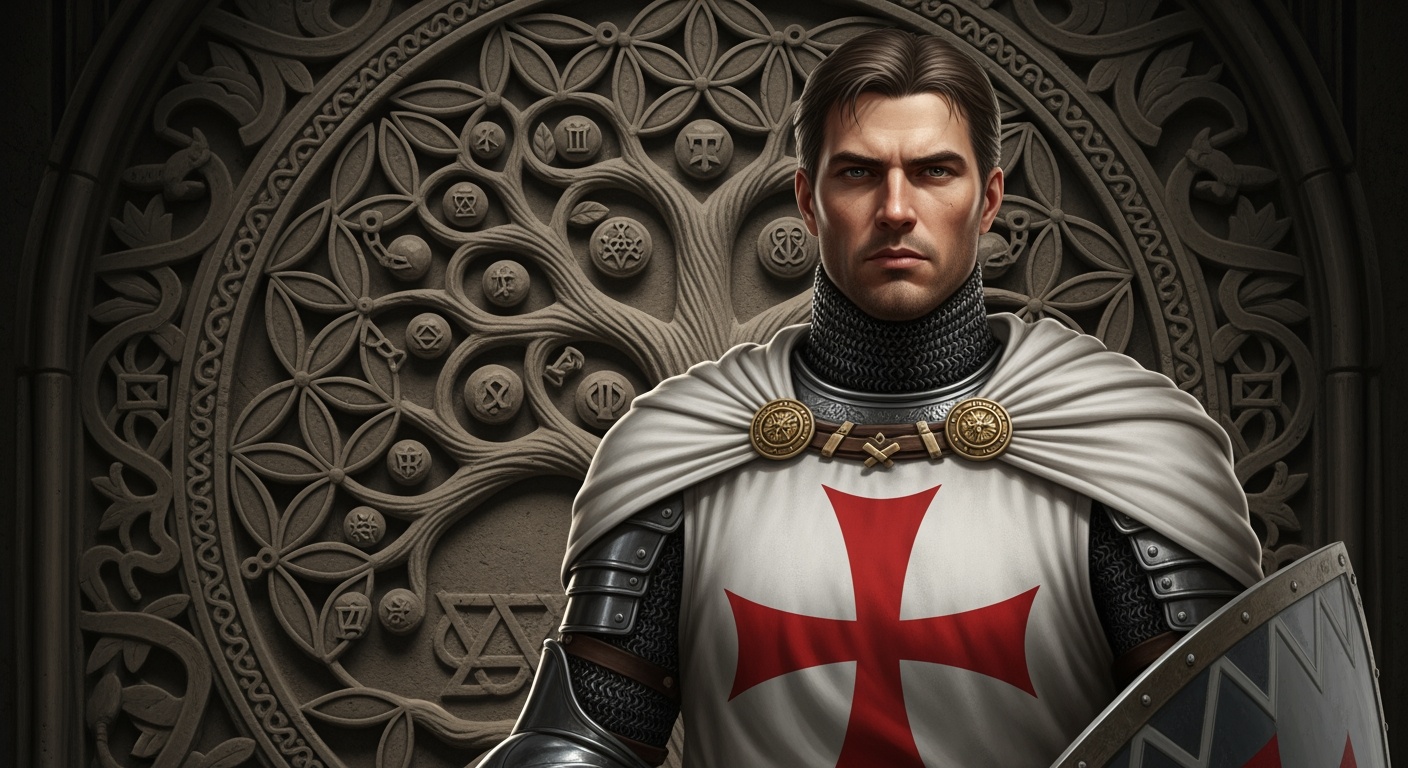
- The Sefirot – the Kabbala deploys the concept of the Sefirot, which are ten divine attributes or emanations through which God interacts with the world. It is depicted as interconnected spheres on the Tree of Life, through which the divine energy flows and manifests in creation. The Sefirot are the ten “vessels” or channels through which the divine energy, or Ein Sof (the infinite, unmanifest God), is expressed and interacts with the created world. The Sefirot are not isolated; they are interconnected and influence each other, forming a dynamic and balanced system.
- And what is inside those ten circles in the Sefirot? Each circle has a different meaning. These are: Kether/Crown – the source of all creation, representing the highest level of divine energy; Chokmah/Wisdom – the active principle of creation, representing divine wisdom and understanding; Binah/Understanding – the receptive principle of creation, representing divine understanding and receptivity; Chesed/Mercy – the attribute of divine kindness and compassion; Geburah/Strength – the attribute of divine strength and justice; Tiphareth/Beauty – the central balancing sefirah, representing harmony and balance; Netzach/Endurance – the attribute of divine endurance and perseverance; Hod/Splendour – the attribute of divine splendor and glory; Yesod/Foundation – the foundation of the lower worlds, representing the connection between the higher and lower realms; and, Malkuth/Kingdom – the lowest sefirot, representing the physical world and the manifestation of the divine in creation.
- The Tree of Life – this is the representation of the Sefirot as described above. The tree reveals both the structure of the universe and the path to enlightenment. The twenty-two paths connecting the Sephirot represent the forces that allow the divine to manifest in the world. In this Tree of Life there are three pillars representing different aspects of creation: Right Pillar (Expansion), Left Pillar (Constriction), and Middle Pillar (Balance).
- The Zohar – this is the main text of the Kabbala that encompasses the teachings of a second century CE rabbi, Shimon bar Yochai (c.100 CE – 160 CE). He led a mystical cult within Judaism in the decades following the destruction of the Temple in Jerusalem by the Romans after the first and second Jewish revolts. It’s often the case that mysticism rises during periods of despair and that’s certainly observable in the history of Judaism – a long story of torment and persecution. For example, the Kabbala would revive among Spanish and Portuguese Jews exiled in the 16th century during the height of the Catholic Inquisition, who settled in the village of Safed, in modern Israel, to found a Kabbalistic community.
- Ein Sof – the concept of God as “without end” or the infinite, the source of all creation, and beyond human comprehension.
- Relationship with the Talmud – as stated above the Torah is the first five books of the Old Testament, the main body of Jewish scripture. The Talmud is a compilation of rabbinic discussions and interpretations of the Mishnah (an ancient, oral version of the Torah) and deals with practical Jewish law, ethics, and customs. While the Talmud is concerned with the practical application of the Torah, the Kabbala strays into mystical interpretations – a very different approach to the Talmud.
The Kabbala revives during the Templar period
During the Templar period – in the 13th century – there was a resurgence of interest in the Kabbala among Jews led by scholars like the Catalan-born Moses ben Nachman (1194-1270), מֹשֶׁה בֶּן־נָחְמָן in Hebrew. He was also known by the nickname, Ramban. Most of his life was spent in his native Catalonia (north-east Spain centred on Barcelona), where he was chief rabbi. But the Inquisition, led by Dominican friars, was on the march and determined to forcibly convert Jews and Muslims to Roman Catholicism – on pain of death.
The Knights Templar had been instrumental in pushing back the frontiers of the Muslim caliphate on the Iberian Peninsula, enlarging Christian crusader kingdoms that would eventually unify into modern Spain and Portugal. At the same time, the Dominican order was founded, in part to end the ‘convivencia’ – the relatively peaceful co-existence between Muslims, Jews, and Christians that had prevailed under Islamic rule. There was to be one true faith in the new Spain: Roman Catholicism. Full stop. No argument.
Ramban, as we shall call him, was ordered to publicly defend Judaism in a very threatening ‘debate’ with the Dominican friar, Pablo Christiani – which continued for four days before King James I of Aragon. Christiani had been born a Sephardic Jew. He not only converted to Catholicism but, with the zeal of the newly converted, became a Dominican and hammer of his own people. He attempted to force Ramban to concede that the Messiah status of Jesus had been confirmed by the Pharisees, which Ramban easily refuted.
While the Dominicans claimed victory in the debate – they also began to file heresy charges against Ramban with a view to having him burned at the stake – the standard form of capital punishment for heretics. He wisely fled to Jerusalem, where he founded a synagogue and played a role in reviving the Jewish community, which had been devastated after the crusader invasion of the city in 1099.
Interestingly, Ramban died in Acre – which had become the main crusader-controlled city in the Holy Land after the loss of Jerusalem to the Muslim leader Saladin in 1187.
King Solomon, the Kabbala and the Templars
So how are the Templars connected to the Kabbala? Here we enter the realm of esoteric theories about the Templars. There is no hard evidence for the following but let me outline the theory.
It was no accident that the Knights Templar decided to be based in what had been the biblical Temple of Solomon – as described in the Old Testament. Because Solomon was the ‘biblical magician king’ behind the Kabbala. The Templars were afraid of the former Saracen rulers of Jerusalem finding out more about the Kabbala so had to get to the Temple Mount to find the secrets first – before the Saracens retook the city, as they did in 1187.
The Templars tunnelled under the Temple Mount and got what they wanted. This included the Holy Grail which is not a physical object, as usually stated, but a series of Kabbalistic secrets. More specifically, the Holy Grail is the secret that physical matter can be transformed through incantations of Hebrew codes.
FIND OUT MORE: The Knights Templar – magicians or heretics?
Sodomy and the Kabbala
This proves, among other things, that the planet is a living breathing conscious being. The proponent of this theory is the controversial David Icke – so please feel free to administer a pinch of salt at this point. He argues, amongst other things, that the Templars were engaged in Kabbalistic ritual sodomy. After being arrested, the knights confessed to their sexual practices and their black magic artifacts were confiscated – included desiccated heads called ‘baphomets’, through which the devil was conjured up to speak.
Some Templars escaped to Scotland and Malta. The Maltese branch got to America before Columbus and went to Scotland as well, emerging their as Freemasons. Organisations that can trace their roots back to the Kabbalistic Templars include the Ku Klux Klan! One of their rituals was part-performed by Elizabeth II during her coronation in 1952. All of which ‘proves’ that Prince William is the next King of the Kabbala. And I’ll leave you to decide what you think about all that!
If you would like to know more about the Knights Templar, then get your hands on a copy of my book: The Knights Templar – History & Mystery. Published by Pen & Sword and available on Amazon, Waterstones, Barnes & Noble, and WHSmith. Don’t miss out on your copy!