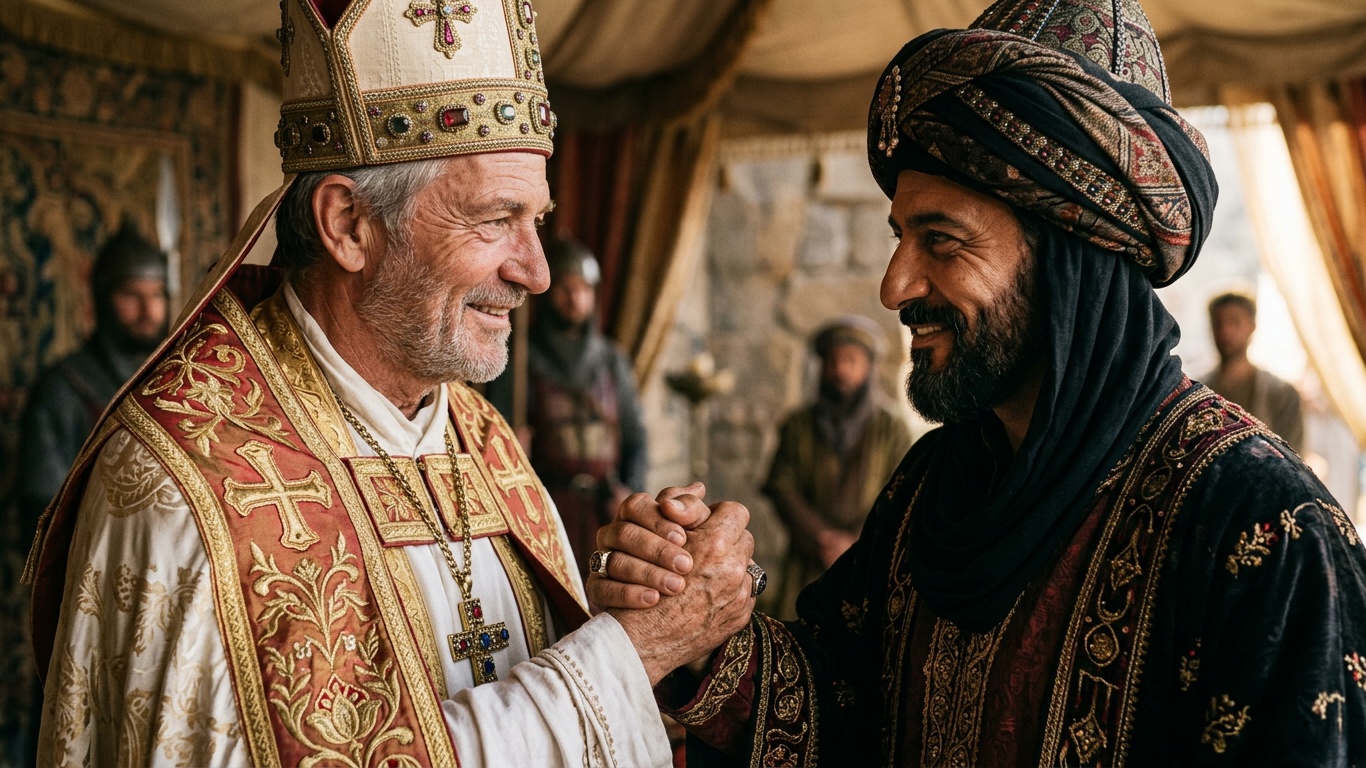


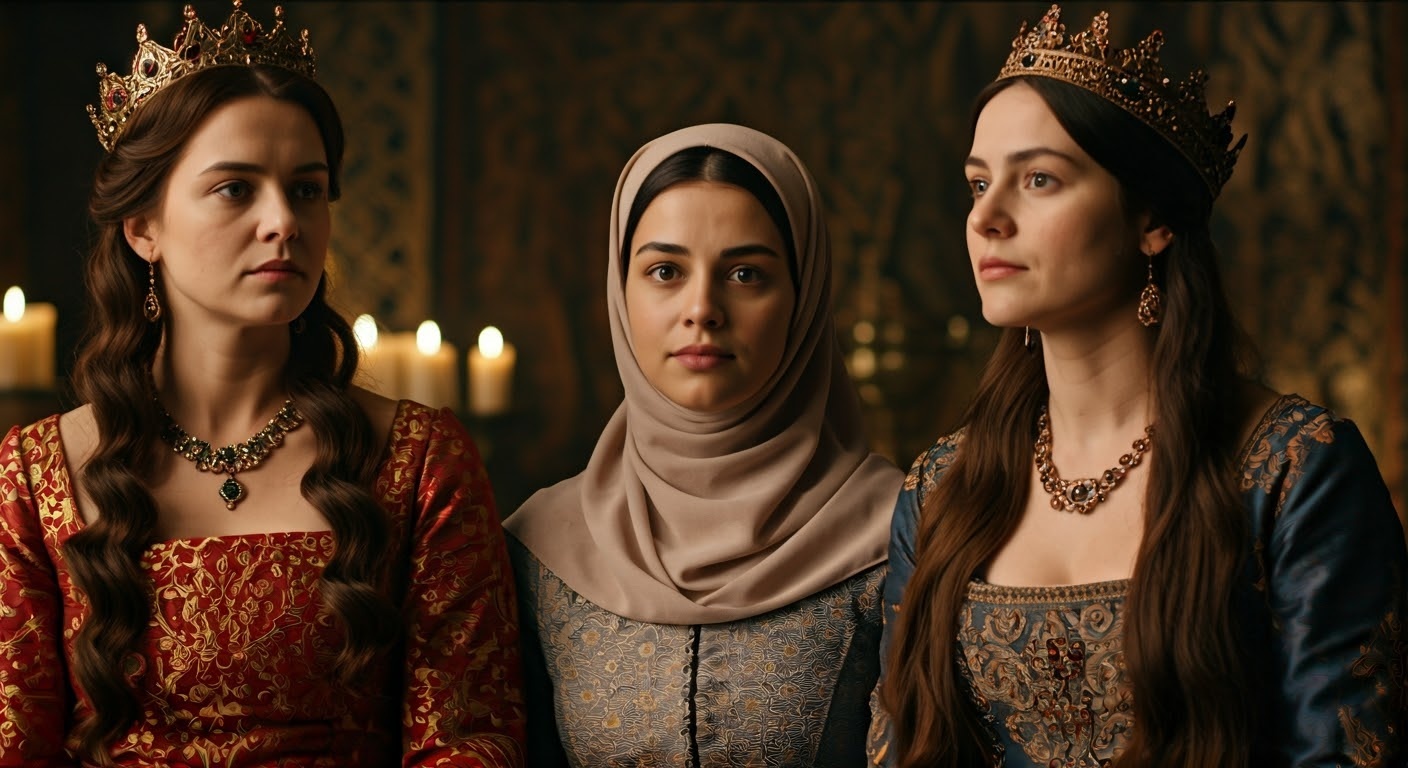
Men tend to dominate the history of the Crusades and the Knights Templar. But there were powerful women involved in the Crusades, who are too often overlooked. And these women were on both sides: Christian and Muslim.
Let’s go meet them!
Melisende – Queen of Jerusalem
Melisende (c. 1105 – 11 September 1161), was the first female ruler of the Kingdom of Jerusalem, reigning jointly with her husband Fulk and later her son Baldwin III. Both these men challenged her authority and sought to undermine her. Throughout her reign, Melisende needed to display a mix of wisdom, cunning, and ruthlessness. Her position was constantly assailed by enemies within.
Melisende was the eldest daughter of King Baldwin II and Queen Morphia of Melitine. Her father was a westerner from France while her mother was an eastern, Armenian Christian. In the late 1120s, when it became clear her father would likely not have a son, Melisende was declared heir presumptive to the throne and married Fulk of Anjou – a marriage largely facilitated by the first Templar grand master, Hugh de Payens. He went to France to convince Fulk to come and marry Melisende.
Fulk was an experienced crusader and had served with the Knights Templar before being chosen to marry Melisende. Upon her father’s death in 1131, Melisende became the first female ruler of the Kingdom of Jerusalem, jointly with her husband Fulk and their infant son – the future Baldwin III. Early in their joint reign, Fulk attempted to rule without Melisende, leading to a revolt by barons led by Melisende’s kinsman, Count Hugh II of Jaffa.
Despite the initial defeat of Hugh, Melisende grew powerful and eventually forced Fulk to share the government with her. Later, tensions arose between Melisende and her son Baldwin III, as she further reduced his role in state affairs.
In 1152, the High Court decided that the kingdom would be divided between mother and son, with Melisende ruling the south and Baldwin ruling the north. Despite the division, tensions continued, and Baldwin eventually forced Melisende to retire from public life, though she continued to act as regent when he was away. Melisende died on September 11, 1161. At the time, she was referred to as Melisende the Magnificent. So, we need to remember her name!
Eleanor of Aquitaine – Queen of France and England
Eleanor was a powerful woman at the centre of medieval politics, diplomacy, and even military campaigns, leaving a significant mark on the history of Europe. Incredibly – at different times – she managed to be a monarch in France and England. She was the Queen of France through her marriage to Louis VII and later the Queen of England after marrying Henry II.
Her married to Louis was annulled as no male heir had been produced. The official reason was a seemingly sudden realisation that they were very proximate cousins and so their marriage contravened church law on “consanguinity”.
Louis was a rather monk-like figure who had been destined for the church, and a life of chastity, until his older brother died. His relationship with Eleanor was fraught, to put it mildly. They both went on crusade but Eleanor spent more time with her uncle, Raymond of Poitiers, who ruled the crusader kingdom of Antioch. This led to unfounded rumours that uncle and niece were in an incestuous relationship. Whether or not it was true – Louis went off in a strop to visit the holy sites in Jerusalem.
After terminating her marriage with Louis, Eleanor wasted no time. She got hitched very quickly to Henry Plantagenet and fortunately for her, he ended up becoming King of England as Henry II. This united Henry’s empire in both England and modern France with Eleanor’s very rich duchy of Aquitaine. In fact, their lands in what we now call France exceeded the actual kingdom of France ruled by her ex-husband.
Like most medieval kings, Henry had mistresses. He was very fond of one in particular: Rosamund Clifford. Contemporary chroniclers and later writers claimed that Eleanor didn’t take this situation lightly. Confronting Rosamund, she ordered the mistress to choose her own method of death: poison or a dagger. She took poison and died. However, another version of what happened has Eleanor roasting Rosamund between two fires; having her stabbed; and then chucked into a bath full of boiling water.
With Henry, Eleanor had no difficulty giving birth to sons, who all promptly rebelled against their father the king. Unwisely, Eleanor supported her boys. Two of them would go on to rule England. On Henry’s death, her son Richard was crowned. Better known to history as Richard the Lionheart, he spent most of his time on crusade leaving his mother to run the kingdom. By all accounts, she did a very good job.
Eleanor had a long and turbulent life dying at 82 years of age – which was impressive in the medieval period.
Shajar al-Durr – Muslim female ruler
This incredible woman was the effective founder of the Mamluk dynasty in Egypt and the only female Islamic ruler of that country in its history. What makes her even more impressive is that unlike the two Christian women profiled above, she was not born into the nobility. In fact, as a young girl she was sold into slavery. Her ascent from slave to sultan is almost unbelievable – and yet it’s true.
Shajar was born among the Turkic Qipchaq (Kipchak) people of the Russian steppe. During her childhood, the Mongols invaded her homeland and sold Shajar as a slave to the caliph of the Abbasid empire. Today we would say that as a girl, way below a modern age of consent, she was trafficked for sex. There’s no gloss you can put on this.
At the age of eleven, Shajar was presented as a gift to an Ayyubid prince. The Ayyubids were the rulers of Egypt and Syria and their dynasty had been founded by the great Muslim warrior, Saladin. This prince, As-Salih Ayyub, eventually married Shajar who quickly learned the dark arts of medieval politics. Her husband became sultan of Egypt in 1240 and found himself assailed from all sides. Crusaders, Mongols, and even his erstwhile allies – the Khwarezmians – turned out to be duplicitous. In addition, he faced treachery within his own family.
Shajar had to hold the fort in Egypt – as crusaders invaded – while the sultan went off to fight his own uncle in Syria. After having his leg amputated while returning to Egypt, the sultan died. Now, Shajar was in total control. She hid the news of her husband’s death for as long as possible. Then the late sultan’s son (from a previous wife) and heir, Turanshah, turned up to claim the throne as the new Ayyubid sultan.
Turanshah imagined that he could simply elbow his stepmother to one side but the Mamluk warriors who constituted the military backbone of Egypt were not fond of the new sultan. In fact, they murdered him in a very grisly manner. Like Shajar, the Mamluks had come to Egypt as slaves so it’s arguable that there was a special relationship between these warriors and their female ruler. In an astonishing move for the time, the Mamluks proclaimed Shajar as the new sultan with Friday prayers in mosques across Egypt exhorting the people to display their loyalty to her.
One of Shajar’s first acts was to negotiate a ransom for King Louis IX of France, who had been captured by her troops. These delicate talks were conducted between two women: Shajar and Queen Margaret of Provence, wife of Louis IX. The ransom paid for his release was so huge that it filled Egypt’s coffers to the rim.
Sadly for Shajar, the caliph of Baghdad refused to recognise her as sultan. As the foremost political and religious figure in the Islamic world, this snub meant she had to adopt a new strategy. Having ruled for only eighty days, she married the Mamluk commander Izz al-Din Aybak who declared the end of the Ayyubid dynasty and the beginning of the Mamluk dynasty. Shajar was the bridge between both those dynasties.
However, the new Mamluk sultan then took another bride and tried to remove Shajar from the royal court, where she still exerted huge influence. Once again, Shajar showed her steely resolve. Her husband’s body was discovered in a royal pavilion and Shajar was suspected of homicide.
Aybak’s teenage son was proclaimed sultan. He was angered at the killing of his father so handed Shajar over to the women of the court for their judgement. The proud and gifted ex-sultan was beaten to death with wooden shoes and her body dragged to the top of the citadel, from where it was thrown to the mob below.
If you would like to know more about the Knights Templar, then get your hands on a copy of my book: The Knights Templar – History & Mystery. Published by Pen & Sword and available on Amazon, Waterstones, Barnes & Noble, and WHSmith. Don’t miss out on your copy!