


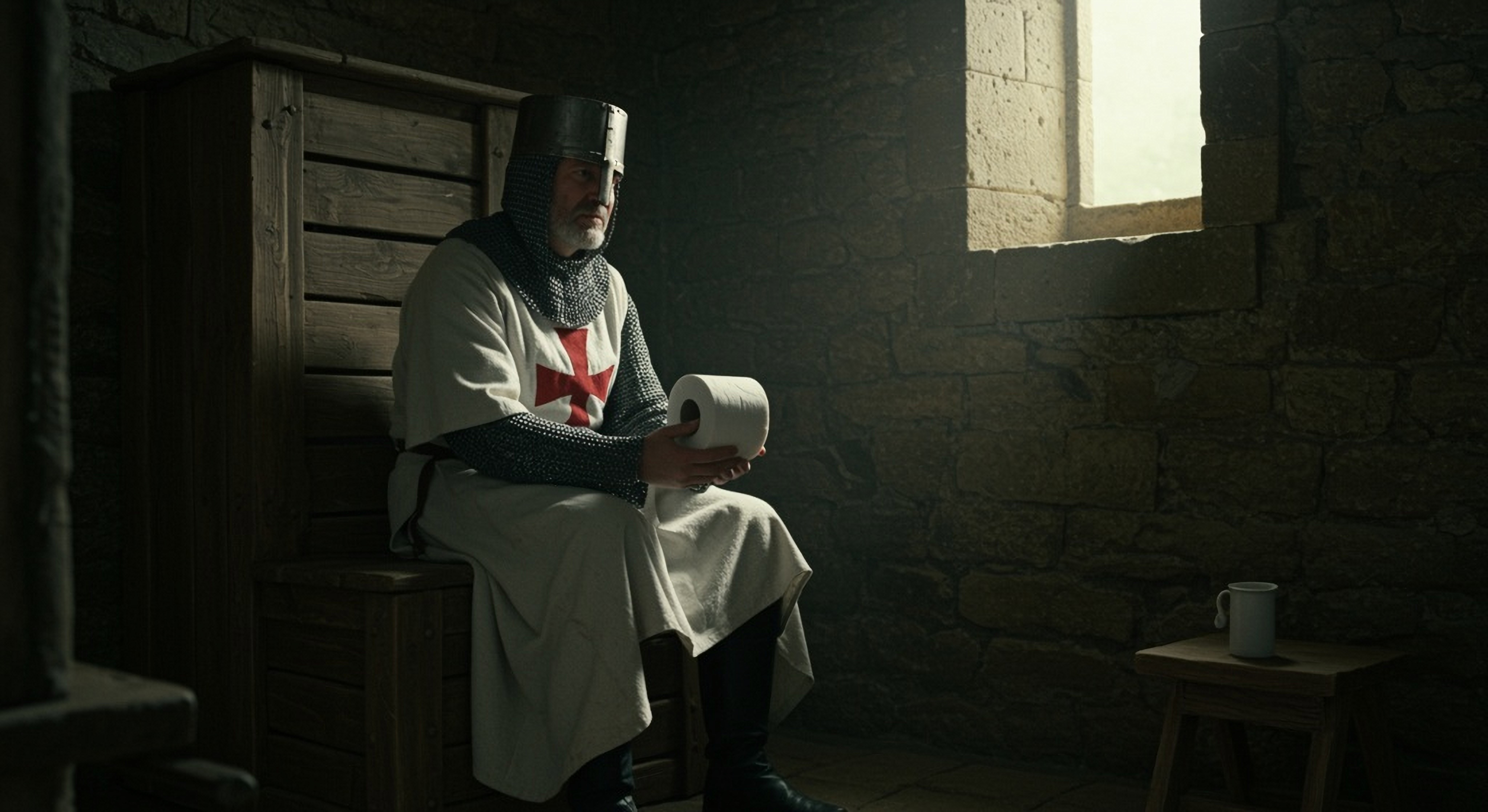
When most Templar fans go to the city of Acre – they marvel at the Templar secret tunnels or the remains of the Hospitaller castle. But what really captured my attention (for a few moments) was the medieval toilet facilities. And the photograph I took at Acre (see below) was featured in World Archaeology magazine!
Let me disabuse you of some myths about going to the restroom/bathroom/powder room/loo in medieval times. People did wipe their backside. There was even…a flushing mechanism, for the most royal of toilets. And monks installed cubicles at their abbeys as I’ll evidence below. So, when nature called for a Templar knight – the toilet experience wasn’t entirely grim!
I visited many castles as a child and saw some primitive and crude evacuation slides used as toilets. Essentially, a Templar knight sat above a hole and expelled his waste into the moat below. These facilities were described as “garderobes” or “privies” and human waste dived into a moat or cesspit. If the latter, it might then be shovelled up by a “gong farmer”, who sold the precious manure on to farmers as fertiliser. Medieval recyling!
Garderobes were often built into the walls of the castle, with a hole or chute leading to the outside. Some castles had latrine shafts that emptied into the courtyard or bailey, while others hung over a cliff face. The simplest form was a hole in a wooden or stone bench, with waste falling down a chute.
Medieval toilets were often referred to by euphemisms, such as privy chamber, privy, draught, gong, siege-house, necessarium, or golden tower. A king using the toilet could be in a very vulnerable position. The Saxon monarch, Edmund Ironside, was allegedly shot with a crossbow while sitting on the garderobe in the year 1016. Very Game of Thrones!
Other rulers who came a cropper on the toilet include Jaromír, Duke of Bohemia who got a spear to the groin while relieving himself. Wenceslaus III of Bohemia was impaled with a spear while seated on the privy. The Japanese warlord Uesugi Kenshin was killed by an assassin who hid in the cesspit, ready with his sword. Once his target was seated above, he rose from the accumulated excrement to commit the foul deed.
You want to know more details about medieval toilet hygiene – don’t deny it – so allow me to oblige. Wiping was done with straw, grass, moss, or hay – or just hands and water. Soap was not unknown in the Middle Ages but far less common than it is today. It might be made from tallow (animal fat) or olive oil if you were rich. Wealthier folk used wool rags to wipe their backside.
FIND OUT MORE: Templars accused of dumping
At Acre, the Templar-era toilets more closely resembled the sort of communal WCs favoured by the Romans. It was quite a well laid out, presumably plumbed latrine. And so I pointed my camera at it and took a snap. Luckily no crusaders were present to object!

Here is a toilet built for King Henry III at Clifford’s Tower in York, England. It had a fully functioning flushing mechanism. Rain water gathered in a tank above and by pulling a lever, the king could wave goodbye to his bowel movement. So if you thought flushing was a relatively modern invention, think again.

And here I am in the impressive ruins of Fountains abbey in Yorkshire, England and behind me is a row of toilets used by the Cistercian monks for centuries. A river flows underneath to remove the offending material.

If you would like to know more about the Knights Templar, then get your hands on a copy of my book: The Knights Templar – History & Mystery. Published by Pen & Sword and available on Amazon, Waterstones, Barnes & Noble, and WHSmith. Don’t miss out on your copy!