


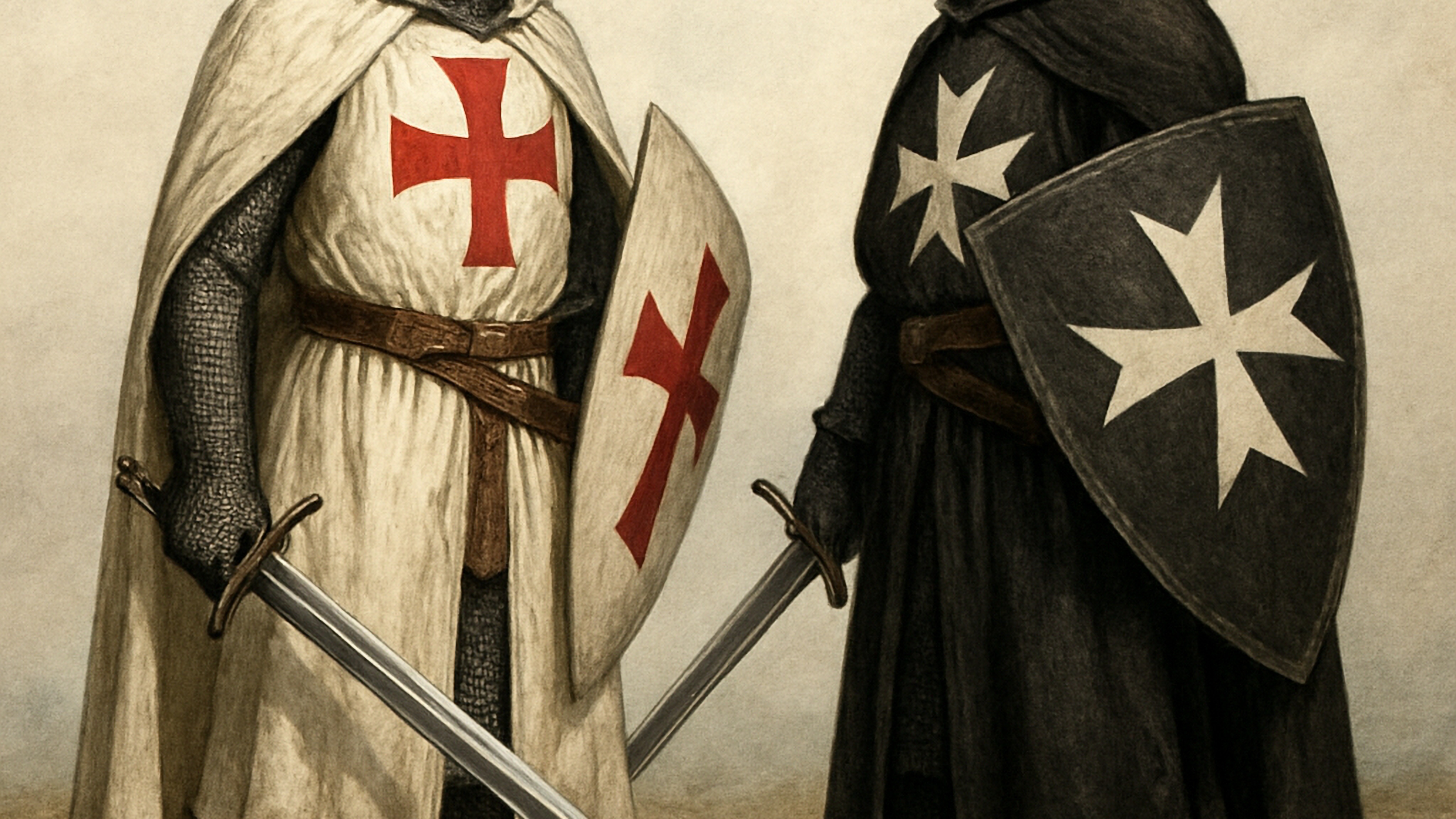
I get asked this question so many times. What was the difference between the Knights Templar and the Knights Hospitaller? Truthfully, there wasn’t a huge difference between the two other than their uniform, origin and areas of Europe where they were strongest. However, both orders were definitely rivals and when the Knights Templar were crushed after 1307, the Knights Hospitaller were only too happy to gobble up their assets.
Origin of the Hospitallers
The Hospitallers started out running a hospital in Jerusalem with the backing of Italian merchants BEFORE the city had been taken from Saracen control in 1099. They also managed hospitals on the pilgrim routes in modern France and Italy. In the year 1113, they achieved official papal recognition as the Knights Hospitaller.
Once Jerusalem was in crusader hands, the Hospitallers responded by upping their activity and undergoing something of a transformation. Maybe in response to the formation of the Knights Templar around 1118, the Hospitallers rapidly militarised. They went from running a medical operation to taking up arms and fighting alongside the crusaders. The order also became more French than Italian influenced.
FIND OUT MORE: The Knights Hospitaller at Hampton Court Palace
Why become a Knight Hospitaller?
One question that intrigues me is why a young Christian warrior would choose the Hospitallers over the Templars? There seems to have been regional variations between the two orders. The Hospitallers, for example, recruited many young men in Bohemia and Hungary. Though it seems the Hospitaller leadership remained overwhelmingly French and Italian while the Hungarians, Croats and Germans formed the lower levels as ordinary brothers.
It’s suggested that the Templars were less popular in German speaking Europe because they were viewed as being too French and too close to the Pope. This was a time when the Holy Roman emperor, who ruled most of German Europe, was in sharp conflict with Rome.
But this didn’t give the Hospitallers a clear run among Germans, many of whom preferred to join their own local order, the Teutonic Knights. That order was engaged in crusades against pagans and orthodox Christians in the Baltics and Russia respectively.
DISCOVER: The Knights Templar in Cyprus
Similar monastic rule for Templars and Hospitallers
Both Hospitallers and Templars were governed by monastic style rules with an insistence on poverty, chastity and obedience. The only difference – to my mind – is that the Templars’ military mission was established pretty much at the outset while the Hospitallers had to evolve from medicine to fighting. Under a Grand Master called Raymond du Puy, they made the transformation.
Both orders had castles in the Holy Land to defend and fought in a similarly disciplined manner. But, there does seem to have been a rivalry between them. This sharpened as the crusaders were steadily defeated.
Fighting in the Crusades – winning and losing
Like the Knights Templar, the Hospitallers fought alongside secular knights in the Crusades. The Templars in battle were identifiable by their distinct white mantles with red crosses. The Hospitaller knights wore black mantles with eight-pointed white crosses. They managed about 25 castles including the vast Krak des Chevaliers, which is still standing today in Syria.
As the crusades headed for defeat, both Templars and Hospitallers lost their castles and prestige. The two orders were forced off the mainland to Cyprus – where by all accounts they fell out with each other pretty quickly.
I read one theory that the Hospitallers were appalled by Templar lust for wealth but I find this hard to believe – the Hospitallers were pretty well off and always open to donations. Maybe the Templars had a more efficient network of money making preceptories across Europe, but I don’t buy the notion of Hospitaller shock and horror at Templar venality.
The Hospitallers moved to Rhodes in the early 14th century and then on to Malta where they saw off attempts by the Ottoman Empire to overrun them. In the same time period, the Templars were destroyed by the rulers of Christian Europe and snuffed out entirely. That begs the question – why did the Hospitallers survive while the Templars didn’t?
Cashing in on the end of the Templars
The Knights Templar were crushed by the papacy and the king of France in 1307. Their assets were transferred in many cases to the Hospitallers. These knights continued to thrive in the Mediterranean establishing a strong base on Rhodes and later on Malta until the Turks took the island in the 16th century.
Because of their presence as Christian soldiers seeing off Turkish enemies, the Hospitallers became close allies of the beleaguered Byzantines in Constantinople. They also became very rich and independent of any monarch’s control. And inevitably, they attracted the kind of criticism and hatred that had previously been reserved for the Templars.
Whereas the Templars ended with a bang, the Hospitallers went out with more of a whimper. They continued battling crusades in the Mediterranean and on the Iberian peninsula for several centuries after the Templars’ demise. But as knighthood and chivalry went out of military fashion, so the order evolved again into a charitable foundation.
In effect, it’s returned back to where it started – doing good deeds and looking after the sick.
The Hospitaller and Templar orders were two of several military orders that were established during the Crusades. But not all of them were focussed on the Holy Land. Some concentrated their efforts on fighting in modern Spain and Portugal while others were taking on Europe’s last pagans in the Baltic states.
Other medieval military orders included:
- The Teutonic Knights: Or if you prefer…The Order of Brothers of the German House of Saint Mary in Jerusalem. They were founded decades after the Knights Templar in the port city of Acre in the Holy Land. After the loss of Jerusalem, they shifted their operations into central Europe and the Baltic regions fighting Turkic armies, pagans and the eastern Orthodox Russians. Hard to believe but what is now Lithuania was pagan up until the year 1387
- Order of Santiago: Or if you prefer….The Order of St. James of the Sword. This order was most active in the crusade fought on the Iberian Peninsula between the Islamic caliphate that controlled half of modern Spain and Portugal and the crusader Christian kingdoms in the north. Ostensibly, the order’s role was to defend pilgrims on their way to the shrine of Saint James the apostle in Santiago de Compostela. But like the Templar, the order’s real role went far beyond pilgrim protection
- Order of Calatrava: Another military order based in what is now Spain and performing a similar function to the Order of Santiago mentioned above. Like the Knights Templar, it essentially emerged as a military wing of the Cistercian order of monks. Calatrava was a castle based in the uncontrollable badlands between the Islamic caliphate and the crusader kingdoms in Iberia. The Templars had failed to hold the castle so this order was created to focus its entire activity on retaining Christian control
- Order of Saint Lazarus: Otherwise known as the Leper Brothers of Jerusalem. Like the Knights Hospitaller, they had their origins in running hospitals for pilgrims. Their specialism was leprosy. The brothers lived by the rule of Saint Augustine. And they had houses across Europe as well as in the Holy Land. Like the Templars in the 14th century, they resisted being merged with the Knights Hospitaller in the 15th century but unlike the Templars, they were able to continue an independent existence for a while before eventually being divided up among other orders
- Livonian Brothers of the Sword: Similar mission to the Teutonic Knights fighting pagans in the Baltic regions. They were founded in Riga – capital of modern Latvia. Eventually they were merged into the Teutonic Knights
- Knights of Saint Thomas: This was an order for English knights founded around 1191 and disappearing with the Protestant Reformation in England. Named after St Thomas Becket, the martyred Archbishop of Canterbury and their full name was The Hospitallers of St Thomas of Canterbury at Acre. They came into being after Richard the Lionheart had taken Acre and crusader frenzy was at its height in England. In the latter part of the Crusades they retreated alongside the Knights Templar to the island of Cyprus
There are other military orders which I’m happy to answer any questions about. But these are the main ones listed above. And below is the latest edition of Templar Knight TV explaining the difference between the Knights Templar and Hospitaller. Watch and give me your feedback!
If you would like to know more about the Knights Templar, then get your hands on a copy of my book: The Knights Templar – History & Mystery. Published by Pen & Sword and available on Amazon, Waterstones, Barnes & Noble, and WHSmith. Don’t miss out on your copy!




4 thoughts on “Knights Templar and Knights Hospitaller – what’s the difference?”